Pre-Born! gives free ultrasounds to women looking to abort their babies and 86% of those women choose to keep their babies!
We like visible strength. We trust good plans, strong resumes, and enough effort to push things over the line. Then Zechariah 4:6 shows up and tells us the work of God is not carried by human muscle.
That verse hits harder when we are tired, uncertain, or staring at something bigger than us. This is the Zechariah 4:6 meaning in plain language, God was telling a leader in a hard season that the temple would not be rebuilt by force, talent, or pressure. It would happen by His Spirit.
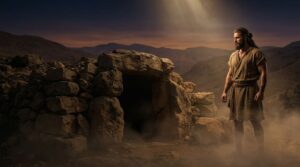
Zechariah spoke after Israel had come back from Babylon. The people were home, but home was not restored. The temple was still in ruins, and the rebuilding had slowed under pressure, fear, and discouragement. Zerubbabel, the governor, carried the burden of leading that work.
Then God gave Zechariah a vision of a lampstand and two olive trees. Oil kept flowing to the lamp, and that detail matters. The lamp did not make its own fuel. The light depended on a supply outside itself. In the same way, God's work would not survive on human drive alone.
"Then he answered and spake unto me, saying, This is the word of the LORD unto Zerubbabel, saying, Not by might, nor by power, but by my spirit, saith the LORD of hosts."
"Who art thou, O great mountain? before Zerubbabel thou shalt become a plain..."
The mountain in the next verse was real. The obstacle was not imaginary. Still, the word to Zerubbabel was not, "try harder." It was, "look to the Lord." The message was meant to steady a weary builder, not flatter him.
What “not by might nor by power” really means
Might is outward force
The word translated "might" points to strength, military force, and resources. The Hebrew word carries the sense of power that can be measured, gathered, and displayed. It is the kind of strength we notice first.
For Zerubbabel, that could have meant manpower, influence, money, or political backing. For us, it might look like charisma, strategy, experience, or sheer will. The verse is not saying those things never matter. It is saying they cannot carry God's assignment by themselves.
That is the part we often miss. Human strength has a ceiling. We can plan, organize, and push, but our effort can only go so far. Once we reach that limit, the real question appears. Are we trusting force, or are we trusting God?
Power is personal ability
"Power" is a different word, and it points to ability, capacity, and inner strength. If "might" is the outside force, "power" is the energy in our own hands and backs. It is the strength we feel when we say, "I can handle this."
That sounds harmless until we start leaning on it too hard. Then we begin to act as if our skill is enough, our schedule is enough, and our stamina is enough. Zechariah 4:6 cuts through that illusion. The work of God does not move forward because we are impressive. It moves because God gives what we do not have.
That does not excuse laziness. Zerubbabel still had to work. The priests still had to serve. The people still had to lift stones. Yet the verse says effort without God's help is empty. We can push through a task and still miss the life that should be in it.
“My Spirit” is the source
When the Lord says, "by my spirit," He is not talking about a mood or a spiritual buzz. The Hebrew word is ruach, which can mean breath, wind, or spirit. It is the life of God moving where human strength runs out.
That changes everything. The temple would not be rebuilt by hype, pressure, or raw effort. It would be rebuilt by God's own presence at work among His people. The same is true for us. The Holy Spirit is not a bonus for stronger believers. He is the One who empowers obedience in the first place.
If we strip the verse down, it says this: our strength has a ceiling, but God's Spirit does not.
Click Our Ad to Support Us!
What it meant for Zerubbabel and Israel
Zerubbabel was not just a man with a project. He was a governor from David's line, standing in a ruined city with a real assignment. The temple mattered because it was tied to worship, sacrifice, and the restored life of Israel. This was not about architecture alone. It was about God's people learning to live before His face again.
For Israel, the promise was not, "You can sit still and watch." It was, "You will not finish this by human force alone." That difference matters. God's Spirit did not replace their obedience. He gave their obedience strength.
A quick comparison keeps the distinction clear.
In Zerubbabel's day
For us today
A half-built temple in Jerusalem
Work that feels bigger than our ability
A discouraged people after exile
Weariness, pressure, and slow progress
Opposition from surrounding enemies
Resistance, fear, and unanswered questions
God's Spirit supplying the work
God's Spirit sustaining faithful obedience
The point is not that every hard thing in life is the same as rebuilding the temple. It is that God's people have always needed the same lesson. We do not finish His work by sheer force of personality. We finish it because He supplies what He asks for.
How we should read it today
A lot of people quote Zechariah 4:6 as a general success verse. They use it for a job, a goal, a project, or a dream. Sometimes that application is close, but it can also flatten the verse. God was not promising that every plan we start will work out if we say the right words.
The safer reading is simpler. When God gives a task, He also gives the help needed to do it. That help comes through His Spirit. So if we are praying, serving, forgiving, giving, preaching, parenting, or enduring, we are not meant to do it in our own strength.
What does that look like in daily life?
We pray before we force an outcome.
We confess where we are empty instead of pretending otherwise.
We obey the next step, even when we don't feel strong enough.
That kind of dependence is hard on the flesh. We would rather feel capable first. We would rather look in control. But the Spirit of God often meets us where our control runs out.
We do not need more pressure. We need more surrender.
This verse also helps us when we are tired of trying to look strong. Some of us are exhausted from holding things together. Others are worn out from serving without seeing much fruit. Zechariah 4:6 gives us a cleaner way to think. God does not ask us to manufacture power. He asks us to rely on His.
That does not make us passive. It makes us honest. We still work, plan, and obey. We just stop pretending that our effort is the source of life. There is a difference, and it is a holy one.
Conclusion
Zechariah 4:6 was spoken to a man standing before rubble, pressure, and unfinished work. It was not a scolding. It was mercy. God was saying that His purpose would not rest on human muscle, and that His Spirit would be enough.
That same word still reaches us when we feel stretched thin. We do not rebuild, endure, or serve by might alone. We do it by the Spirit of the Lord, and that is where hope begins to breathe again.
Related Posts
1 Truth: Blood of Jesus: God's Life in Sinless Flesh What if the very thing running through the veins of Jesus was not just human, but the Blood of Jesus holding the actual life of God Himself, poured out for us? That sounds huge, maybe even hard to take in at first, yet Scripture keeps pulling us back to this one thread: life is in the blood, sin corrupts human…
Reprobate Mind: 5 Warning Signs and Hope for Change The Bible’s take on a reprobate mind isn’t just a warning or a piece of theology. It’s a wake-up call. “Reprobate mind” (from the Greek adokimos, meaning rejected or unapproved) describes what happens when people no longer care about God’s truth—they trade what’s holy for what feels good, grow numb to right and wrong, and God lets go. It’s mentioned…
Holy Spirit Scriptures: 21 Century Meaning, Original Words, and God's Purpose What would life be if we never understood the heart behind every movement of God’s Spirit? Every verse that mentions the Holy Spirit points us somewhere deeper—into friendship with God, into His power for living, and into the mystery of His love and presence that started in Eden and keeps going until Jesus rules the earth in the Millennial Reign.…
The Seven Spirits of God stand as one of the most profound and often misunderstood truths in Christian theology. Rooted deeply in Scripture, they aren’t seven separate entities but rather seven attributes of the one Holy Spirit—God revealing Himself in fullness. Isaiah 11:2 describes these [...]
The gifts of the Holy Spirit reveal the active power of God working in the lives of His people. They aren’t just distant historical records or fading Biblical accounts; they’re living because the Holy Spirit, He is living and He is God, and His transformative gifts are reaching people [...]
The phrase “tongues of fire” in Acts 2:3 sparks worldwide curiosity and spiritual wonder. It appears in Scripture to describe the Holy Spirit’s descent during Pentecost, when visible flames rested on the apostles, marking the time when God’s Spirit descended on earth, [...]
The Bible’s take on a reprobate mind isn’t just a warning or a piece of theology. It’s a wake-up call. “Reprobate mind” (from the Greek adokimos, meaning rejected or unapproved) describes what happens when people no longer care about God’s truth—they trade what’s holy for what feels good, grow numb [...]
The upper room, a sacred space in Jerusalem, holds profound significance in Christian history. Acts 2 tells us it is the gathering place for Jesus’ disciples when the Holy Spirit descended upon them during Pentecost. This transformative moment not only empowered those present but also sparked [...]
Pentecost isn’t just a Christian event; its roots stem from the Jewish celebration of Shavuot, the day Moses received the Ten Commandments from God. For Christians, Pentecost marks the moment when God poured out His Spirit and Jesus’ worldwide church empowered by the Holy Spirit and His gifts [...]
Charismatic gifts, often referred to as manifestation gifts, showcase the miraculous power of the Holy Spirit. From healing and miracles to prophecy and discernment, they serve as tangible evidence of God’s presence and transformative work. These gifts, seen throughout Biblical history, have [...]
Revelation 3:7-8 offers a powerful message to the church in Philadelphia, a message that remains relevant today. It speaks of a divine “open door” that no man can shut, given by the one who holds the Key of David. This imagery represents not only an opportunity but also God’s sovereign [...]
Have you ever wondered why the word “anointing” carries so much depth in Scripture? The idea of anointing—of sacred oil poured out on kings, priests, and prophets—echoes through the Old Testament as a symbol of God choosing, empowering, and setting apart. God didn’t leave the details of [...]
The Bible boldly declares the truth that Jesus is both fully God and fully man—a mystery that anchors the Christian faith. But what does it mean, practically, for us as believers? Jesus didn’t perform miracles or operate in the gifts of the Holy Spirit simply as God; He demonstrated how a [...]
The Antichrist
The Apostate Church
The Rapture
Angels
Book of Daniel
Giants
Judgment
Prophecy
The Apostles
Bible Prophecy
Beware of Deception
Sin
Antichrists
Demon Possession
Healing
Millennial Reign
Redemption
The Gospels
The Holy Spirit
American Prophecy
Israel
Armageddon
Forgiveness
Intercession
Prayer
Revival
The Old Testament
The Tribulation
Faith
Kingdom Of God
Bible Interpretation
Free Will
Book Of Jude
Pride
The Afterlife
The Red Dragon
We use cookies so you can have a great experience on our website. View more
Cookies settings
Accept
Decline
Privacy & Cookie policy
Privacy & Cookies policy
Cookies list
Cookie name
Active
Who we are
Our website address is: https://theholyspirit.us.
Comments
When visitors leave comments on the site we collect the data shown in the comments form, and also the visitor’s IP address and browser user agent string to help spam detection.
An anonymized string created from your email address (also called a hash) may be provided to the Gravatar service to see if you are using it. The Gravatar service privacy policy is available here: https://automattic.com/privacy/. After approval of your comment, your profile picture is visible to the public in the context of your comment.
Media
If you upload images to the website, you should avoid uploading images with embedded location data (EXIF GPS) included. Visitors to the website can download and extract any location data from images on the website.
Cookies
If you leave a comment on our site you may opt-in to saving your name, email address and website in cookies. These are for your convenience so that you do not have to fill in your details again when you leave another comment. These cookies will last for one year.
If you visit our login page, we will set a temporary cookie to determine if your browser accepts cookies. This cookie contains no personal data and is discarded when you close your browser.
When you log in, we will also set up several cookies to save your login information and your screen display choices. Login cookies last for two days, and screen options cookies last for a year. If you select "Remember Me", your login will persist for two weeks. If you log out of your account, the login cookies will be removed.
If you edit or publish an article, an additional cookie will be saved in your browser. This cookie includes no personal data and simply indicates the post ID of the article you just edited. It expires after 1 day.
Embedded content from other websites
Articles on this site may include embedded content (e.g. videos, images, articles, etc.). Embedded content from other websites behaves in the exact same way as if the visitor has visited the other website.
These websites may collect data about you, use cookies, embed additional third-party tracking, and monitor your interaction with that embedded content, including tracking your interaction with the embedded content if you have an account and are logged in to that website.
Who we share your data with
If you request a password reset, your IP address will be included in the reset email.
How long we retain your data
If you leave a comment, the comment and its metadata are retained indefinitely. This is so we can recognize and approve any follow-up comments automatically instead of holding them in a moderation queue.
For users that register on our website (if any), we also store the personal information they provide in their user profile. All users can see, edit, or delete their personal information at any time (except they cannot change their username). Website administrators can also see and edit that information.
What rights you have over your data
If you have an account on this site, or have left comments, you can request to receive an exported file of the personal data we hold about you, including any data you have provided to us. You can also request that we erase any personal data we hold about you. This does not include any data we are obliged to keep for administrative, legal, or security purposes.
Where your data is sent
Visitor comments may be checked through an automated spam detection service.