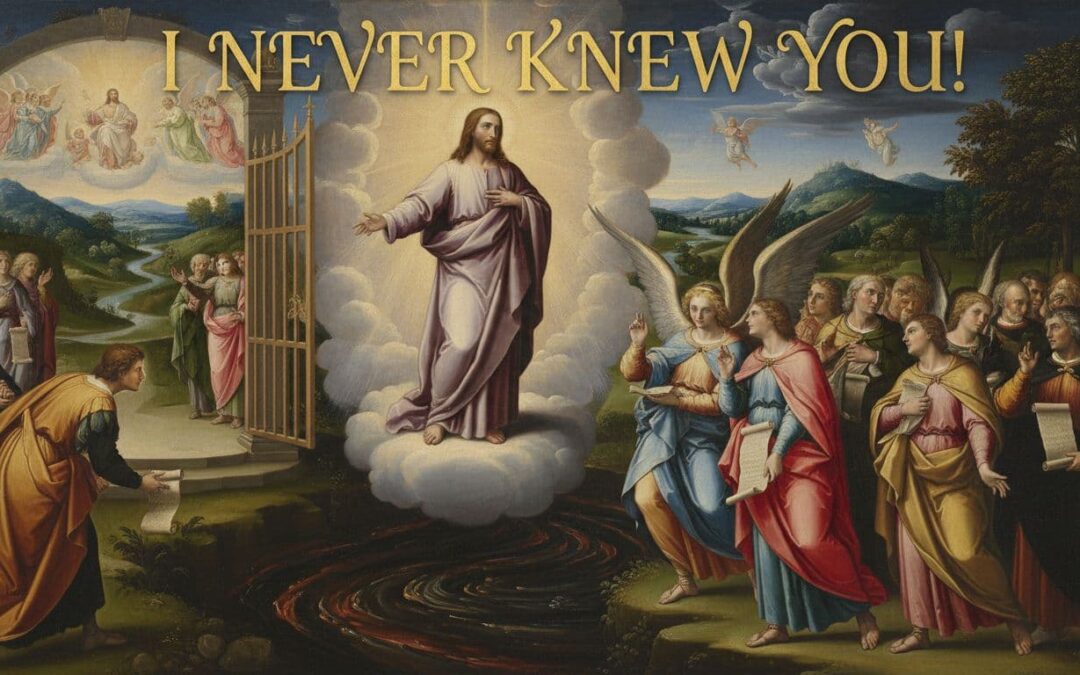
With Jesus or Against Him: Scattered Hearts, 70 AD, and the Lie of “Follow Your Heart”
“He who is not with Me is against Me, and he who does not gather with Me scatters abroad.” (Matthew 12:30; Luke 11:23)
That one line from Jesus cuts through every gray area we like to hide in. It sounds harsh to modern ears, but it is full of mercy if we really listen.
In simple terms, Jesus is saying: If we are not standing with Him, helping Him bring people to God, then we are actually working against Him and tearing things apart.
Watch and share our video of this article to help us spread the Word of God. Be kind and subscribe to our YouTube Channel. Thank You!
In this article we will look at what He meant in the original Greek, how first‑century Jews would have heard those words, how this connects to the destruction of Jerusalem in 70 AD and the earlier scatterings of Israel, and then bring it all the way into our own hearts today.
We will also face a slogan many of us love: “follow your heart.” Jesus’ words force us to ask whether that is safe. Without the Holy Spirit in our spirit, to follow your heart is to follow sin, not God. So we want to pause, breathe, and honestly ask: in our actual choices, are we with Jesus, or against Him?
Understanding Matthew 12:30 in the Original Language and First Century Context
Matthew 12 and Luke 11 tell the same scene with slightly different details. Jesus has just cast a demon out of a man who was blind and mute. The crowd is amazed. Some start wondering if He might be the Son of David, the promised King.
Jesus answers with simple logic. A kingdom divided against itself cannot stand. If Satan is casting out Satan, his kingdom is already falling. Then He draws a line in the sand:
“He who is not with Me is against Me, and he who does not gather with Me scatters abroad.”
He is not inviting casual agreement. He is calling for loyal union. In that moment He is warning the leaders that they are lining up against the Spirit of God.
When we pay attention to the Greek words behind “with Me,” “against Me,” “gather,” and “scatter,” His meaning gets even sharper.
The Greek Meaning of “With Me,” “Against Me,” “Gather,” and “Scatter”
In Greek, “with Me” uses the word meta plus “Me.” It is more than just standing next to Jesus. It pictures being in step with Him, sharing His cause, moving in the same direction.
“Against Me” uses kata plus “Me.” That is not mild disagreement. It is active resistance, pushing down, working in the opposite direction.
“Gather” comes from synagō, the root behind the word synagogue. It carries the picture of a shepherd or a harvester bringing things together into one place. To “gather with” Jesus is to help Him bring people into God’s Kingdom, into truth, into unity.
“Scatter” uses the verb skorpizō, the same word behind “scatter” in Greek studies like the skorpizomai entry. It pictures driving things apart, wasting, or throwing around what was meant to be kept together.
So in plain language, Jesus is saying:
If we are not in loyal union with Him, we are against Him.
If we are not helping Him bring people into His Kingdom, we are tearing apart what He is building.
There is no spiritual “neutral.” Our lives are either gathering or scattering. Our habits are either helping people come closer to Jesus, or making it harder for them to see Him.
That is why the idea of “follow your heart” is so dangerous when our hearts are not ruled by His Spirit. Our hearts do not drift to neutral. They either move toward Jesus or away from Him.
Why Jesus Spoke These Words After Casting Out a Demon
The timing matters. Jesus did not say this line in a calm classroom talk. He said it in the heat of conflict.
A demon is cast out.
A man is set free, able to see and speak.
The crowd is stirred.
The leaders feel threatened and accuse Jesus of using satanic power.
Jesus then talks about kingdoms, houses, and division. A divided kingdom will fall. A divided house will crumble. If He is driving out demons by the Spirit of God, then the Kingdom of God has come upon them.
From Stone to Flesh: How God Turns Cold Religion Into Living Relationship
Right there He draws the line: “He who is not with Me is against Me.”
He is saying to those leaders, “You are not neutral observers. By calling My Father’s work the devil’s work, you are setting yourselves against Me and against the Holy Spirit.”
That warning hangs over that whole generation of Israel. It is one of the threads that ties into Jesus’ later prophecies about judgment and the fall of Jerusalem.
How “He Who Is Not With Me” Points to Israel’s Scattering and the Destruction of Jerusalem in 70 AD
Jesus did not drop that sentence in a vacuum. Throughout the Gospels He speaks to “this generation” in Israel, calling them to repent and warning about coming judgment.
In Matthew 23 He weeps over the hypocrisy of the scribes and Pharisees and then cries out:
“Jerusalem, Jerusalem, who kills the prophets and stones those who are sent to her! How often I wanted to gather your children together, as a hen gathers her chicks under her wings, but you were not willing. See! Your house is left to you desolate.” (Matthew 23:37‑38)
Gather or desolate. Those are the options.
In Matthew 24 and Luke 21 He predicts the destruction of the Temple, the siege of Jerusalem, and great distress for that people. In Luke 19:41‑44 He weeps over the city because it did not know the time of its visitation.
Many Bible students see these warnings fulfilled in 70 AD, when Rome destroyed Jerusalem and the Temple. That tragedy is traced in historical and Biblical detail in studies like The 70 AD Destruction of Jerusalem Explained.
In that light, “he who does not gather with Me scatters” becomes not only a spiritual warning, but a prophetic pointer to another national scattering, one that would last around 2000 years, until 1948.
Old Testament Background: God Gathers His People, Sin Scatters Them
Jesus is not inventing new language. He is stepping into an old history.
Again and again in the Old Testament, God pictures Himself as a Shepherd who gathers His people, and sin as the thing that scatters them.
In Ezekiel 34:11‑13, God says He will search for His sheep, rescue them from where they were scattered, and gather them to their own land.
In Jeremiah 23:1‑4, He rebukes unfaithful shepherds who “have scattered My flock,” then promises to gather His remnant and give them new shepherds.
In Deuteronomy 28:64‑65, God warns that if Israel turns to idols, He will scatter them among all nations. Their life will be full of fear and restless hearts.
Over and over, the pattern shows up:
When Israel listens to God, He gathers and protects.
When Israel follows idols and its own stubborn heart, God hands them over to scattering.
Jesus comes as the Good Shepherd, the One Ezekiel 34 and other passages look forward to. He comes to gather the lost sheep of Israel, then people from every nation. When He says, “he who does not gather with Me scatters,” He is standing inside that whole shepherd‑and‑scattering history.
Jesus’ Warnings to That Generation and the Coming Fall of Jerusalem
If we line up Jesus’ sayings, a picture forms.
Matthew 23:37‑38: “How often I wanted to gather you… but you were not willing… your house is left to you desolate.”
Matthew 24:1‑2: The Temple will be torn down, “not one stone left upon another.”
Luke 19:41‑44: Jesus weeps over Jerusalem, saying enemies will surround and crush the city “because you did not recognize the time of your visitation.”
Luke 21:20‑24: He speaks of Jerusalem surrounded by armies, its people falling by the sword, and being “led away captive into all nations.”
That is exactly what happened in 70 AD and the years that followed, but it will all happen again in the near future, which is the reason we are beginning to see acceleration. God is speeding up time.
When Jesus spoke in Matthew 24:22 about the days being “shortened,” He used the Greek verb koloboō, which doesn’t mean God will delete days from the calendar, but that He will cut down or limit the length and intensity of that unique period of Tribulation, and in the context of Matthew 24 the “elect” (eklektoi) are not the church in general but the Jewish remnant who will come to faith in Him in that final 7‑year storm, the ones preserved through the 2nd time of Jacob’s Trouble while the church has already been caught up to Him.
Click Our Ad to Support Us!
When you read the whole chapter in context, Jesus is answering Jewish disciples about Jerusalem, the temple, and the end of the age, and He moves from near‑term judgments to that final Tribulation where believing Israel is hunted, refined, and finally rescued, which is why many careful students see the “elect” in this passage as Jewish believers under intense persecution, not the present‑day body of Christ, and you can see this view worked out in detail in this teaching on who these elect people in the Tribulation are.
The shortening of the days is not a random mercy; it is a laser‑focused act of covenant faithfulness to Abraham, Isaac, and Jacob, because if God allowed that final wave of evil to run its full course, Jesus says, “no flesh would be saved,” humanity would tear itself apart under Antichrist, yet for the sake of these elect, those days will be “cut short,” as explored in resources like this verse‑by‑verse commentary on Matthew 24:22.
When we say, “Time is flying,” or, “This year felt like three months,” we’re not just being dramatic; our hearts are picking up on something real, that God is allowing pressure, convergence, and acceleration, a kind of dress rehearsal of what Jesus described, where wars, shaking, deception, and moral collapse start to pile on top of each other so fast that people can hardly catch their breath.
In prophetic language, God often speaks of “hastening” His word, and what we’re living in right now feels like a compression of history, as if decades of change are being squeezed into a few short years, which lines up with the idea that He will not let this age just drift on in slow motion forever, but will move it toward that appointed window of Tribulation where the days are literally counted and cut.
We’re not in the Great Tribulation yet, but we are in the early contractions, the “beginning of sorrows,” and many believers can feel how God’s clock has shifted from a gentle tick to a hard, fast beat, as if the Holy Spirit is saying, “Wake up, sober up, your redemption is closer than you think.”
The acceleration we feel in our schedules, our news cycle, and even our inner life is like a shadow on the wall of what Jesus spoke about; time feels thinner, choices feel more urgent, and sin ripens faster, because God is allowing the stage to be set for Israel’s final shaking and rescue, while He also calls the church to step through every open door of end‑times opportunity He puts in front of us.
In that sense, we are already “in the midst” of the prophecy, not in its final 3‑and‑a‑half‑year blaze, but in the ramp‑up where technology, global systems, and spiritual deception line up almost perfectly with what Jesus, Daniel, and Revelation describe, and our sense that time is speeding up is like a mercy alarm so we don’t sleep through it.
God’s Open Door
When the text says “for the sake of the elect those days will be shortened,” it tells us something tender about God’s heart, that He watches the clock for His people, especially that future Jewish remnant, and refuses to give Satan one extra hour of torment beyond what is necessary to complete His plan.
That same God is watching the clock on your life too, and as He compresses seasons, closes long‑standing doors, and opens others almost overnight, He’s not trying to crush you; He’s training you to live awake, to measure your days, and to see your story as folded into this larger prophetic countdown.
If your spirit feels like, “Everything is moving so fast, I can’t keep up,” you’re not crazy; you’re sensing a real spiritual acceleration, and the right response is not panic, but surrender, repentance, and a fresh yes to Jesus.
This is the strange mercy of “time speeding up” in the latter days: God shortens what would destroy, hastens what He has promised, and invites us, right now, to walk with Him as He moves history toward that final, shortened, terrible, and beautiful set of days.
So when He says, “He who is not with Me is against Me, and he who does not gather with Me scatters,” He is not just talking about personal opinions. He is speaking to leaders and crowds who are about to make a final decision about Him.
If they stand against Him, if they refuse to gather with Him, they will once again be scattered. Their spiritual rejection will spill over into physical judgment.
From Israel’s Scattering to Our Scattered Hearts: What This Means for Christians Today
It is easy for us to read about 70 AD and ancient exiles as distant history. But Jesus is not only talking about armies, temples, and geography. He is also talking about hearts.
Today many of us sit in churches, sing worship songs, and say we love Jesus. At the same time, our hearts are pulled in a hundred directions by sin, comfort, fear, and self. We can say we are “with Him” while living in ways that actually work against what He is building.
This is where the popular idea of “follow your heart” hits us. The world tells us that our inner feelings are the truest guide we have. But Jesus says our hearts are either gathering with Him or scattering. There is no safe neutral zone where you can follow your heart and somehow stay untouched by sin.
Why “Follow Your Heart” Without the Holy Spirit Leads Us Away From Jesus
Scripture is not gentle about the natural human heart.
Jeremiah 17:9 says the heart is deceitful above all things and desperately sick.
Jesus Himself says in Mark 7:20‑23 that evil thoughts, sexual sin, greed, envy, pride, and foolishness all come from within, out of the heart.
Romans 1 paints a picture of people who trade God’s truth for their own desires until God gives them over to a corrupt mind and darkened heart.
If you follow your heart without the Holy Spirit, you are really following whatever desire shouts the loudest in the moment. Sometimes that might point in a decent direction. Many times it will pull us toward sin, resentment, lust, or selfish comfort.
The result is inner scattering:
We say we want God, but we chase approval.
We say we hate sin, but we keep returning to it like a dog to its vomit.
We say we love people, but our hearts hold silent grudges and judgments.
Inside, we feel pulled apart. No steady center. No clear loyalty. A scattered heart.
The good news is that the Holy Spirit does not just stand outside and shout rules at us. He comes within to write God’s law on our hearts, to make us new from the inside. If we want a deeper picture of who He is and how He works, resources like Understanding the Holy Spirit’s Role can be a helpful companion.
Scriptures Jesus Echoed About Divided Hearts, Idols, and Scattering
When Jesus draws the line between “with Me” and “against Me,” He is echoing a whole chorus of Scriptures.
Deuteronomy 6:4‑5 calls Israel to love God with all their heart, soul, and strength. Not half, not divided.
Ezekiel 36:24‑27 promises that God will gather His people, give them a new heart, and put His Spirit within them so they can actually walk in His ways.
James 1:5‑8 speaks of the “double‑minded” person, unstable in all his ways.
James 4:4 calls friendship with the world spiritual adultery.
1 John 2:15‑17 warns that if we love the world’s desires more than God, His love is not in us.
All of that runs underneath Jesus’ words. Divided hearts, idols, scattered lives. Whole‑hearted love, Spirit‑filled hearts, gathered lives.
The New Testament church repeats the same story line. When believers are worldly, double‑minded, or content to follow our heart instead of the Spirit, the result is division, compromise, and weakness. When we walk in the Spirit, there is gathering, unity, boldness, and love.
Signs Our Hearts Are Scattered Instead of Standing With Jesus
How do we know if our hearts are gathering with Jesus or scattering?
Here are some honest signs of a scattered heart:
We keep a private list of sins we will not give up, no matter what Jesus says.
We have no steady time in Scripture or prayer, yet we always have time for screens and noise.
We are easily offended, and we replay hurts more than we rehearse God’s promises.
Our main drive is success, comfort, or pleasure, with God squeezed into the cracks.
We repeat “follow your heart” to ourselves when the Spirit is actually nudging us to repent.
None of this means we are beyond hope. It does mean Jesus is asking us, right now, “Are you with Me, or against Me?” Not in theory, but in the way we spend our days.
How to Move From Scattered to Gathered: Walking With Jesus and the Holy Spirit
Jesus did not say these hard words so we would sit in guilt. He spoke them so scattered people could become gathered people.
He came to gather our hearts, our stories, our broken pieces, and bring them home to the Father. That happens as we repent, trust Him, and learn to walk by the Spirit instead of just follow your heart.
Letting Jesus Gather Our Hearts: Repentance, Surrender, and Trust
Repentance is not just saying “sorry.” It is turning around. It is admitting, “My way is scattering me. Your way gathers me. I am changing direction.”
Practically, that looks like:
Honest confession of sin, without excuses.
Naming places where we have been against Jesus in our choices.
Laying down “non‑negotiable” desires that keep us from obedience.
Giving Him the “steering wheel” instead of letting our feelings drive.
Jesus called people to this kind of surrender in Luke 9:23: “If anyone desires to come after Me, let him deny himself, take up his cross daily, and follow Me.”
Paul lived it when he said, “I have been crucified with Christ; it is no longer I who live, but Christ lives in me” (Galatians 2:20).
This is where following Jesus and follow your heart part ways. One says, “My desires stay in charge.” The other says, “Jesus, You are in charge. Shape my desires.”
Walking in the Spirit Instead of Simply Following Our Hearts
The Spirit‑filled life is not mystical fog. Scripture paints it in very simple colors.
Galatians 5:16 says, “Walk in the Spirit, and you shall not fulfill the lust of the flesh.”
Galatians 5:22‑23 lists the fruit the Spirit grows: love, joy, peace, patience, kindness, goodness, faithfulness, gentleness, self‑control.
Romans 8:1‑14 describes those who live according to the flesh setting their minds on fleshly things, and those who live according to the Spirit setting their minds on things of the Spirit.
To walk in the Spirit means we:
Listen to Scripture more than to our moods.
Say “yes” when the Spirit prompts us to obey quickly.
Say “no” to desires that pull us away from Christ, even if our heart screams.
Ask the Holy Spirit every day to rule our thoughts, reactions, and choices.
As that happens, the inside of us stops scattering. Our loves start to line up around Jesus. Our relationships begin to heal. Our witness gains weight. We begin to actually help Jesus gather instead of scatter.
If we want to see how Jesus Himself relied on the Spirit in His earthly life, a reflection like Why Jesus Relied on the Holy Spirit can stir fresh hunger in us to live the same way.
Conclusion: Let Jesus Gather Your Heart
Jesus’ words, “He who is not with Me is against Me, and he who does not gather with Me scatters abroad,” are not a cold threat. They are a burning invitation.
We have seen what they meant in Greek and in their first‑century setting. We have watched how they tie into Israel’s long history of gathering and scattering, and how they echo in the fall of Jerusalem in 70 AD. We have also seen how today our hearts can still scatter far from Jesus when we decide to simply follow your heart instead of the Holy Spirit.
Now the question comes back to us. In our thoughts, habits, screens, money, and relationships, are we with Him, or against Him? Are we helping Him gather, or are we quietly scattering what He is trying to build?
We can turn right now. We can pray something like:
“Lord Jesus, I confess that my heart has been scattered. I have often followed my own desires instead of Your Spirit. Forgive me. Gather my heart back to Yourself. Fill me with Your Holy Spirit. Teach me to stand with You in every part of my life. I want to help You gather, not scatter. I am Yours.”
He loves to answer that kind of prayer. And when He does, scattered hearts become gathered hearts, and gathered hearts can help gather others to Him.
Related Posts
1 Truth: Blood of Jesus: God's Life in Sinless Flesh What if the very thing running through the veins of Jesus was not just human, but the Blood of Jesus holding the actual life of God Himself, poured out for us? That sounds huge, maybe even hard to take in at first, yet Scripture keeps pulling us back to this one thread: life is in the blood, sin corrupts human…
Heart of Stone to Heart of Flesh: 1 Finger of God Exposed What if the real problem is not that God’s commands are too hard, but that something inside us is too hard? The Bible talks about a heart of stone and a heart of flesh. It sounds poetic, but it is actually very concrete. It reaches into how you think, what you love, and why you keep doing what you hate.
Religious But Unknown? Your Kingdom Come Matthew 7:21-23 Matthew 7:21-23 is one of Jesus’ most sobering warnings, because the people He speaks to aren’t atheists. They’re religious. They pray, preach, and talk like insiders. Some even point to miracles. And Jesus says, “I never knew you.”
What the Fruit of the Spirit Looks Like in Daily Life
Bible Study / Devotional / Fruits of the Holy Spirit / Holy Spirit Scriptures / Humility / Led by the SpiritPre-Born! gives free ultrasounds to women looking to abort their babies and 86% of those women choose to keep their babies! We all know the ache of reacting the wrong way. We snap at home, tense up at work, or carry quiet envy into church. Yet Galatians 5:22-23 gives us a better picture. The fruit [...]Read more...
Spirit of Adoption in Romans 8:15: Fear, Sonship, and Assurance
Bible Study / Devotional / Faith / Holy Spirit Freedom / Holy Spirit Scriptures / Led by the Spirit / Once Saved Always SavedPre-Born! gives free ultrasounds to women looking to abort their babies and 86% of those women choose to keep their babies! Many of us know the strange feeling of believing the gospel, yet still living as if we’re on probation with God. We pray, repent, and serve, but deep down we wonder [...]Read more...
How to Hear God’s Voice Biblically in John 10:27
Bible Study / Devotional / Discernment / Faith / Follow Jesus / Led by the Spirit / What Does Jesus MeanPre-Born! gives free ultrasounds to women looking to abort their babies and 86% of those women choose to keep their babies! How do we hear God’s voice without guessing? Many of us have asked that in quiet moments, because confusion here can lead to fear, pride, or drift.Jesus gives a steady [...]Read more...
Popular
Seven Spirits of God Explained: Trinity Insights for Your Faith Journey – Isaiah 11:2
The Seven Spirits of God stand as one of the most profound and often misunderstood truths in Christian theology. Rooted deeply in Scripture, they aren’t seven separate entities but rather seven attributes of the one Holy Spirit—God revealing Himself in fullness. Isaiah 11:2 describes these [...]Read more...
The 9 Gifts of the Holy Spirit: Biblical Truths, Historical Evidence, and Today
The gifts of the Holy Spirit reveal the active power of God working in the lives of His people. They aren’t just distant historical records or fading Biblical accounts; they’re living because the Holy Spirit, He is living and He is God, and His transformative gifts are reaching people [...]Read more...
Tongues of Fire in Acts 2:3: Meaning, Biblical Significance and Holy Spirit Power
The phrase “tongues of fire” in Acts 2:3 sparks worldwide curiosity and spiritual wonder. It appears in Scripture to describe the Holy Spirit’s descent during Pentecost, when visible flames rested on the apostles, marking the time when God’s Spirit descended on earth, [...]Read more...
The Antichrist
The Apostate Church
The Rapture
Angels
Book of Daniel
Giants
Judgment
Prophecy
The Apostles
Bible Prophecy
Beware of Deception
Sin
Antichrists
Demon Possession
Healing
Millennial Reign
Redemption
The Gospels
The Holy Spirit
American Prophecy
Israel
Armageddon
Forgiveness
Intercession
Prayer
Revival
The Old Testament
The Tribulation
Faith
Kingdom Of God
Bible Interpretation
Free Will
Book Of Jude
Pride
The Afterlife
The Red Dragon
We use cookies so you can have a great experience on our website. View more
Cookies settings
Accept
Decline
Privacy & Cookie policy
Privacy & Cookies policy
Cookies list
Cookie name
Active
Who we are
Our website address is: https://theholyspirit.us.
Comments
When visitors leave comments on the site we collect the data shown in the comments form, and also the visitor’s IP address and browser user agent string to help spam detection.
An anonymized string created from your email address (also called a hash) may be provided to the Gravatar service to see if you are using it. The Gravatar service privacy policy is available here: https://automattic.com/privacy/. After approval of your comment, your profile picture is visible to the public in the context of your comment.
Media
If you upload images to the website, you should avoid uploading images with embedded location data (EXIF GPS) included. Visitors to the website can download and extract any location data from images on the website.
Cookies
If you leave a comment on our site you may opt-in to saving your name, email address and website in cookies. These are for your convenience so that you do not have to fill in your details again when you leave another comment. These cookies will last for one year.
If you visit our login page, we will set a temporary cookie to determine if your browser accepts cookies. This cookie contains no personal data and is discarded when you close your browser.
When you log in, we will also set up several cookies to save your login information and your screen display choices. Login cookies last for two days, and screen options cookies last for a year. If you select "Remember Me", your login will persist for two weeks. If you log out of your account, the login cookies will be removed.
If you edit or publish an article, an additional cookie will be saved in your browser. This cookie includes no personal data and simply indicates the post ID of the article you just edited. It expires after 1 day.
Embedded content from other websites
Articles on this site may include embedded content (e.g. videos, images, articles, etc.). Embedded content from other websites behaves in the exact same way as if the visitor has visited the other website.
These websites may collect data about you, use cookies, embed additional third-party tracking, and monitor your interaction with that embedded content, including tracking your interaction with the embedded content if you have an account and are logged in to that website.
Who we share your data with
If you request a password reset, your IP address will be included in the reset email.
How long we retain your data
If you leave a comment, the comment and its metadata are retained indefinitely. This is so we can recognize and approve any follow-up comments automatically instead of holding them in a moderation queue.
For users that register on our website (if any), we also store the personal information they provide in their user profile. All users can see, edit, or delete their personal information at any time (except they cannot change their username). Website administrators can also see and edit that information.
What rights you have over your data
If you have an account on this site, or have left comments, you can request to receive an exported file of the personal data we hold about you, including any data you have provided to us. You can also request that we erase any personal data we hold about you. This does not include any data we are obliged to keep for administrative, legal, or security purposes.
Where your data is sent
Visitor comments may be checked through an automated spam detection service.