Pre-Born! gives free ultrasounds to women looking to abort their babies and 86% of those women choose to keep their babies!
When we hear Jesus say we must be born of the Spirit, the words sound simple and mysterious at once. Nicodemus felt that tension too. He knew Scripture, yet Jesus spoke of a life no effort could produce.
That is why John 3 still confronts us. It moves past religion and asks whether God’s own life has entered us. Let’s stay close to John 3:5-8 and hear Jesus in context.
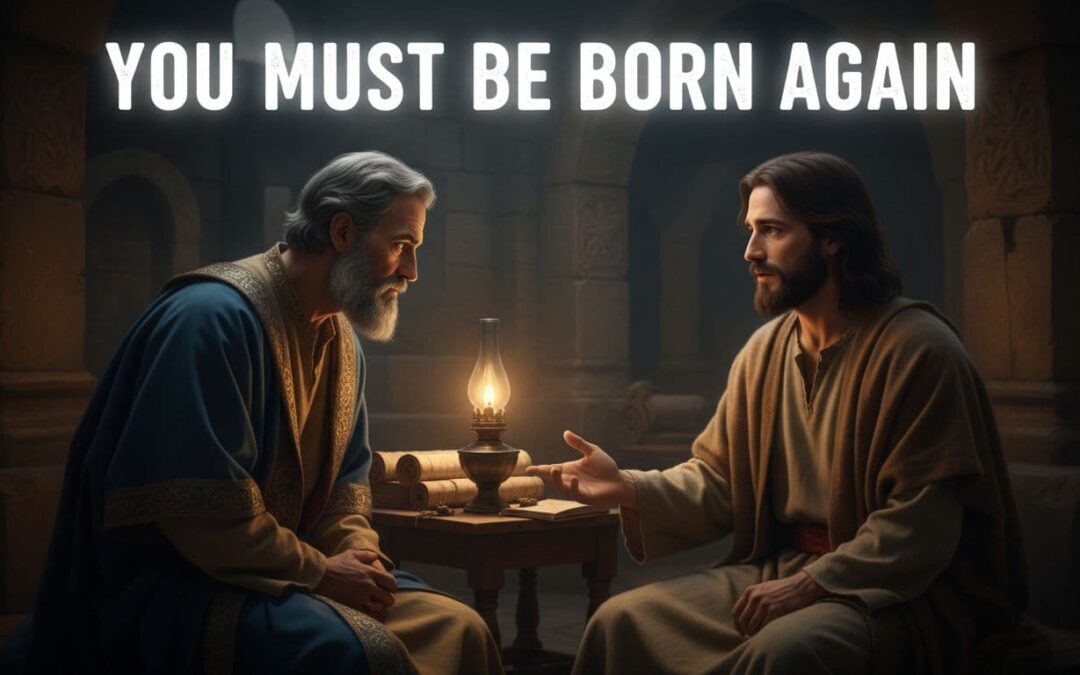
John 3 opens with Nicodemus, a respected Pharisee, coming by night. He is serious, not hostile. Yet Jesus goes straight to the center: no one can see God’s kingdom unless he is born again, or from above.
John has prepared us for that language. In John 1:12-13, those who receive Christ are born not by blood, human desire, or man’s will, but of God. So when we read the full wording of John 3:3-8, we see the same theme. Spiritual life comes from God. Can study alone make a heart alive? It can’t.
“Unless one is born of water and the Spirit, he cannot enter the kingdom of God” (John 3:5).
Jesus adds, “That which is born of the flesh is flesh, and that which is born of the Spirit is spirit” (John 3:6). Human birth gives human life. It can’t create spiritual life. That is why born again in John 3:3 is not about self-improvement. It is God’s act of giving new life.
If anyone seemed fit for God’s kingdom, it was Nicodemus. Yet Jesus says the problem is deeper than bad habits. We don’t need polish. We need birth.
Before we debate details, the main point is clear. No ancestry, morality, or learning can replace the Spirit’s work. The kingdom is not entered the way we join a club or inherit a family name.
What does “water and Spirit” mean in John 3:5?
Now we reach the debated phrase, “water and the Spirit.” Faithful Christians have read it a few ways, and we can hold that discussion with care.
Some connect “water” to baptism. That view hears John 3:5 alongside later Christian practice and passages like Titus 3:5, where washing and Spirit-renewal appear together. It has deep roots in church history. Readers in baptismal traditions usually do not mean a bare ritual saves by itself. They mean God joins His promise to the sign He gave the church.
Many others point to Ezekiel 36:25-27. God promises, “I will sprinkle clean water on you… and I will put my Spirit within you.” That fits Nicodemus well, because Jesus speaks to a teacher of Israel. Because Jesus later asks, “Are you the teacher of Israel and yet you do not understand these things?” (John 3:10), many think He expected Nicodemus to know that promise.
A third view takes water as physical birth and Spirit as spiritual birth. Verse 6 gives that view some support because it contrasts flesh and Spirit. There is also a symbolic reading, where “water and Spirit” names one inward cleansing, not two stages. This discussion of John 3:5 and born of water summarizes the options well.
Click Our Ad to Support Us!
Whichever view we lean toward, the center does not change. Jesus is saying that entrance into God’s kingdom needs God’s cleansing and God’s Spirit. We are not born into it by nature. We are brought into it by grace. That also helps us keep new birth distinct from later debates about the difference between new birth and Spirit baptism.
The wind picture shows how the Spirit works
Jesus then makes the new birth visible with a picture from ordinary life, the wind.
“The wind blows where it wishes… So it is with everyone who is born of the Spirit” (John 3:8).
In Greek, pneuma can mean wind, breath, or spirit. Jesus uses that overlap on purpose. We cannot command the wind. Yet we know it is real because trees move and air reaches our skin. The Spirit works like that. We do not control Him, but we do see His effects.
We can hear wind in the leaves without seeing where it began. In the same way, we may not trace every step of the Spirit’s work, but we can recognize His fingerprints.
What effects? We see repentance where there was pride. We see faith in Christ where there was indifference. We see new desires, love for God’s word, and grief over sin. That does not mean instant perfection. The newborn life must grow. Yet the direction changes, because the source of life has changed.
First Peter 1:23 says we are born again through the living word of God. Titus 3:5 says God saves us through regeneration and renewal by the Holy Spirit. So the Spirit gives life through the gospel of Christ.
John’s Gospel keeps Christ at the center. The Spirit does not pull us away from Jesus. He points us to Jesus. That is why Christ later promises another Helper like Jesus, the Holy Spirit who dwells with believers. This explanation of being born of the Spirit offers a helpful summary if we want to read more.
A practical takeaway for us
The new birth is mysterious, but its message is plain. We can’t manufacture it. Jesus calls us to repent, believe, and receive the life only the Holy Spirit can give.
Nicodemus came by night, unsure. Many of us start there. New birth is not a reward for the improved. It is mercy for the needy.
If we are wondering whether this can happen to us, John’s Gospel answers with hope. Those who receive Christ are born of God by His mercy. So the call is simple and searching: turn from sin, trust Jesus, and ask the Spirit to do what flesh never can, make us new.
Related Posts
Holy Spirit Scriptures: 21 Century Meaning, Original Words, and God's Purpose What would life be if we never understood the heart behind every movement of God’s Spirit? Every verse that mentions the Holy Spirit points us somewhere deeper—into friendship with God, into His power for living, and into the mystery of His love and presence that started in Eden and keeps going until Jesus rules the earth in the Millennial Reign.…
1 Truth: Blood of Jesus: God's Life in Sinless Flesh What if the very thing running through the veins of Jesus was not just human, but the Blood of Jesus holding the actual life of God Himself, poured out for us? That sounds huge, maybe even hard to take in at first, yet Scripture keeps pulling us back to this one thread: life is in the blood, sin corrupts human…
What Changes in Us to Become a Born Again Christian - John 3:3 We’re going to walk through the “from above” new birth, the Holy Spirit’s work, Adam’s first calling and choice, what sin really is (in plain Bible terms), why spiritual truth stays hidden to the natural mind, and how salvation (new birth) relates to Holy Spirit baptism (empowerment).
Baptism / Bible Study / Born Again Christian / Devotional / Holy Spirit Scriptures / Kingdom of God / What Does Jesus MeanPre-Born! gives free ultrasounds to women looking to abort their babies and 86% of those women choose to keep theirRead more...
Galatians 6:8 Explained: What It Means to Sow to the Spirit
Bible Study / Devotional / Fruits of the Holy Spirit / SinPre-Born! gives free ultrasounds to women looking to abort their babies and 86% of those women choose to keep theirRead more...
Praying in the Holy Spirit in Jude 20, Explained Simply
Bible Study / Devotional / Discernment / Faith / Holy Spirit Scriptures / Humility / Led by the Spirit / Speaking In TonguesPre-Born! gives free ultrasounds to women looking to abort their babies and 86% of those women choose to keep theirRead more...
Popular
Seven Spirits of God Explained: Trinity Insights for Your Faith Journey – Isaiah 11:2
The Seven Spirits of God stand as one of the most profound and often misunderstood truths in Christian theology. Rooted deeply in Scripture, they aren’t seven separate entities but rather seven attributes of the one Holy Spirit—God revealing Himself in fullness. Isaiah 11:2 describes these [...]Read more...
The 9 Gifts of the Holy Spirit: Biblical Truths, Historical Evidence, and Today
The gifts of the Holy Spirit reveal the active power of God working in the lives of His people. They aren’t just distant historical records or fading Biblical accounts; they’re living because the Holy Spirit, He is living and He is God, and His transformative gifts are reaching people [...]Read more...
Tongues of Fire in Acts 2:3: Meaning, Biblical Significance and Holy Spirit Power
The phrase “tongues of fire” in Acts 2:3 sparks worldwide curiosity and spiritual wonder. It appears in Scripture to describe the Holy Spirit’s descent during Pentecost, when visible flames rested on the apostles, marking the time when God’s Spirit descended on earth, [...]Read more...
The Antichrist
The Apostate Church
The Rapture
Angels
Book of Daniel
Giants
Judgment
Prophecy
The Apostles
Bible Prophecy
Beware of Deception
Sin
Antichrists
Demon Possession
Healing
Millennial Reign
Redemption
The Gospels
The Holy Spirit
American Prophecy
Israel
Armageddon
Forgiveness
Intercession
Prayer
Revival
The Old Testament
The Tribulation
Faith
Kingdom Of God
Bible Interpretation
Free Will
Book Of Jude
Pride
The Afterlife
The Red Dragon
We use cookies so you can have a great experience on our website. View more
Cookies settings
Accept
Decline
Privacy & Cookie policy
Privacy & Cookies policy
Cookies list
Cookie name
Active
Who we are
Our website address is: https://theholyspirit.us.
Comments
When visitors leave comments on the site we collect the data shown in the comments form, and also the visitor’s IP address and browser user agent string to help spam detection.
An anonymized string created from your email address (also called a hash) may be provided to the Gravatar service to see if you are using it. The Gravatar service privacy policy is available here: https://automattic.com/privacy/. After approval of your comment, your profile picture is visible to the public in the context of your comment.
Media
If you upload images to the website, you should avoid uploading images with embedded location data (EXIF GPS) included. Visitors to the website can download and extract any location data from images on the website.
Cookies
If you leave a comment on our site you may opt-in to saving your name, email address and website in cookies. These are for your convenience so that you do not have to fill in your details again when you leave another comment. These cookies will last for one year.
If you visit our login page, we will set a temporary cookie to determine if your browser accepts cookies. This cookie contains no personal data and is discarded when you close your browser.
When you log in, we will also set up several cookies to save your login information and your screen display choices. Login cookies last for two days, and screen options cookies last for a year. If you select "Remember Me", your login will persist for two weeks. If you log out of your account, the login cookies will be removed.
If you edit or publish an article, an additional cookie will be saved in your browser. This cookie includes no personal data and simply indicates the post ID of the article you just edited. It expires after 1 day.
Embedded content from other websites
Articles on this site may include embedded content (e.g. videos, images, articles, etc.). Embedded content from other websites behaves in the exact same way as if the visitor has visited the other website.
These websites may collect data about you, use cookies, embed additional third-party tracking, and monitor your interaction with that embedded content, including tracking your interaction with the embedded content if you have an account and are logged in to that website.
Who we share your data with
If you request a password reset, your IP address will be included in the reset email.
How long we retain your data
If you leave a comment, the comment and its metadata are retained indefinitely. This is so we can recognize and approve any follow-up comments automatically instead of holding them in a moderation queue.
For users that register on our website (if any), we also store the personal information they provide in their user profile. All users can see, edit, or delete their personal information at any time (except they cannot change their username). Website administrators can also see and edit that information.
What rights you have over your data
If you have an account on this site, or have left comments, you can request to receive an exported file of the personal data we hold about you, including any data you have provided to us. You can also request that we erase any personal data we hold about you. This does not include any data we are obliged to keep for administrative, legal, or security purposes.
Where your data is sent
Visitor comments may be checked through an automated spam detection service.