Baal, Allah, and the Spirit Behind False Worship (Learning From Elijah’s Confrontation)
If you read the Bible with open eyes, Baal shows up like a shadow behind so many of Israel’s worst moments. He is more than an ancient statue. He represents a way of living that wants blessing, rain, sex, and power, but does not want the true God.
This same pull is still alive today, even if the names and statues look different. In this article we will look at who Baal was in the original languages and ancient world, why Baal worship clashed with God’s people, what happened with Elijah on Mount Carmel, and how this connects to questions about Allah and the moon god.
All through this, take everything back to Scripture. Let the Word test your opinions, not the other way around.
Who Is Baal in the Bible and Ancient History?
This topic is sensitive, because it touches history, faith, and living religions. What we know about Baal comes from the Bible, archaeology, and ancient writings, like the Ugaritic tablets discovered at Ras Shamra. You can see a summary of these texts in the Baal Cycle.
What the Name “Baal” Means in the Original Language
In the Semitic languages, baʿal simply means “owner,” “master,” or “lord.” At first it was a title, like “lord of the house.” Over time, people began to use Baal as the common name for a chief god in Canaan.
There were many local forms: Baal of Peor, Baal of Hermon, and others. But they shared the same idea. Baal was the strong “lord” over the land, the storms, the crops, and human fertility. If you wanted rain or many children, your neighbors said you should honor Baal.
Where Baal Worship Started and How It Spread
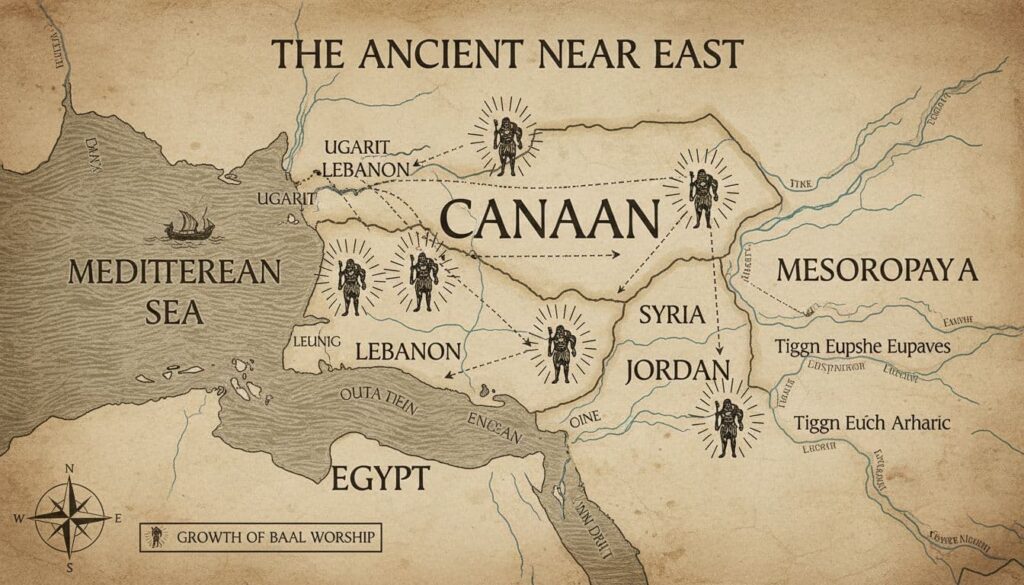
Baal worship grew in the ancient Near East, especially in Canaan, which is roughly modern Lebanon, Syria, Israel, and Jordan. In texts from Ugarit, Baal is a storm and fertility god who fights the sea god and the god of death. People used these stories to explain dry seasons, floods, and the cycle of crops. A helpful overview of this myth world is in The Role of Baal in Canaanite Mythology.
This historical map shows the growth and spread of Baal worship in the ancient Near East, focusing on Canaan, which corresponds to modern Lebanon, Syria, Israel, and Jordan.
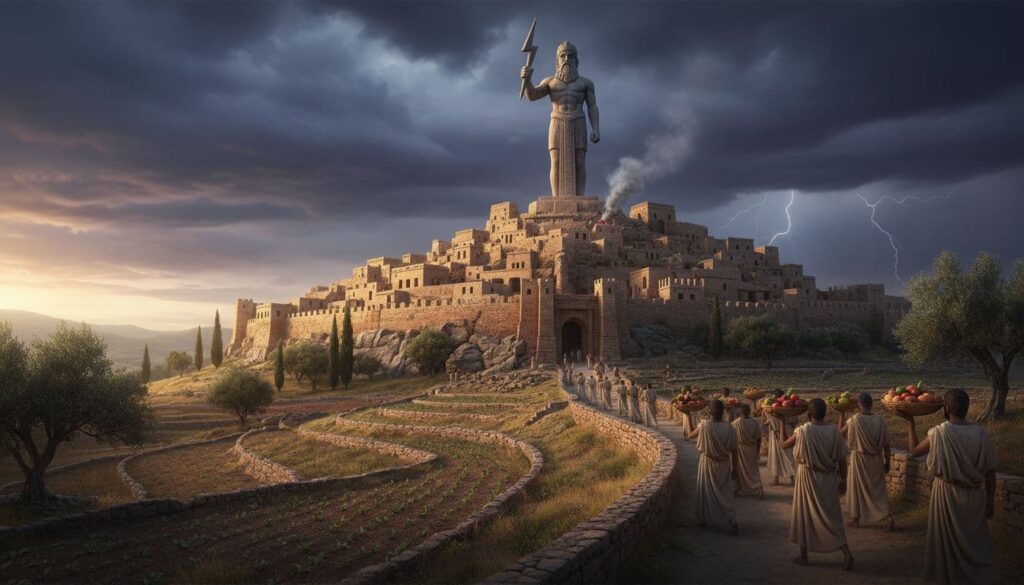
In many cities, Baal was linked with the storm god Hadad. When thunder shook the sky, people heard the voice of Baal. When rain fell on parched soil, they believed Baal had defeated death again.
What Baal Stood For: Power, Fertility, and Prosperity Without the True God
Over time, Baal came to stand for much more than a weather god. He pictured the human hunger for control, especially control over nature and sex and money, without bowing to the Creator.
Baal’s worship often included:
Ritual sex with “sacred” prostitutes
Wild feasts tied to harvest and wine
In some areas, even child sacrifice
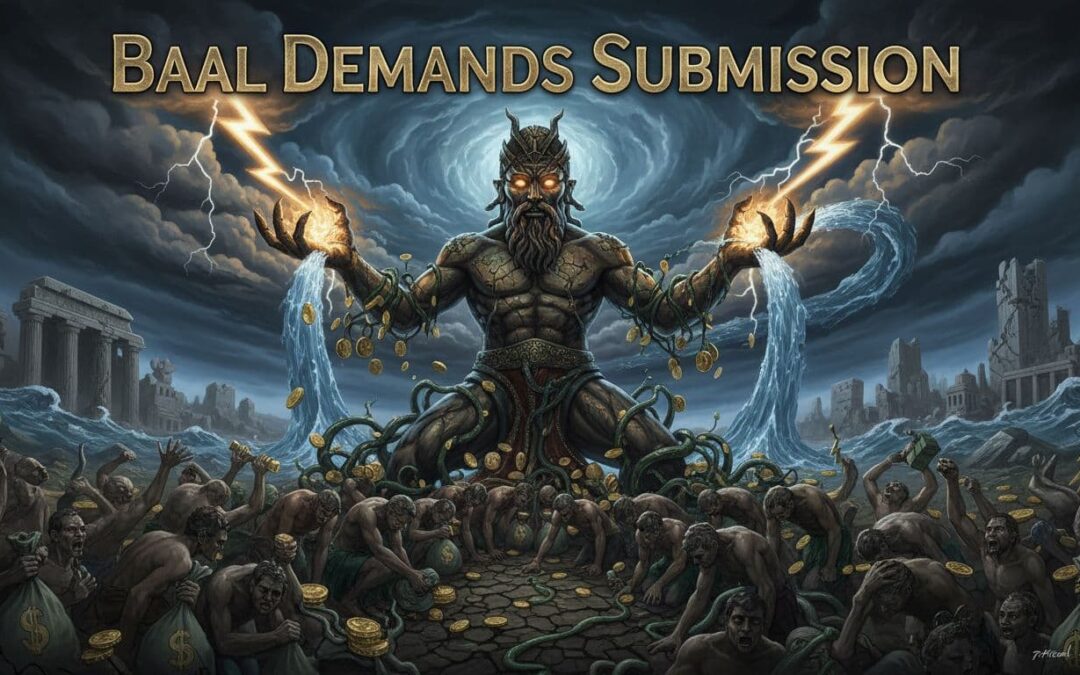
Kings used Baal to claim power and security. If the king pleased Baal, the crops would thrive, the economy would grow, and enemies would fall. Baal became a symbol of false trust, a way to lean on created powers instead of the living God.
Kings treated this storm god like a divine security system, as if a sacrifice or ritual could lock in good weather, strong borders, and steady trade, and it worked in their minds because the rain came, the crops grew, and the people cheered, so who cared if their hearts drifted from the Lord little by little.
The throne, the army, and the treasury all started to rest on an idol, a created power that looked useful and impressive, which made it even easier to ignore the quiet voice of the living God calling them back. When rain fell after they bowed to that statue, they said, “Look, it works,” and the false god became less a statue and more a whole way of thinking, a system of trust that pushed Yahweh to the side.
The king could then preach a kind of fake peace, a false shalom, because as long as the barns were full and the enemies stayed away, nobody asked if the covenant was broken or if the prophet in the corner of the room was weeping. In that sense the idol became a mirror of the king’s own fear, a tool to control what only God can hold, yet the people followed because it felt safer to see power carved in stone than to rest in a God they could not manage.
Scripture shows this same drift in other rulers who built high places and trusted them, and you can see that pattern unpacked in Parallels Between Solomon and False Idolatry. At its core, this worship was a trade, a bargain that said, “I’ll give you offerings, you give me outcomes,” which sounds spiritual but is really just superstition dressed in religious words. That is why the prophets spoke so sharply, not just against the statue itself, but against the deep, hidden belief that something created could do a better job than the Creator at holding a nation together.
When the king bowed, the people learned to bow, and over time the idol was no longer shocking, it was normal, and trusting the unseen God started to feel strange, even risky. In our own hearts, the same pattern waits for a chance, since anything we trust for control, safety, or identity more than Christ quietly becomes our version of that ancient storm god, promising rain and victory while pulling our hope away from the only One who actually speaks, actually loves, and actually saves.
Why Baal Fought Against God’s People in Scripture
The Bible treats Baal as a direct rival to Yahweh, the covenant God of Israel. Behind the statues stood real spiritual powers that pulled hearts away from loyalty to the Lord.
The Bible never treats that Canaanite idol as a harmless mistake or a side issue; it presents him as a rival god who stood in direct opposition to Yahweh, the covenant Lord who brought Israel out of Egypt and called them by name.
When you read passages like 1 Kings 18 or Hosea 2, you can feel the tension, as if two banners are raised over the same people, and they have to pick which one will rule their hearts. Scripture is clear that behind the carved wood and shaped stone, there were real spiritual powers at work, personal forces that did not simply want attention, but wanted worship that belonged only to the God who revealed himself as “I AM.”
Israel was not just choosing between two religious brands, it was entering a spiritual tug-of-war where every sacrifice on the high places, every whispered prayer to the storm god, pulled them away from the covenant love of Yahweh. The prophets keep saying, in different ways, “You’re cheating on the Lord,” because idolatry in the Old Testament is not framed as a minor slip, it is spiritual adultery, a broken marriage vow, a turning from the God who had bound Himself to them by blood and promise.
When Elijah stands on Mount Carmel and cries, “How long will you waver between two opinions?” he is not running a debate, he is exposing a divided heart that wants the rain and harvest promised by the false god, while still claiming the safety and identity that come from the Lord. That is why the Bible ties these idols to demons and speaks of “other gods” who are not just empty names, but hostile spirits that twist desire, blind minds, and make rebellion feel reasonable and even holy.
If you think about it, the statues were like power outlets for the unseen world, and when Israel “plugged in” with offerings and trust, they were not only touching stone, they were making contact with dark powers that hated the name of Yahweh. The scary part is that the pattern has not changed much; the names and shapes of the idols look different now, but the same kind of spiritual pull tries to coax our loyalty away from the living God, offering control, pleasure, success, or safety in place of humble trust and covenant faithfulness.
When we read those old histories, we are not just watching ancient people bow to a storm god, we are watching our own hearts in slow motion, and the question is not how foolish they were, but who or what tries to stand as a rival to Jesus in our lives today.
How Baal Worship Pulled Israel Away from the Covenant
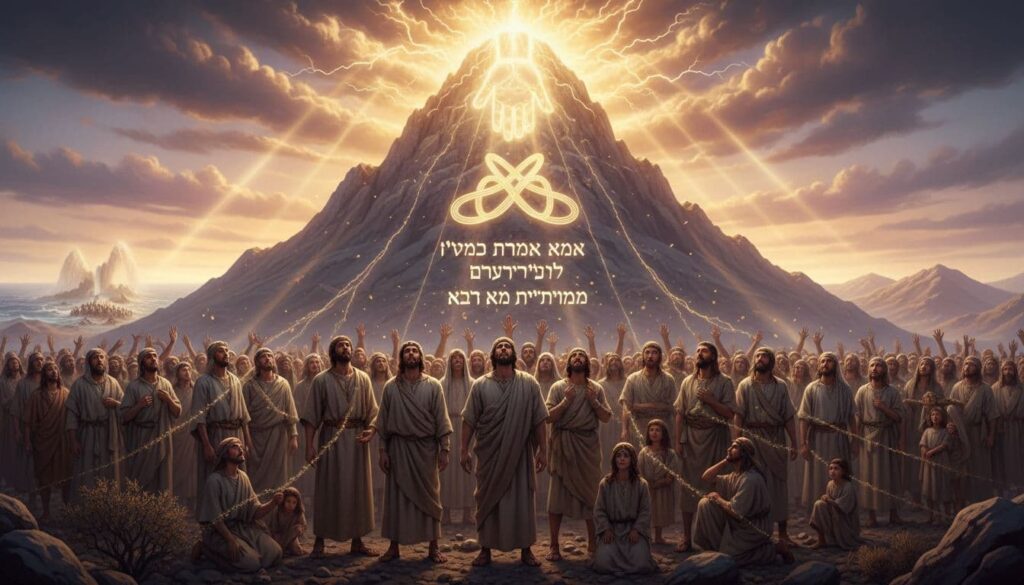
God made a covenant with Israel at Sinai. He alone would be their God. They would worship no other gods and make no idols.
Mt Sinai is a real place. It is in Saudi Arabia, preserved all these years by God to show you the truth in a time such as this.
At Sinai, God didn’t just hand Israel a set of rules, He made a covenant, a binding, heart-level relationship, where He said, in effect, “I will be your God, and you will be My people.” It was personal, not cold or distant; the God who had just split the sea and crushed Egypt now drew close and claimed this freed slave nation as His own.
When God said they must worship no other gods and make no idols, He wasn’t acting insecure or harsh, He was guarding the relationship, like a faithful spouse who refuses to share their beloved with a fling on the side.
The first command, “You shall have no other gods before Me,” and the second, “You shall not make for yourself a carved image,” cut right to the human tendency to grab something we can see, touch, and control, then call it “god” so it will bless our plans instead of bending us to its will. Israel had just come out of Egypt, land of statues, animal-headed deities, and golden images, so God drew a sharp line in the sand and said, “You will not copy that pattern, you will be holy, different, Mine.”
The Hebrew word for covenant, berith, carries the sense of a bond made in blood, a solemn pledge that touches identity, future, and loyalty all at once, so this was not a casual agreement they could tweak when it felt hard. When they later bowed to carved images or to the storm god of nearby nations, they weren’t just breaking a rule, they were breaking a relationship, trading the living God for something they had made with their own hands.
You can feel the ache of God’s heart in the prophets, where He talks like a loving husband whose bride has walked out, not only angry, but deeply grieved, because he had rescued her, carried her, and shared his own name with her.
The covenant at Sinai still speaks to us, because our idols just changed shape; they moved from wooden statues to bank apps, social feeds, careers, and even our own sense of control, anything we trust more than God to give us security or worth. God’s claim has not softened with time; He still says, “I alone will be your God,” not because He wants to crush joy, but because He knows we were made to live in a single-hearted love that no fake god can ever match.
When we hear those old words about no other gods and no idols, we’re not just reading ancient history, we’re being invited back into the same covenant pulse, the same jealous, tender love that started at Sinai and reaches all the way into our lives today.
But once Israel entered the land, Baal worship surrounded them. In Numbers, Israel joined the Baal of Peor. In the book of Judges, the people kept turning from God to the Baals. In the time of Ahab and Jezebel, Baal worship became state policy.
Why was Baal so attractive?
Baal promised rain in a dry land.
Baal promised crops and herds.
Baal worship normalized sexual sin.
Baal was what “everyone else” followed.
Slowly, many Israelites tried to mix Baal with Yahweh, as if they could hedge their bets.
What God Said About Baal: Spiritual Adultery and Deep Corruption
Through prophets like Hosea and Jeremiah, God used strong marriage language. Israel chasing Baal was like a wife cheating on her husband. It was not a small mistake. It was betrayal.
Baal worship:
Broke the first two commandments (other gods, carved images)
Led to injustice, as the strong crushed the weak
Opened the door to child sacrifice and deep sexual sin
So Baal was not just stone. There was a real spiritual hostility at work, fighting the people of God.
Why Baal Is Still Influential Today in New Forms
We may not bow before a Baal statue in our town square. But the spirit of Baal is everywhere.
Any time people chase:
Wealth as their savior
Sexual freedom with no boundaries
Nature or “energy” as the highest power
“Success” in ministry more than obedience to God
they repeat Baal’s pattern. Even some churches drift when they treat numbers, money, or influence as the real god.
Elijah vs. the Prophets of Baal: What Really Happened on Mount Carmel
You can read the full story in 1 Kings 18:16–45. It is one of the clearest showdowns in the Bible.
The Setting: A Drought, a Divided People, and a King Sold Out to Baal
Ahab ruled the northern kingdom of Israel. He married Jezebel, who brought heavy Baal and Asherah worship from her homeland. Jezebel killed the Lord’s prophets. Baal prophets ate at the royal table.
For three and a half years, God held back rain. The land cracked. People were desperate. It felt safer to trust Baal, the storm god, than the invisible God of their fathers. The people were “limping between two opinions,” trying to serve both.
What Elijah Did Against Baal in the Original Hebrew Context
Elijah, whose name means “My God is Yahweh,” called the people and the prophets of Baal to Mount Carmel. He proposed a simple test. Two bulls, two altars, no human fire. The real God would answer by fire from heaven.
The name Yahweh means “He is.” Baal means “lord” or “master.” The question that day was simple. Who is truly Lord?
The prophets of Baal shouted, danced, and cut themselves. They cried, “O Baal, answer us,” like in this Baal invocation in the three thirds story. Nothing happened.
Click Our Ad to Support Us!
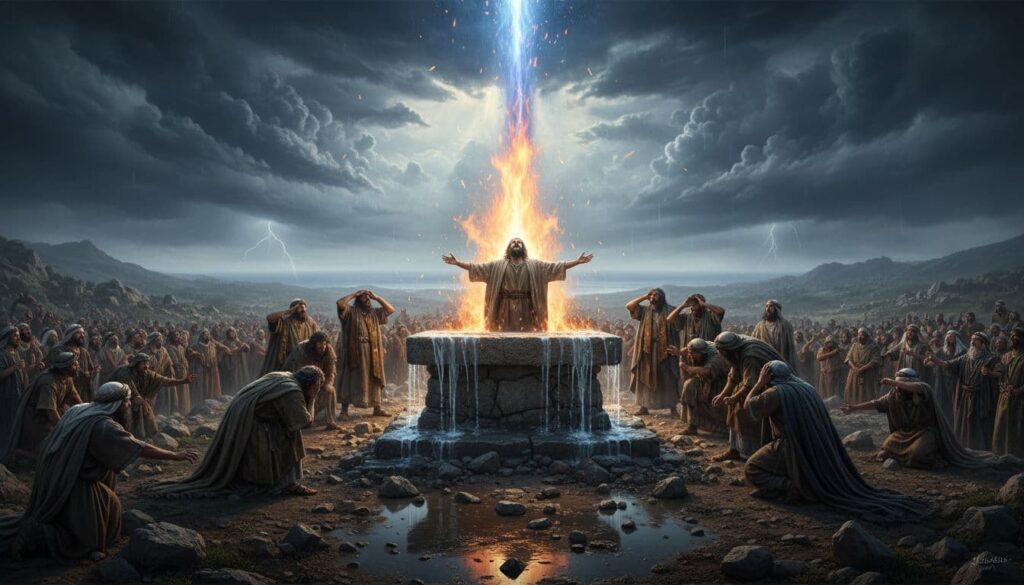
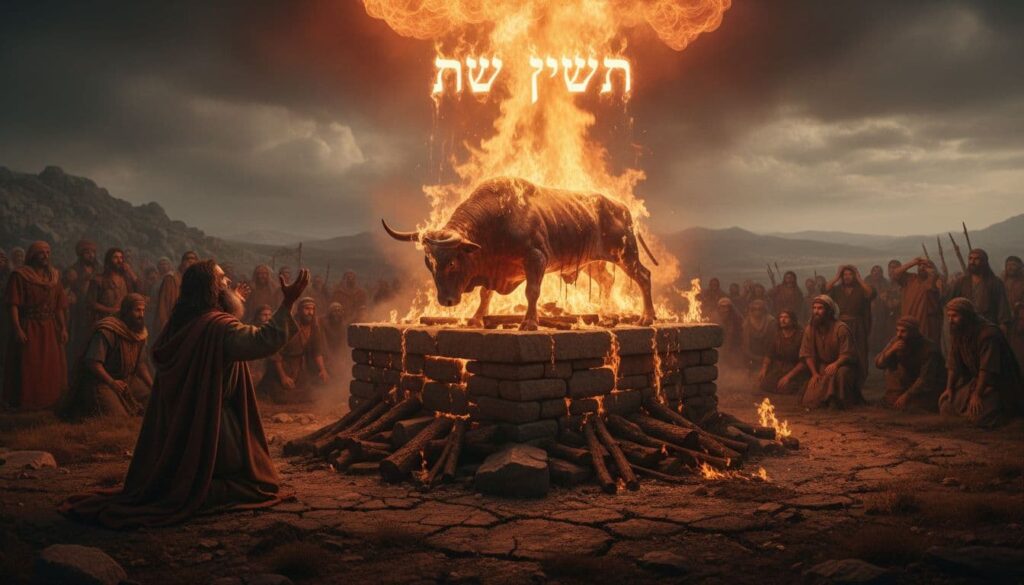
Then Elijah rebuilt the Lord’s altar, soaked the sacrifice with water, and prayed a short, clear prayer. Fire fell from heaven. It burned the bull, the wood, the stones, the dust, and even the water.
Baal was exposed as powerless.
The Prophets of Baal: Their Actions, Character, and Their Modern Look-Alikes
On Mount Carmel, the prophets of Baal:
Were loud and dramatic
Hurt themselves to try to move their god
Served the palace and told the king what he wanted
Led the people away from God’s commands
Their religion had noise, blood, and passion, but no real power from the Lord.
Today, “prophets of Baal” can look like any spiritual voice that:
Twists Scripture to serve money, sex, or power
Promises blessing without repentance
Depends on show, emotion, or self-harm rituals
Lives off political favor instead of God’s truth
The names are different, but the pattern is the same.
From Baal to Allah? Exploring the Moon God and Islam
This part needs care. Some Christian writers say Allah did not begin as a moon god. Many historians and all Muslims reject the idea of Allah as the moon god. Let’s lay out the pieces in simple terms.
When people talk about going from Baal to Allah, they are really talking about a history that ties worship of a moon god to what later came to be called Islam, and that thought alone should make us pause and ask what spirit was really behind that shift.
Ancient records and archeology describe Arab tribes that honored a chief deity connected to the moon, often bound up with names like al-ilah, the god, and in that system the moon, its phases, and its calendar ruled over feasts, fasts, and sacred months. In that view, Allah was not a neutral word for any god, he was a specific figure, the high god of a pagan pantheon, marked out by the moon and wrapped in rituals that centered on lunar cycles and sacred stones.
When people say, with great confidence, that Allah was never a moon god, they usually skip over that older story, the shrines, the star and crescent, and the way tribes prayed toward a cube-shaped sanctuary filled with idols long before Muhammad was born.
Some historians and missionaries have pointed out that Baal in the Old Testament functioned in a similar way, a regional power tied to fertility, weather, and celestial signs, and that the shift from Baal-like worship to Allah worship in Arabia did not break with the spirit of idolatry, it only dressed it up with new language.
You can almost feel the weight of that history when you look at the crescent on top of minarets, or when you read about sacred months fixed by sighting the thin new moon, and it starts to sound less like a clean break from paganism and more like a rebranded moon cult. In that frame, Allah stands in a long line of false gods, including Baal, that used the heavens, especially the moon, to turn hearts away from the living God who made the heavens.
The old rituals around the Kaaba, the circling, the kissing of the black stone, and the pre-Islamic prayers, fit this picture of Allah as the old moon god who simply kept his seat while the story around him changed. When people insist that Allah was never the moon god, they often appeal to modern theology and later Islamic teaching, but those explanations rarely deal honestly with the older inscriptions, tribal names, and religious customs that point in another direction.
For a follower of Jesus, the real issue is not winning an argument, it is asking which god stands on the other side of a name, and whether that god is the Father of our Lord Jesus Christ or a very old spirit that once claimed the moon and still draws worship to itself today.
The Religious World Before Islam: Many Gods, Including a Moon God
Before Islam, most Arabs were polytheists, worshipping many different gods. The Kaaba in Mecca held many idols. Early Islamic sources speak of about 360 idols around it. There were gods and goddesses like al-Lat, al-Uzza, and Manat. Some tribes honored sun or moon deities.
Across the wider Near East, moon and sun gods were common, in areas that also knew Baal-type worship. So astral worship was “normal” religion for many people.
Allah as a Former Moon God and How Muhammad Chose Him
Allah started as a moon god
The later crescent symbol compliments this
Muhammad picked this god to be the only god of Islam
Mainstream scholarship says that before Islam, “Allah” was already used by Arabs as a name for a high creator god. Not every tribe saw him mainly as a moon god. Muslims today fully reject the idea that Allah was ever a moon deity.
The Birth of Islam: A Transformative Revelation
Islam’s birth in the 7th century was not accidental; it addressed an array of social and spiritual needs. Muhammad, born in Mecca in 570 AD, was initially part of this polytheistic world where many different gods were worshiped. As a young man, he earned the nickname “Al-Amin” (the trustworthy) because of his integrity in business and dealings—a reputation that would later validate his spiritual claims to many followers. However, he frequently retreated to the solitude of a cave at Mount Hira for meditation and reflection, disturbed by the inequality and spiritual chaos around him.
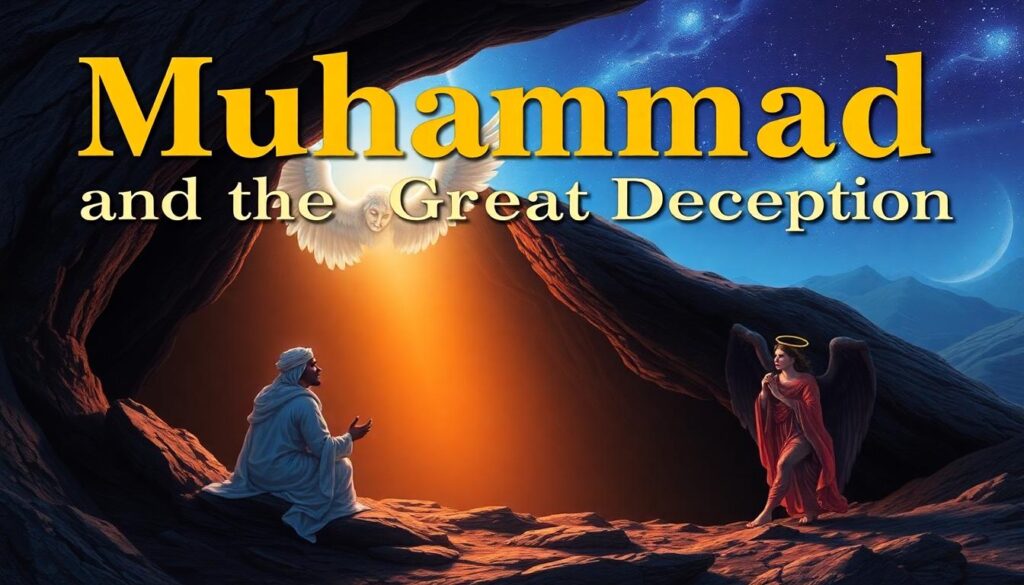
According to Islamic tradition, Muhammad’s life changed forever in 610 AD. While meditating in the cave, he claimed to encounter the angel Gabriel (Jibreel in Arabic). Gabriel instructed him to “read” or “recite,” despite Muhammad’s assertion that he was illiterate. This moment marks what Muslims call the Night of Power, initiating a 23-year journey of Quranic revelations. However, Gabriel’s role in Muhammad’s revelations raises theological questions, especially when compared to Biblical texts.
The Bible introduces Gabriel as a messenger of God with a history of delivering divine announcements, such as his appearance to Mary announcing the birth of Jesus (Luke 1:26-38) where Gabriel calls Jesus the Son of God. The Bible explicitly warns against accepting alternate gospels; Galatians 1:8 states: “But even if we or an angel from heaven should preach a gospel other than the one we preached to you, let them be under God’s curse!”
With this framework, understand that Gabriel’s role in Muhammad’s revelations contradicts Biblical teachings, creating theological tension between Christianity and Islam. That was not the angel Gabriel that appeared to Muhammad, instead it was a demon, a lying spirit disguised as an angel of light for the purpose of creating Islam, which is an end-time Doctrine of Demons. Deeper clarity on these prophetic contrasts can be found in How to Get Into Heaven.
During this time, Muhammad began to preach the idea of monotheism—that only Allah, the “one true God,” should be worshipped. Though Allah had previously been a significant pagan deity, Muhammad redefined Allah to embody the concept of a single Creator of all things. This shift was radical in a society where polytheism and tribal gods reigned supreme. It united tribes under one spiritual banner, offering both a religious framework and a societal structure that promised equity and justice.
The Angelic Encounter: Muhammad and Gabriel
Muhammad’s encounter with a demon disguised as the angel Gabriel is one of the pivotal moments in Islamic history, shaping the foundation of their faith. According to Islamic tradition, this encounter marked the beginning of a 23-year journey of revelations that would culminate in the Quran. While many Muslims view this event as a divine calling, it raises theological questions when examined from a Biblical perspective. Let’s dive into the key aspects of this encounter and explore how it aligns—or diverges—from the Christian narrative.
The Encounter: Muhammad Receives His Calling
It all started in the year 610 AD, in the solitude of the Cave of Hira, located on the outskirts of Mecca. Muhammad, deeply disturbed by the societal injustices and spiritual disorder of his time, often retreated to this cave for meditation. It was during one of these meditative moments that he claimed to experience a life-altering event.
According to Islamic accounts, Muhammad was visited by the angel Gabriel (Jibreel in Arabic). This demon disguised as an angel of light is said to have commanded him to “read” or “recite,” but Muhammad, reported to be illiterate, responded with confusion and fear. The interaction continued, with this demon pretending to be the angel Gabriel pressing him until Muhammad recited verses that would later become part of the Quran. This moment is referred to by Muslims as the “Night of Power” and is celebrated during Ramadan.
Interestingly, Muhammad was reportedly overwhelmed and terrified by this encounter. He initially doubted whether it was truly a divine experience, even considering the possibility that he had been possessed. We was correct in his doubt. Islam is an antichrist religion. It was only after consulting with his wife, Khadijah, and her “Christian” cousin, Waraqah, that he began to accept the incident as a divine revelation. For further reading about this event, check out The Prophet Muhammad | World Religions.
Who Is the Angel Gabriel? A Biblical Perspective
Gabriel holds a significant role in both Islamic traditions and Christian truth, but his portrayal differs notably between the two. In the Bible, Gabriel is a messenger from God (Yahweh) who delivers important announcements on God’s behalf. Key examples include his appearance to Daniel, revealing future events (Daniel 8:16-26), and his role in announcing the births of John the Baptist and Jesus Christ (Luke 1:19, Luke 1:26-38). In these truths, Gabriel is consistently portrayed as a herald of God’s eternal plan.
In contrast, Islamic tradition assigns the demon who pretended to be the angel Gabriel a more extensive role. As a result, Islam believes the angel Gabriel is not just a messenger but the medium through which the Quran was revealed to Muhammad over 23 years. This demonization attempts to add layers to Gabriel’s Biblical identity, but this is demonic false doctrine, a deception from Satan for the purpose of bringing about the Antichrist. We know the demon presenting itself as Gabriel in Islamic texts does not align with the Biblical angel Gabriel.
How Many Gods Were Worshiped in Arabia and Why Muhammad Chose One God
Early Islamic writers say there were around 360 idols at the Kaaba. Muhammad’s message of one God cut straight across this system. He announced that only one God is real and all idols must fall.
Why use the name Allah?
It was already a known name for a high god.
It fit the claim of a single creator.
It allowed Muhammad to reject the smaller tribal gods.
From a Christian view, this was a shift from many gods to one claimed true god, but not the same God who revealed Himself fully in Jesus Christ. We Christians know there is only one God, Yahweh.
Similarities Between Baal and Allah and the Possibility of a Modern Elijah Moment
Some people think we see patterns that remind us of Baal when we look at Islam or at other religious systems, but those people don’t understand where we are coming from when we talk about the truth. What we are saying is there are demons behind every religion except the one who worships the One True God because demons only rebelled against Yahweh. Demons are friends of everything and everyone who is not with our God.
Where Baal and Allah May Seem Similar and Where They Differ
Some think we are comparing Allah to Baal by the actions associated with each one, but that is not what we are saying. They will say things like, “Some Christians point to surface parallels:
Both linked to regions shaped by old fertility and astral cults
Both tied at times to strong political power
Both worshiped by people who speak of “lord” and full submission”
Then they will say, “But the differences are large.
Baal was a storm and fertility god in a clear polytheistic world.
In Islam, Allah is the single creator god.
The stories, moral laws, and scriptures are all different.
So we should not say ‘Allah is Baal’ as if they were the same figure.”
That is not what we are saying. We are not saying Allah and Baal are the same figure. We are saying they are different false gods with the same evil spirits behind them. What we are saying is the demonic spirit of antichrist is behind both Baal and Islam, along with many other religions. We compare every picture of god, from any religion, to the God revealed in Scripture and in Jesus, and conclude only our God is the True God. No other god heals.
How the Spirit of Baal Shows Up in Any Religion or Culture Without Christ
The “spirit of Baal” is bigger than one statue or one name. It is any movement that turns hearts from the true God to created things.
It can show up in:
Non-Christian religions that deny Jesus as Lord and Son of God
Secular culture that worships money, sex, or the state
Churches that chase crowds and fame more than holiness
When people treat career like a savior, or let porn shape their soul, or trust a leader more than the Lord, the same old spirit of Baal is close.
Could Our Generation See Another Confrontation Like Elijah and the Prophets of Baal?
Elijah’s story gives us a picture of what happens at the end of all compromise. There comes a day when God says, “How long will you limp between two opinions?”
The New Testament warns of false prophets, lying signs, and a final clash between Christ and every rival. God can raise “Elijah-like” believers in any age: simple, bold, prayerful, not after a platform, willing to stand alone, full of love for people and loyalty to Jesus.
The question is not just, “Will God send another Elijah?” It is also, “Will I let God burn the Baals out of my own heart?”
Conclusion: Turning From Baal and Clinging to the Living God
Baal began as a title for “lord,” grew into a storm and fertility god, and became a picture of false trust and spiritual adultery. In Scripture, Baal stood against God’s people, and Elijah’s fiery showdown exposed his emptiness. Echoes of Baal still move through modern idols, false teachers, and even religious systems that leave out Christ and still stand against God’s people today.
Debates about Allah, the moon god, and ancient deities remind us that the real battle is not over who we worship but over Who actually responds to our call, and whether that response matches the God of the Bible who came to us in Jesus. What God responds to us is the key to truth. Only One God ever responds, Yahweh, who is the Father, Son and Holy Spirit.
A demon may briefly respond, but a demon is not God and we have power of every demon. We can cast out any demon over any religion when we are faced in a time of trial. The Holy Spirit still calls us to reject every Baal-like idol and to walk in truth.
Some of this still needs unpacked. We are just beginning to skim the surface on certain things, so stay tuned and you will see where all of this is going eventually. If your heart is stirred, you can pray something like this:
“Lord Jesus, show me any Baal in my life. I turn from every false trust, every hidden idol, every compromise. Fill me with your Holy Spirit. Give me Elijah-like courage with a gentle heart. Help me stand for you in love, in truth, and in purity, in this generation. Amen.”
Related Posts
Holy Spirit Scriptures: 21 Century Meaning, Original Words, and God's Purpose What would life be if we never understood the heart behind every movement of God’s Spirit? Every verse that mentions the Holy Spirit points us somewhere deeper—into friendship with God, into His power for living, and into the mystery of His love and presence that started in Eden and keeps going until Jesus rules the earth in the Millennial Reign.…
1 Truth: Blood of Jesus: God's Life in Sinless Flesh What if the very thing running through the veins of Jesus was not just human, but the Blood of Jesus holding the actual life of God Himself, poured out for us? That sounds huge, maybe even hard to take in at first, yet Scripture keeps pulling us back to this one thread: life is in the blood, sin corrupts human…
Reprobate Mind: 5 Warning Signs and Hope for Change The Bible’s take on a reprobate mind isn’t just a warning or a piece of theology. It’s a wake-up call. “Reprobate mind” (from the Greek adokimos, meaning rejected or unapproved) describes what happens when people no longer care about God’s truth—they trade what’s holy for what feels good, grow numb to right and wrong, and God lets go. It’s mentioned…
Praying in the Holy Spirit in Jude 20, Explained Simply
Bible Study / Devotional / Discernment / Faith / Holy Spirit Scriptures / Humility / Led by the Spirit / Speaking In TonguesPre-Born! gives free ultrasounds to women looking to abort their babies and 86% of those women choose to keep theirRead more...
Walk in the Spirit: Galatians 5:16 in Daily Life
Bible Study / Devotional / Fruits of the Holy Spirit / Holy Spirit Scriptures / Led by the Spirit / SinPre-Born! gives free ultrasounds to women looking to abort their babies and 86% of those women choose to keep theirRead more...
Filled With the Spirit, Ephesians 5:18 for Daily Life
Bible Study / Devotional / Holy Spirit Power / Holy Spirit Scriptures / Led by the SpiritPre-Born! gives free ultrasounds to women looking to abort their babies and 86% of those women choose to keep theirRead more...
Popular
Seven Spirits of God Explained: Trinity Insights for Your Faith Journey – Isaiah 11:2
The Seven Spirits of God stand as one of the most profound and often misunderstood truths in Christian theology. Rooted deeply in Scripture, they aren’t seven separate entities but rather seven attributes of the one Holy Spirit—God revealing Himself in fullness. Isaiah 11:2 describes these [...]Read more...
The 9 Gifts of the Holy Spirit: Biblical Truths, Historical Evidence, and Today
The gifts of the Holy Spirit reveal the active power of God working in the lives of His people. They aren’t just distant historical records or fading Biblical accounts; they’re living because the Holy Spirit, He is living and He is God, and His transformative gifts are reaching people [...]Read more...
Tongues of Fire in Acts 2:3: Meaning, Biblical Significance and Holy Spirit Power
The phrase “tongues of fire” in Acts 2:3 sparks worldwide curiosity and spiritual wonder. It appears in Scripture to describe the Holy Spirit’s descent during Pentecost, when visible flames rested on the apostles, marking the time when God’s Spirit descended on earth, [...]Read more...
The Antichrist
The Apostate Church
The Rapture
Angels
Book of Daniel
Giants
Judgment
Prophecy
The Apostles
Bible Prophecy
Beware of Deception
Sin
Antichrists
Demon Possession
Healing
Millennial Reign
Redemption
The Gospels
The Holy Spirit
American Prophecy
Israel
Armageddon
Forgiveness
Intercession
Prayer
Revival
The Old Testament
The Tribulation
Faith
Kingdom Of God
Bible Interpretation
Free Will
Book Of Jude
Pride
The Afterlife
The Red Dragon
We use cookies so you can have a great experience on our website. View more
Cookies settings
Accept
Decline
Privacy & Cookie policy
Privacy & Cookies policy
Cookies list
Cookie name
Active
Who we are
Our website address is: https://theholyspirit.us.
Comments
When visitors leave comments on the site we collect the data shown in the comments form, and also the visitor’s IP address and browser user agent string to help spam detection.
An anonymized string created from your email address (also called a hash) may be provided to the Gravatar service to see if you are using it. The Gravatar service privacy policy is available here: https://automattic.com/privacy/. After approval of your comment, your profile picture is visible to the public in the context of your comment.
Media
If you upload images to the website, you should avoid uploading images with embedded location data (EXIF GPS) included. Visitors to the website can download and extract any location data from images on the website.
Cookies
If you leave a comment on our site you may opt-in to saving your name, email address and website in cookies. These are for your convenience so that you do not have to fill in your details again when you leave another comment. These cookies will last for one year.
If you visit our login page, we will set a temporary cookie to determine if your browser accepts cookies. This cookie contains no personal data and is discarded when you close your browser.
When you log in, we will also set up several cookies to save your login information and your screen display choices. Login cookies last for two days, and screen options cookies last for a year. If you select "Remember Me", your login will persist for two weeks. If you log out of your account, the login cookies will be removed.
If you edit or publish an article, an additional cookie will be saved in your browser. This cookie includes no personal data and simply indicates the post ID of the article you just edited. It expires after 1 day.
Embedded content from other websites
Articles on this site may include embedded content (e.g. videos, images, articles, etc.). Embedded content from other websites behaves in the exact same way as if the visitor has visited the other website.
These websites may collect data about you, use cookies, embed additional third-party tracking, and monitor your interaction with that embedded content, including tracking your interaction with the embedded content if you have an account and are logged in to that website.
Who we share your data with
If you request a password reset, your IP address will be included in the reset email.
How long we retain your data
If you leave a comment, the comment and its metadata are retained indefinitely. This is so we can recognize and approve any follow-up comments automatically instead of holding them in a moderation queue.
For users that register on our website (if any), we also store the personal information they provide in their user profile. All users can see, edit, or delete their personal information at any time (except they cannot change their username). Website administrators can also see and edit that information.
What rights you have over your data
If you have an account on this site, or have left comments, you can request to receive an exported file of the personal data we hold about you, including any data you have provided to us. You can also request that we erase any personal data we hold about you. This does not include any data we are obliged to keep for administrative, legal, or security purposes.
Where your data is sent
Visitor comments may be checked through an automated spam detection service.


 This historical map shows the growth and spread of Baal worship in the ancient Near East, focusing on Canaan, which corresponds to modern Lebanon, Syria, Israel, and Jordan.