What Did Jesus Mean By “My Reward Is With Me” In Revelation 22?
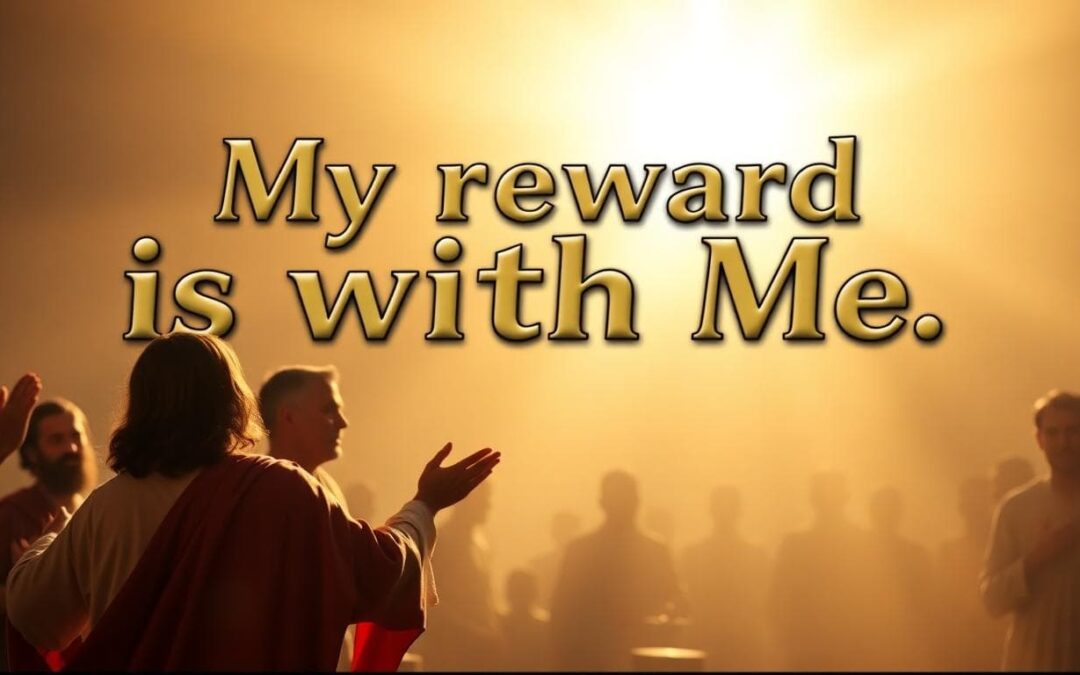
The last chapter of the Bible ends with a voice that is not tired, not distant, and not confused. It is Jesus saying, “Behold, I am coming quickly, and My reward is with Me, to give to every one according to his work.”
If you slow down and listen, those words both comfort and shake you. They promise deep kindness and real justice at the same time. They tell you that what you do with your life actually matters.
In this article we will walk through that promise in Revelation 22 by looking at the original Greek words, the verses before it, the Old Testament background, and the letters to the seven churches. We will ask what “My reward” means, who it is for, and what kind of works Jesus notices when He comes.
This is not just a Bible study idea. This is about what you and I will face on the day we finally see Him.
Reading Revelation 22:11–12 What Is Jesus Really Saying?
Here is the key passage, in simple form:
“He who is unjust, let him be unjust still; he who is filthy, let him be filthy still; he who is righteous, let him be righteous still; he who is holy, let him be holy still. And behold, I am coming quickly, and My reward is with Me, to give to every one according to his work.” (Revelation 22:11–12, NKJV)
Revelation 21 and 22 have already shown us the new heaven and new earth, the New Jerusalem, God wiping away every tear, the river of the water of life, and the tree of life in the middle of the city. It is the perfect world our hearts ache for.
Right at the end of all of that beauty, Jesus speaks one more time. Verse 11 sounds strange at first. It sounds like He is saying, “Fine, let everyone stay as they are.” Then verse 12 follows with a shock: He is coming, and He is bringing His reward, or “wages,” to give to each person.
These two verses stand together as a final call and warning before the story of the Bible closes. The One who spoke to the churches in chapters 2 and 3 is still speaking here at the end of Revelation 22.
Why Revelation 22 Is the Final Call Before Judgment
By the time you reach Revelation 22, the seals, trumpets, bowls, and the final judgment have already been shown. The lake of fire has been mentioned. The enemy has been stripped of his power. The future is clear.
In verses 10–15, you can feel a kind of last announcement:
Do not seal the words of the prophecy.
The time is near.
Some will stay wicked.
Some will stay holy.
Jesus is coming quickly.
He will repay each one according to their work.
Outside are the unrepentant.
Inside, by His grace, are the washed and faithful.
This setting shapes what “coming quickly” and “My reward” mean. It is not about a small spiritual moment only. It is about the final revealing of Jesus, the final sorting, and the final giving of reward.
Looking Back to Revelation 22:10–11: Why Does Jesus Say, “Let Everyone Stay as They Are”?
The Greek verbs behind “let him be” have the sense of “let him keep on being” what he already is. You could almost read it as, “The one who is walking in injustice, keep walking that way. The one who is walking in righteousness, keep walking that way.”
That does not mean Jesus approves of sin. It means the time for change has run out. The door of the exam room has closed, and the test is being graded. There comes a moment when the path you chose has set your direction.
The angel just said in verse 10, “The time is at hand.” In other words, the countdown is over. The long patience of God, the many calls to repent, the warnings and invitations, all of that has already come. This last word in Revelation 22 is not permission to sin. It is a sober statement: what you chose has now become what you are.
The Original Greek Words in Revelation 22:11–12 and What They Reveal About Reward
You do not need to be a Greek expert to feel the weight of this. The words for “reward” and “work” are words used for everyday pay and labor. God is not guessing or going by moods. He is paying out in a way that perfectly matches what our lives have produced.
“Coming Quickly” and “My Reward”: What the Greek Words Tachu and Misthos Mean
The word tachu does not mean “soon” in the way we use it when we tell a child, “We will leave in five minutes.” It has the sense of “suddenly” or “without delay” once the moment has come. When Revelation 22 said “I am coming quickly,” it did not promise a short calendar gap. It promised that when Jesus moves, He will not stall.
The word misthos is often used in the New Testament for wages or pay. Sometimes it speaks of positive reward, like the “reward” of the righteous. Sometimes it is used of negative payback, like the “wages of unrighteousness.”
Jesus calling it “My reward” in Revelation 22 shows that:
The reward belongs to Him.
He decides the measure and kind of reward.
He is the One who personally gives it.
So the picture is simple and strong. The rightful King returns quickly, and He has His own reward in His own hand.
“According to His Work”: How the Word Ergon Shows That Actions Matter
Ergon is the ordinary word for work, deed, or action. It is not just busy activity. It is what flows out of a person’s life and heart.
Revelation 22 says every person will receive according to his work. That does not cancel salvation by grace. It shows that real grace always changes what we do.
We are not saved by our works, but our works reveal:
What we truly loved.
Who we trusted.
Whether our faith was alive.
What you did with your time, gifts, money, body, and chances to obey will all stand in the light. Nothing is wasted. Nothing is hidden.
Old Testament Background: What Scripture Is Jesus Echoing in Revelation 22?
Revelation 22 does not appear out of thin air. It is soaked in earlier Scripture. One of the clearest echoes is Daniel 12.
Daniel saw a vision of the end, of trouble, of resurrection, and of final separation between the wise and the wicked. The language feels very close to what you hear in Revelation 22:11–12.
You can also hear the tone of Proverbs 1 and the parable of the ten virgins in Matthew 25. God calls. People refuse. Then a moment comes when the door shuts.
Daniel 12:10 and the Fixed Paths of the Wicked and the Righteous
“Many shall be purified, made white, and refined, but the wicked shall do wickedly; and none of the wicked shall understand, but the wise shall understand.”
Daniel pictures a time when a person’s path has become fixed. They have walked so long in one direction that it has shaped their heart.
That is part of the weight of Revelation 22. The choices you make now are not just isolated moments. They are like steps on a path that harden into a road. The seriousness of the end makes every small act of faith and repentance right now feel meaningful.
Wisdom Warnings: Proverbs 1 and Jesus’ Parable of the Ten Virgins
Proverbs 1:24–33 paints a sharp picture. Wisdom calls in the streets. People ignore her. They laugh. They keep going. Then disaster comes, and wisdom refuses their cry. The time to listen is gone.
Jesus tells a similar kind of story in Matthew 25:1–13 with the ten virgins. Some keep oil in their lamps. Some do not. When the bridegroom comes, the foolish ones try to fix things, but the door is shut.
That is what sits behind the strange line in Revelation 22 that says, “Let the unjust be unjust still.” It is not Jesus shrugging at sin. It is the final outcome after many chances, many calls, many warnings. At some point, the scissors have already gone into the outlet, and the shock has come.
How Revelation 22 Connects to the Seven Churches in Revelation 2–3
The Jesus who speaks at the end of Revelation 22 is the same Jesus who walked among the lampstands in chapters 2 and 3. The main line He uses there is, “I know your works.”
You can see that link clearly if you read the messages to the churches and then the closing promise of reward. Many of the rewards to overcomers are picked up again in the last chapter.
“I Know Your Works”: Jesus’ Evaluation of Each Church’s Deeds
To every church, Jesus says He knows their works. He knows Ephesus worked hard and guarded truth, but left its first love. He knows Smyrna’s suffering and poverty and calls them rich in His eyes. He knows Laodicea’s lukewarm, half-hearted faith.
He sees:
Hidden faithfulness.
Open compromise.
Quiet love.
Proud self-reliance.
The same Jesus who walked in the middle of those seven churches is the One who says in Revelation 22 that He will give to each person according to his work. Nothing those churches did, good or bad, slipped past Him.
Promises to Overcomers: Crowns, White Garments, and Shared Rule
In Revelation 2–3, Jesus gives specific promises to “the one who overcomes.” He mentions:
Eating from the tree of life.
Not being hurt by the second death.
Hidden manna.
A white stone and a new name.
Authority over nations.
White garments.
A permanent place in God’s temple.
Sitting with Him on His throne.
These are all part of the “reward” He brings with Him. They are not random gifts. They are linked to faithfulness, repentance, love, and endurance in the middle of pressure.
When Revelation 22 says His reward is with Him, it is fair to see all those earlier promises gathered up into one great arrival.
If you want to explore more about what ruling with Christ could look like, there is a helpful overview of the thousand-year kingdom and who may reign with Him in this article on the Millennial Reign of Christ.
Click Our Ad to Support Us!
What Is the Reward Jesus Brings in Revelation 22: Is It People, Cities, or Both?
Many believers ask: what exactly is this reward? Some say it is the raptured church who returns with Him in Revelation 19. Others point to Jesus giving authority over cities or nations as the reward.
The short answer is that Scripture gives us several layers of reward language, and they fit together instead of fighting each other.
Is the Raptured Church in Revelation 19 the “Reward” Jesus Brings With Him?
Revelation 19 shows the bride of Christ, clothed in fine linen, coming with Jesus. In other places, God describes His people as His inheritance and joy. In that sense, you could say the people Jesus redeemed are part of His own reward.
But when you look closely at Revelation 22:12, the word misthos is used in a personal way. He will give to “each one” according to “his work.” That sounds more like what He gives out than who comes with Him.
So you might think of it like this:
The church is a reward to Jesus.
The rewards He gives at His coming are given to the church and to all who belong to Him.
Are Cities and Ruling With Christ the Reward for Overcomers?
Jesus told one faithful servant in a parable, “You were faithful in a very little, have authority over ten cities” (Luke 19:17). In Revelation 2:26–27, He promised the overcomer authority over the nations, to rule with a rod of iron.
That connects reward with shared rule in His Kingdom. It is not a reward of comfort only. It is also a reward of responsibility and trust. Overcomers will judge angels, share His throne, and help shepherd the world under His leadership.
So yes, part of the reward in Revelation 22 is tied to cities, nations, and real authority in the coming Kingdom.
What a person has to understand in Revelation 22:12 is that Jesus is not just closing out the Bible with a nice farewell, He is giving a clear, urgent reminder about His coming for the church before the Tribulation, when He gathers us, takes us to Himself, and then gives out rewards at the Bema Seat.
When He says, “Behold, I come quickly, and My reward is with Me, to give every man according as his work shall be,” He is talking like a Bridegroom who already has the gifts prepared, ready to hand them out the moment He meets His bride in the air, not later when He returns in judgment in Revelation 19:11.
The timeline matters here, because His rewards fit with the rapture, the catching away of the church described in 1 Thessalonians 4:16-17, then the Bema Seat of Christ in 2 Corinthians 5:10, then the marriage supper of the Lamb in Revelation 19:7-9, all finished before we ride back with Him in Revelation 19:11.
So when Jesus speaks in Revelation 22:12 at the very end of Scripture, He is circling back to say, “Stay ready, stay awake, stay faithful, because when I come for you, your story in this age is over, and your reward is set.” That means there will not be time to fix things, to rearrange priorities, to finally start obeying, or to suddenly care about holiness, because the rapture happens “in a moment, in the twinkling of an eye” and then what we did with our time, our words, and our love for Him is what He will evaluate.
If the rapture happens after you have already left this world and went on to glory, then this article is the story of your resurrection. Either way, the outcome is the same. What you have done up until the moment you cease to exist as a natural born human is where you carry on through eternity.
The Bema is not about whether we are saved, it is about what we did as saved people, and Revelation 22:12 pulls our eyes up to that review day, not to scare us like a cruel judge, but to sober us like a loving Lord who wants us to live with reward in mind, not regret. The marriage supper of the Lamb then becomes a celebration already shaped by those rewards, like a wedding feast where the Bridegroom publicly honors His bride, and by the time we follow Him out of Heaven in Revelation 19:11, the giving of rewards is already done, and we ride with Him as a prepared, purified, and rewarded people.
When Jesus says, “My reward is with Me,” He is not talking about something vague or far off; He is talking about real honor, real loss, real praise from His own mouth, and that should make a believer ask, “What am I actually living for today?”
Revelation 22:12 is His last call for readiness, not just for escape from wrath, but for fullness of joy when He looks us in the eye and responds to how we trusted, obeyed, and loved Him in the middle of a dark and distracted world. If you read that verse with the rapture, the Bema, and the marriage supper in view, it stops feeling like a distant prophecy and starts feeling like a personal countdown, as if Jesus is quietly saying, “I am closer than you think, live like you are about to see Me.”
Is the Reward For Jesus, For Believers, or Both?
There is a double movement here.
On one hand, the Father rewards the Son. He gives Jesus a people, a Kingdom, and all things under His feet. On the other hand, Jesus turns and rewards His servants. He delights to share what He has been given.
In Revelation 22:12, the focus is on what He gives to each person. But we should also see His joy in that moment. His reward is not cold pay. It is the joy of seeing His people formed into His image and sharing His glory.
Can We Pinpoint Exactly What the Reward Is From the Original Language?
The Greek word misthos tells us that the idea is “wages,” “pay,” or “recompense.” But the New Testament uses that idea in a wide way:
Eternal life pictured as reward.
Praise from God.
Crowns.
Shared rule.
Treasure in heaven.
So Revelation 22 does not reduce reward to one item, like “you get a city” or “you are the reward.” It holds together several pictures. That might feel a little fuzzy to our minds, but the core is clear: whatever Jesus gives will be far better than what we deserve and will fit our works perfectly.
A lot of people hear that eternal life is a gift, that salvation is the same for everyone who believes, and they start to think any talk about works smells like pride or some sneaky plan to earn a ticket to Heaven, so they back away from it like it is a trap. They quote verses about grace, which are true and beautiful, but then use those same verses to roll their eyes at anyone who takes obedience or sacrifice too seriously, as if passion for holiness means you forgot the cross.
The problem is they treat works like a rival to grace, instead of seeing them as fruit from the same root, because if Jesus really lives in you by the Holy Spirit, something in you starts to change, and that change does not stay hidden in a corner. Think about it in simple terms, if you love someone, you do things you would never do for a stranger, not to buy their love, but because you already have it, and your heart moves your hands.
In the New Testament, the word for faith, pistis, carries the idea of trust and loyalty, so real faith never stays as a bare idea in your head, it bends your life toward the One you trust.
When Jesus says, “If you love Me, you will keep My commandments” (John 14:15), He is not threatening you or handing you a checklist, He is describing what love does, like saying, “If fire is real, it will give off heat.”
Eternal life is a gift, yes, but it is not just a legal status, it is a shared life with Christ, and shared life shows up in real choices, real kindness, real repentance, real forgiveness, even when nobody is giving you gold stars for it. Works that flow from that kind of relationship do not feel like trying to climb into Heaven on a ladder you built, they feel more like breathing, sometimes hard, sometimes costly, but honest and alive, because His Spirit is the one teaching your lungs to move.
When people accuse every strong effort as “works-based salvation,” they often confuse motive, since the same outward act can either be dead religion or living worship, and the difference is whether it starts with “Look at me” or “I belong to Him.” Salvation is the same gift for every believer, but the way that gift shines through each life will vary, and those works are not the price of Heaven, they are the evidence that Heaven’s King already moved in.
What Works Does Jesus Reward, and How Should We Live Until He Comes?
Since Jesus is coming with His reward, the natural question is simple: what kind of works will He reward?
Scripture is plain that we are saved by grace through faith in Christ alone. We do not earn forgiveness. But Scripture is also plain that there will be a judgment according to works.
Saved by Grace, Judged by Works: How Faith and Deeds Fit Together
James says that faith without works is dead. Paul says in 1 Corinthians 3 that each person’s work will be tested by fire. Some works survive and gain reward. Some works burn up, even though the person is saved.
You could picture it like a fire going through a house. The house that was built with gold and stone still stands. The house built with dry straw crashes down. The person is pulled out, but empty-handed.
The Bema, the judgment seat of Christ, is not about deciding Heaven or hell for born-again believers, it is about Jesus testing what we did and why we did it, like fire testing gold to see what is solid and what was just for show. At the Bema, He is not judging our sins for punishment, the cross already dealt with that, He is judging our works for reward, and the spotlight will fall right on our motives.
You can do the right thing with a wrong heart, give with pride, serve to be seen, preach for attention, and on that day all the spiritual makeup comes off and only what was done in love for Him will stay.
We should not need a chart of reward levels, a list of spiritual perks, or a cheerleader in our ear just to get us to obey, because when the Holy Spirit is alive in us, love for Jesus should pull good works out of us almost like breathing. If you are only kind when someone is watching, only generous when it benefits you, or only faithful when you think God owes you, then the work itself might look bright now, but it will not stand strong at the Bema.
Just working for rewards is already a wrong motive, because it makes Jesus a means to an end instead of the Treasure Himself, and that turns serving God into a strange kind of spiritual business deal.
We are called to love Him because He is God, holy and worthy in Himself, not because He hands out blessings like prizes in a game. When that truth finally lands in your heart, it can be a hard wake-up call, because you start to see how often your love has been “I’ll love You if You bless me” love, which is not real agape love at all, it is a conditional love that moves with your moods and your comfort.
If this hits you and you feel exposed, that is not Jesus shaming you, it is Him inviting you into a deeper place where you stop chasing reward charts and start looking at His face. On that day at the Bema, the greatest “reward” will not be a trophy in your hand, it will be the look in His eyes when He finds even one small thing you did just because you loved Him.
Revelation 22 joins that same story. Jesus is not checking if you did enough good to buy your way into Heaven. He is showing whether your faith was real by what it produced.
Examples of Works That Scripture Says Will Receive Reward
The New Testament gives many simple examples of works that connect with reward:
Serving others in love, even in small hidden ways.
Giving in secret, without trying to impress people.
Enduring suffering without giving up on Jesus.
Holding to truth when the culture mocks or twists it.
Refusing idols, greed, and sexual sin.
Caring for the poor, the weak, and the forgotten.
Using spiritual gifts to build up the church.
Jesus praised the churches in Asia for their patience, their refusal to deny His name, their love and service. He warned them about dead religion, lukewarm hearts, and hidden sin.
If you want to see how compromise in a king’s life can picture end-time warnings, this study on King Solomon’s parallels to the Antichrist explained gives a sobering example of how a heart can drift far from God over time.
Revelation 22 invites you to live like your daily choices are seeds. When He comes, every seed will show what kind of tree it really was.
Conclusion: Living Today in Light of “My Reward Is With Me”
When you read Revelation 22:11–12 slowly, the pieces line up. The context shows a final call before the Bema judgment. The Old Testament background in Daniel and Proverbs shows that a day comes when paths are fixed. The letters to the seven churches show that Jesus really does know our works and that He loves to reward overcomers.
His reward is wide. It includes His people, shared rule, cities, crowns, and the joy of His presence. It is a reward for Him and for us at the same time. Above all, it is His reward, in His hand, given in perfect justice and mercy.
The last chapter of the Bible does not tell you to guess dates. It calls you to trust, repent, and obey today, because the Jesus of Revelation 22 is still speaking. He is coming quickly. His reward is with Him. Now is the time to choose the path you will be glad to walk forever.
Related Posts
5 Religions Humility: Biblical Warning On False Humility Most people agree that humility is good. Few agree on what it actually is. Some think humility means hating yourself. Others think it is being quiet, passive, or “nice.” Many people, even in churches, live in something that looks like humility but is actually spiritual poison. The Bible calls that false humility.
6 Honest Truths About the Kingdom of God You Can’t Ignore In this article we will walk through what these verbs mean in their original Bible context, how they fit together, and how they help us see the difference between the Kingdom of God, Heaven, being born again, and being saved. Under all of it stands one simple truth: the King Himself, Jesus, is inviting you into far more than “not…
Religious But Unknown? Your Kingdom Come Matthew 7:21-23 Matthew 7:21-23 is one of Jesus’ most sobering warnings, because the people He speaks to aren’t atheists. They’re religious. They pray, preach, and talk like insiders. Some even point to miracles. And Jesus says, “I never knew you.”
The Seven Spirits of God stand as one of the most profound and often misunderstood truths in Christian theology. Rooted deeply in Scripture, they aren’t seven separate entities but rather seven attributes of the one Holy Spirit—God revealing Himself in fullness. Isaiah 11:2 describes these [...]
The gifts of the Holy Spirit reveal the active power of God working in the lives of His people. They aren’t just distant historical records or fading Biblical accounts; they’re living because the Holy Spirit, He is living and He is God, and His transformative gifts are reaching people [...]
The phrase “tongues of fire” in Acts 2:3 sparks worldwide curiosity and spiritual wonder. It appears in Scripture to describe the Holy Spirit’s descent during Pentecost, when visible flames rested on the apostles, marking the time when God’s Spirit descended on earth, [...]
The Bible’s take on a reprobate mind isn’t just a warning or a piece of theology. It’s a wake-up call. “Reprobate mind” (from the Greek adokimos, meaning rejected or unapproved) describes what happens when people no longer care about God’s truth—they trade what’s holy for what feels good, grow numb [...]
The upper room, a sacred space in Jerusalem, holds profound significance in Christian history. Acts 2 tells us it is the gathering place for Jesus’ disciples when the Holy Spirit descended upon them during Pentecost. This transformative moment not only empowered those present but also sparked [...]
Pentecost isn’t just a Christian event; its roots stem from the Jewish celebration of Shavuot, the day Moses received the Ten Commandments from God. For Christians, Pentecost marks the moment when God poured out His Spirit and Jesus’ worldwide church empowered by the Holy Spirit and His gifts [...]
Charismatic gifts, often referred to as manifestation gifts, showcase the miraculous power of the Holy Spirit. From healing and miracles to prophecy and discernment, they serve as tangible evidence of God’s presence and transformative work. These gifts, seen throughout Biblical history, have [...]
Revelation 3:7-8 offers a powerful message to the church in Philadelphia, a message that remains relevant today. It speaks of a divine “open door” that no man can shut, given by the one who holds the Key of David. This imagery represents not only an opportunity but also God’s sovereign [...]
Have you ever wondered why the word “anointing” carries so much depth in Scripture? The idea of anointing—of sacred oil poured out on kings, priests, and prophets—echoes through the Old Testament as a symbol of God choosing, empowering, and setting apart. God didn’t leave the details of [...]
The Bible boldly declares the truth that Jesus is both fully God and fully man—a mystery that anchors the Christian faith. But what does it mean, practically, for us as believers? Jesus didn’t perform miracles or operate in the gifts of the Holy Spirit simply as God; He demonstrated how a [...]
The Antichrist
The Apostate Church
The Rapture
Angels
Book of Daniel
Giants
Judgment
Prophecy
The Apostles
Bible Prophecy
Beware of Deception
Sin
Antichrists
Demon Possession
Healing
Millennial Reign
Redemption
The Gospels
The Holy Spirit
American Prophecy
Israel
Armageddon
Forgiveness
Intercession
Prayer
Revival
The Old Testament
The Tribulation
Faith
Kingdom Of God
Bible Interpretation
Free Will
Book Of Jude
Pride
The Afterlife
The Red Dragon
We use cookies so you can have a great experience on our website. View more
Cookies settings
Accept
Decline
Privacy & Cookie policy
Privacy & Cookies policy
Cookies list
Cookie name
Active
Who we are
Our website address is: https://theholyspirit.us.
Comments
When visitors leave comments on the site we collect the data shown in the comments form, and also the visitor’s IP address and browser user agent string to help spam detection.
An anonymized string created from your email address (also called a hash) may be provided to the Gravatar service to see if you are using it. The Gravatar service privacy policy is available here: https://automattic.com/privacy/. After approval of your comment, your profile picture is visible to the public in the context of your comment.
Media
If you upload images to the website, you should avoid uploading images with embedded location data (EXIF GPS) included. Visitors to the website can download and extract any location data from images on the website.
Cookies
If you leave a comment on our site you may opt-in to saving your name, email address and website in cookies. These are for your convenience so that you do not have to fill in your details again when you leave another comment. These cookies will last for one year.
If you visit our login page, we will set a temporary cookie to determine if your browser accepts cookies. This cookie contains no personal data and is discarded when you close your browser.
When you log in, we will also set up several cookies to save your login information and your screen display choices. Login cookies last for two days, and screen options cookies last for a year. If you select "Remember Me", your login will persist for two weeks. If you log out of your account, the login cookies will be removed.
If you edit or publish an article, an additional cookie will be saved in your browser. This cookie includes no personal data and simply indicates the post ID of the article you just edited. It expires after 1 day.
Embedded content from other websites
Articles on this site may include embedded content (e.g. videos, images, articles, etc.). Embedded content from other websites behaves in the exact same way as if the visitor has visited the other website.
These websites may collect data about you, use cookies, embed additional third-party tracking, and monitor your interaction with that embedded content, including tracking your interaction with the embedded content if you have an account and are logged in to that website.
Who we share your data with
If you request a password reset, your IP address will be included in the reset email.
How long we retain your data
If you leave a comment, the comment and its metadata are retained indefinitely. This is so we can recognize and approve any follow-up comments automatically instead of holding them in a moderation queue.
For users that register on our website (if any), we also store the personal information they provide in their user profile. All users can see, edit, or delete their personal information at any time (except they cannot change their username). Website administrators can also see and edit that information.
What rights you have over your data
If you have an account on this site, or have left comments, you can request to receive an exported file of the personal data we hold about you, including any data you have provided to us. You can also request that we erase any personal data we hold about you. This does not include any data we are obliged to keep for administrative, legal, or security purposes.
Where your data is sent
Visitor comments may be checked through an automated spam detection service.