The Good Samaritan (Luke 10:25-37) in Context and in a Gospel Mirror
Most of us know the Good Samaritan as a simple moral story. Help the person in front of us. Don’t pass by. That’s true, and Jesus meant it.
Still, Luke 10:25-37 also carries layers that early Christians loved to point out. First, we read it in its first-century Jewish setting. Then we look at a classic symbolic reading where the wounded man pictures Adam (and us in Adam). The plain meaning stays the plain meaning: love real people in real pain. The deeper picture points to how Christ rescues what’s “half-dead” in us.
Along the way, we’ll keep the original words simple: nomikos (lawyer), tis (certain), plēsion (neighbor), agapaō (love), eleos (mercy), and splagchnizomai (compassion).
Watch and share our video of this article to help us spread the Word of God. Be kind and subscribe to our YouTube Channel. Thank You!
Luke 10:25 starts with a test, who is the “certain lawyer,” and what does “certain” mean?
Luke opens with, “And behold, a certain lawyer stood up and tested Him” (Luke 10:25). That little word “certain” matters. In Greek it’s tis, a flexible word meaning “someone,” “a particular person,” or “a man.” Luke often uses it to keep us from obsessing over the name, background, or social rank. The point is the lesson, not the biography.
The “lawyer” here is not a modern courtroom attorney. The Greek word is nomikos, a Torah expert. He studies Moses, debates fine points, and trains others in Israel’s law. Luke also tells us his posture: he “tested” Jesus. That’s not the same as an honest question. It’s more like, “Let’s see if this Rabbi slips.”
So Jesus answers him on his own ground. Not with a new idea, but with Scripture. That alone is a kindness. Jesus meets a challenger with the Word of God instead of a personal attack.
What we mean every time the Bible says “a certain” person (the Greek word tis)
When we see “a certain man,” “a certain woman,” or “a certain lawyer,” we’re often hearing tis. In plain English, it’s “somebody.” It’s a storytelling tool.
In Luke’s parables, tis pulls us in. It nudges us to stop watching from a distance and step into the scene. We’re not meant to say, “Oh, that’s about that guy.” We’re meant to ask, “Where are we in this story?”
There’s also a related form that means “who?” or “what?” but Luke 10:25 uses the indefinite sense: “a particular person,” unnamed.
Why the “certain lawyer” asks about inheriting eternal life
His question is sharp: “Teacher, what shall I do to inherit eternal life?” (Luke 10:25). We can hear the tension. You don’t “do” an inheritance. You receive it because of relationship.
In Jewish thought, “eternal life” connects to the coming age of God’s Kingdom. It isn’t only about length of life, but the kind of life that belongs to God’s restored world. The lawyer wants a checklist, a boundary line, a minimum bar.
Jesus answers with a question because He’s after the man’s heart, not just his vocabulary. “What is written in the Law? How do you read it?” (Luke 10:26). In other words, “You’re the expert. Say it out loud.”
Luke 10:27 in the original sense, love and neighbor are not small words
The lawyer quotes two texts as one: Deuteronomy 6:5 and Leviticus 19:18. “Love the Lord your God…” and “love your neighbor as yourself” (Luke 10:27). Jesus says he answered correctly.
Yet the lawyer still feels exposed, so he tries to shrink the command. “And who is my neighbor?” (Luke 10:29). That question sounds curious, but Luke adds the motive: he wanted to “justify himself.” We know that move because we’ve done it too. “Define neighbor so I can know who I’m allowed to ignore.”
Recent US sermons in early 2026 keep landing in the same place: Jesus pushes mercy across every divide, and He won’t let us treat compassion like a hobby. That’s consistent with what the text demands.
A tension often hides here: we can memorize love, and still refuse it. Knowledge isn’t the same as mercy. If we want a gut check on what resentment does to love, we can also reflect on the dangers of holding grudges Biblically.
“Love” (agapaō) means action that costs us something
Agapaō is doing-love. It’s committed love that moves, even when it’s inconvenient.
In the parable, compassion becomes motion. Luke uses the verb splagchnizomai, a deep “gut-level” compassion (Luke 10:33). That compassion doesn’t stay inside. It turns into eleos, mercy expressed in help. Bandages. Oil and wine. A ride on an animal. Money for an inn. A promise to return.
When love stays theoretical, it stays safe. When love becomes mercy, it gets expensive.
“Neighbor” (plēsion) is not a label we control, Jesus flips the question
Plēsion means “the one near.” Not “the one like us,” but the one we come close to.
Jesus flips the lawyer’s question at the end. He doesn’t ask, “Which people qualify as neighbors?” He asks, “Which person became a neighbor?” (Luke 10:36). The neighbor isn’t the one we approve. The neighbor is the wounded person God puts in our path, and the identity we choose to live out.
The Good Samaritan on the road from Jerusalem to Jericho, the plain meaning before the symbols
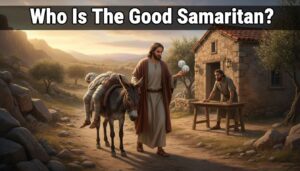
Before we spiritualize anything, we have to let Jesus’ story hit us in the face. A man gets attacked and left wounded. Two respected religious figures pass by. A Samaritan, viewed by many Jews as a religious outsider, becomes the hero.
A man lies beaten on the road, and that man is Adam, meaning “man,” so he’s all of us after the fall. Two respected religious figures pass by, and they keep walking because law can spot sin but can’t heal it. Meanwhile, the Good Samaritan shows up, and everyone expects the outsider to fail. Yet the Good Samaritan moves toward blood and dust, because that’s what Jesus does.
The Good Samaritan is Jesus in disguise, not hiding His mercy, but showing it where we least expect. In this reading, the robbers aren’t only bad people, they picture demonic forces and the raw human pull toward evil that leaves us half-dead. So the wounded man doesn’t just need advice, he needs rescue, because he can’t walk himself home.
Then, the Good Samaritan lifts him up, which is grace, not a self-help plan. Also, the Good Samaritan spends His own oil and wine, like healing poured out at personal cost. When you see The Good Samaritan refuse to pass by, don’t you hear Jesus saying, “I came for you,” even when you couldn’t love your neighbor at all?
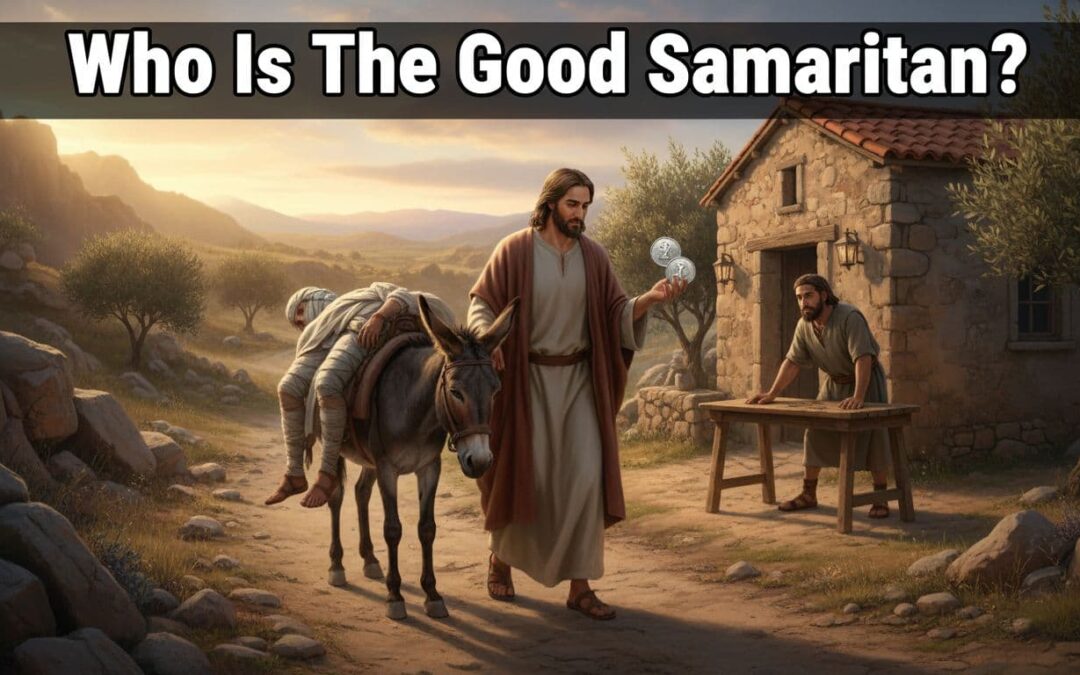
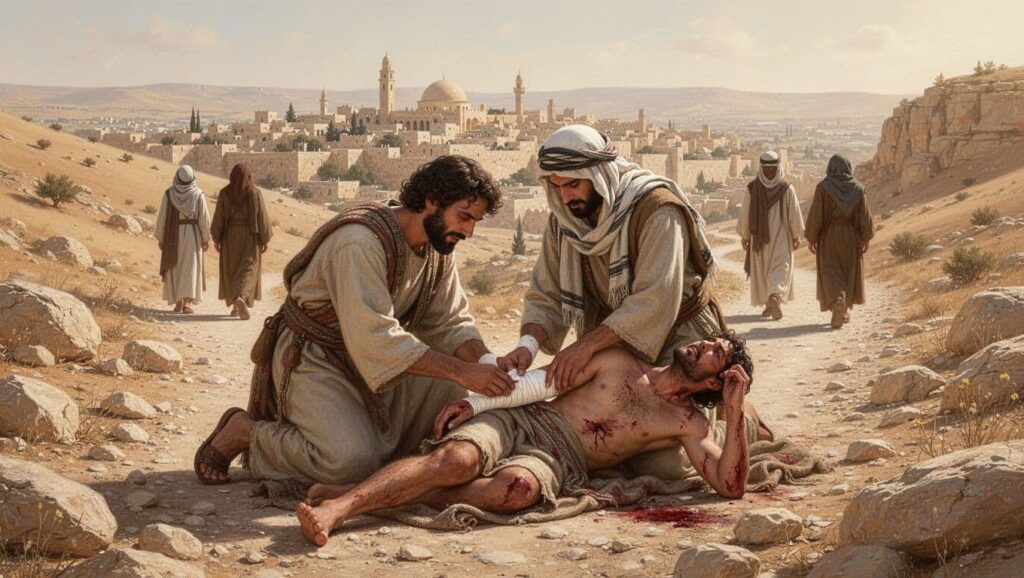
In Luke 10, the Good Samaritan finds a broken man and doesn’t walk past him. Instead, the Good Samaritan pours on oil and wine, then binds up the wounds (Luke 10:34). That oil, often called shemen in the Old Testament, shows up with anointing, healing, and the Holy Spirit’s set-apart work. So when the Good Samaritan uses oil, we hear a picture of Jesus tending the raw places by the power of the Holy Spirit, not just covering them, but restoring what sin has torn.
The Good Samaritan uses wine, and wine (yayin) in Scripture can signal joy and covenant, yet it also stings when it hits an open cut. In other words, Jesus heals with mercy that comforts, and with truth that burns, because real cleansing hurts before it helps. Then the Good Samaritan lifts the man onto His own animal, and that’s what Jesus does, He carries what we can’t carry.
The Good Samaritan brings him to an inn and pays the cost, which points to Jesus giving His own life, and He doesn’t send a bill later. Meanwhile, the Holy Spirit keeps applying what Jesus has provided, like oil that softens scars and keeps infection from returning. So when we read the Good Samaritan, don’t just see a lesson about kindness, see Jesus coming close, pouring in grace, and staying committed until healing becomes whole.
When we read the Good Samaritan, we can see the priest as a picture of Moses and the Law he carried. In the Good Samaritan, the priest comes first, and that order matters because Moses came before grace. Moses gave Torah (God’s instruction), and Torah is holy, but it doesn’t have hands to heal. So in the Good Samaritan, the priest sees the wounded man, yet he passes by, and we feel the ache of that.
The Law can spot the wreck, name the sin, and warn us like a bright sign, but it can’t pick us up. It’s like touching an exposed wire, the shock tells us something’s wrong, but it can’t make us whole. The Good Samaritan keeps showing us that the Law can’t rescue us from the ditch, even when it tells us why we fell.
When we read the Good Samaritan, we see a priest spot a bleeding man and choose the other side. The Good Samaritan doesn’t spell out his motive, yet the law around ritual purity helps us understand why he’d hesitate. Under Torah rules, contact with blood or a body could make someone tamei (unclean), the opposite of tahor (clean), and that status blocked worship until washing and waiting (see Leviticus 15, Numbers 19).
Since the Good Samaritan parable places the victim “half-dead” in the road, the priest could’ve feared that one touch might count as corpse impurity, which was a serious issue for priests with temple duties (see Leviticus 21). So, in the Good Samaritan, passing by can look like a cold choice, but it can also look like a man doing the math of religious risk. If he stopped and the man died in his arms, then in the Good Samaritan that single act could’ve made him unclean for days, infringing on his religious duties.
Besides, in the Good Samaritan, the road itself was dangerous, so fear and purity rules could mix into one excuse. Still, the Good Samaritan presses on a hard point, purity law was never meant to cancel mercy, and “love your neighbor” doesn’t come with a loophole. That’s why the Good Samaritan hits us so personally, we recognize how easy it is to hide behind “I can’t” when we really mean “I won’t.” In the end, the Good Samaritan doesn’t mock the law, it exposes a heart that protects religious comfort while a neighbor bleeds.
In the Good Samaritan, the priest protects purity rules, and that mirrors how the Law guards God’s holiness. Yet the Good Samaritan pushes us to admit a hard truth, Moses can diagnose, but only Jesus can save. As a result, the Good Samaritan teaches us to stop trusting our rule-keeping to fix our sin, and to run to the mercy of Jesus that actually binds wounds.
We also meet the Levite as a religious worker, a temple helper from the tribe of Levi. Like the priest before him in the Good Samaritan, he sees the wounded man and chooses distance. We can’t miss how the Good Samaritan sets that choice in the open road, where robbers could still be nearby.
Because Levites often handled sacred duties, he may have feared ritual impurity if the man was dead (see Leviticus 21), and that fear can make people freeze. Still, the Good Samaritan doesn’t let us hide behind technical rules when a neighbor bleeds in front of us. Also, the Levite may have worried about time, reputation, or losing his place in the routine of worship. In other words, he treats mercy like a risk to manage, not a command to obey, and the Good Samaritan exposes that hard truth.
Click Our Ad to Support Us!
Meanwhile, the Good Samaritan puts compassion on legs, then shows us that love gets practical fast. When we read the Good Samaritan closely, we feel the sting, because passing by “on the other side” is what our excuses look like in motion. So the Levite in the Good Samaritan becomes a mirror for us, warning that clean hands can still come with a closed heart.
Our choice to not help those in need by hiding behind excuses that seem legitimate is the sting. Jesus makes the “wrong kind” of person to the religious elite, Himself, the example of neighborly love. If we’re honest, can we feel the discomfort? That discomfort is part of the teaching.
Why Jerusalem to Jericho is the perfect setting for a story about real-world mercy
This road drops fast in elevation and cuts through rough terrain. It’s the kind of place where you can’t pretend you didn’t see the wounded. If you stop, you risk your schedule and your safety. If you keep going, you keep your comfort and could lose your soul.
Jericho in Jesus’ day sat low in the Jordan Valley, warm and green like an oasis after the hills. We picture date palms, spring water, and busy roads, plus Herod’s winter palaces nearby and plenty of money moving through town. That mix drew tax collectors, like Zacchaeus, and it also drew the kind of trouble the Good Samaritan walked into.
The Bible says Satan showed Jesus “all the kingdoms of the world” from a very high place (Matthew 4:8), yet it doesn’t name Jericho. Still, when we stand near Jericho and look up at the stark cliffs, we understand why people later pointed to the Mount of Temptation (Jebel Quruntul) as the setting. In other words, Jericho becomes a vivid backdrop for the same spiritual pressure, the promise of easy power without the cross.
Meanwhile, the Good Samaritan story fits this geography because the Jerusalem-to-Jericho road drops fast, twists through rocks, and gave bandits cover. So someone would have walked from Jerusalem to Jericho for work, trade, or travel toward the Jordan crossings, and also because Jericho was a gateway to the wider region.
Besides, priests and Levites often made that trip after temple service, which is why Jesus cast them into the Good Samaritan scene. When we read the Good Samaritan, we’re not just hearing a moral lesson, we’re seeing a real road, a real drop in elevation, and a real choice about mercy.
The true meaning of the Inn, the denarii, and point of the Innkeeper
When we read Luke 10:34, we can’t miss how the Good Samaritan moves first toward blood and bruises, not away. The Good Samaritan binds the wounds, and we hear an echo of Isaiah 53:5, by His stripes we’re healed, because Jesus took our blows.
Then the Good Samaritan pours on oil and wine, and we can picture mercy that cleans, soothes, and covers what sin tore open. That’s also where the Messiah’s promises line up, Isaiah 35 shows healing for the blind, deaf, and lame, and Isaiah 61:1 speaks of good news to the poor and freedom for captives. Long before the cross, those prophecies trained Israel to expect a Healer-King who’d touch lepers, lift burdens, and break chains.
So when Jesus tells us about the Good Samaritan, we’re not just getting a morals lesson, we’re seeing His own mission in story form. After all, the Good Samaritan lifts the man onto His own animal, and that feels like substitution, Jesus carrying what we can’t carry. Next, the Good Samaritan brings him to an inn, and we can’t help seeing the New Testament church as a place of recovery, not a trophy room for the strong.
In addition, the Good Samaritan pays the cost and promises to return, and that fits the One who ransoms us and will come again. Finally, if the inn is the church, then we’ve got marching orders, remember the poor (Galatians 2:10), practice pure religion by caring for the vulnerable (James 1:27), and treat the needy like we’re serving Jesus Himself (Matthew 25:35-40), because that’s how the Good Samaritan still tends wounds through His people.
When we track the denarius in the New Testament, we keep seeing it tied to real work and real cost. In Jesus’ vineyard story, a denarius is the agreed pay for one full day (Matthew 20:2), so we’re not guessing what it meant in ordinary life.
Next, the denarius shows up when Jesus asks for the coin used for the tax, the one stamped with Caesar’s image (Matthew 22:19, Mark 12:15, Luke 20:24), which reminds us money can carry an owner’s mark, while we carry God’s.
We also hear denarii in everyday math, like Philip saying 200 denarii wouldn’t buy enough bread (John 6:7), and in the outrage over perfume valued at about 300 denarii (Mark 14:5), which frames what people call waste versus what Jesus calls worship.
Then Revelation pictures scarcity, where a day’s ration costs a denarius (Revelation 6:6), so that same coin becomes a picture of pressure and survival.
Against that backdrop, the Good Samaritan feels even more personal, because the Good Samaritan doesn’t offer kind words only, the Good Samaritan pays (Luke 10:35). The Good Samaritan leaves two denarii, which lands as two days’ wages if we keep the vineyard rate in mind, and the Good Samaritan also promises to return and settle the rest.
Many of us read the Good Samaritan as a portrait of Jesus, and we also read the inn as a picture of the New Testament church, the place where the wounded get care while the road stays dangerous. In that same line of thought, we often see the innkeeper as a picture of the Holy Spirit, appointed to tend Christ’s people until the Good Samaritan returns for what’s His.
Then some of us connect Peter’s “one day is like a thousand years” (2 Peter 3:8) with the Good Samaritan’s “when I return,” so the Good Samaritan’s two denarii start to echo a rough two-thousand-year window. Still, we hold that humbly, because Jesus didn’t give us a date chart, yet the Good Samaritan’s promise keeps our hope anchored as we wait for His return and the gathering of His church.
A classic early Christian reading, the “certain man” as Adam, Jerusalem as God’s presence, Jericho as demonic pull
When we hear Jesus in Luke 10:30 call the victim of robbers a “certain man” (tis anthrōpos), we see Adam in that phrase, humanity in its first father. From the start, Adam stands for all of us, because we fell in him and we still feel it. So the road from Jerusalem to Jericho starts to look like our own story, a move from life with God into danger.
Jerusalem pictures God’s presence, worship, and blessing, the place where our hearts were meant to stay warm and awake. Jericho sits low, and Scripture often ties it to conflict and curse themes, so it can picture that downward pull toward sin, bondage, and dark power. In that drop, we don’t just get scratched up, we end up bloody and bruised, like a body after a hard beating.
That’s why we need the Good Samaritan and not a religious helper who only nods at our pain. The Good Samaritan is Jesus, the Second Adam, and the Good Samaritan comes close when others keep their distance. Then the Good Samaritan heals what Adam’s fall broke, not with cold advice but with mercy that touches wounds. If we’re honest, don’t we know that Jericho-road drift, and aren’t we grateful the Good Samaritan still walks it toward us?
Adam as the “certain man,” half-dead means spiritually wounded by sin
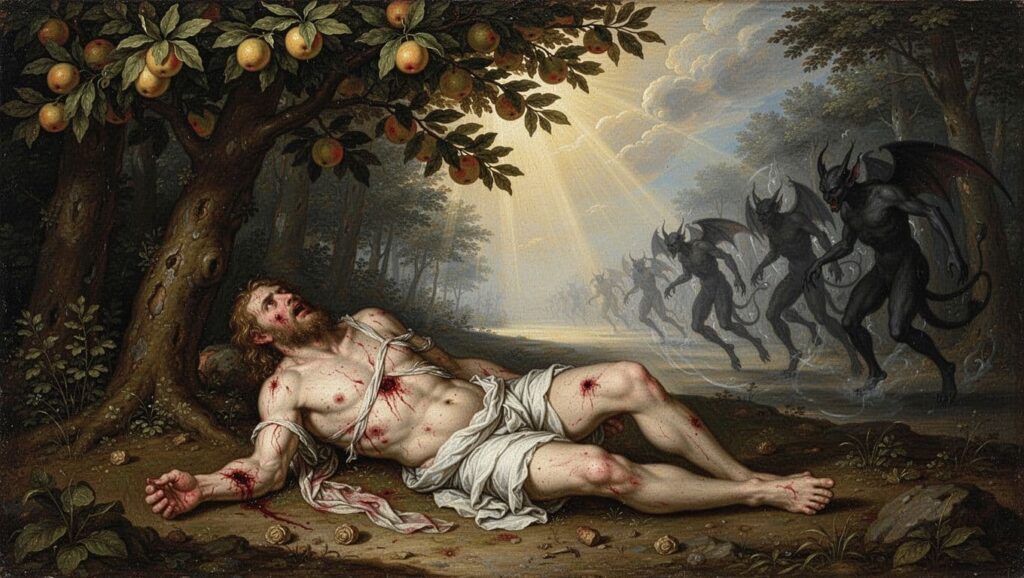
Luke says the man was left “half dead” (Luke 10:30). Symbolically, that fits Genesis. After the tree, Adam still breathes, still walks, still works the ground. Yet something inside is dead. Fellowship with God breaks. Shame enters. Fear rises. He can’t stitch his spirit back together with fig leaves.
That “half-dead” picture also exposes our pride. We’re wounded enough to die, but alive enough to pretend we’re fine. We can still talk religion while bleeding out inside.
The robbers as demonic powers, and the echo of Jesus between robbers at the cross
The robbers picture demonic powers that strip, wound, and leave humanity helpless. Darkness doesn’t just tempt. It also drains, isolates, and abandons.
That’s why many of us can’t read this without hearing an echo of Calvary. Jesus also hangs between two robbers (Luke 23:32-33). Evil crowds in close. Human sin reaches its loudest moment. Demonic hatred also shows its teeth. Yet Jesus isn’t the half-dead victim who can’t rise. He’s the Savior who enters the ditch on purpose, our God who left His throne in Heaven and came to earth to sacrifice Himself on our road to Jericho so He could put us on His own shoulders and carry us back to Jerusalem.
Those robbers didn’t get to the cross in a vacuum. Sin traps people through choices, wounds, and influences that snowball. That’s close to Adam too. One “small” bite turns into exile. Still, there’s a difference: at the cross, a Savior is present. One criminal turns and asks to be remembered (Luke 23:42-43). Mercy reaches even there.
So when we say “Jericho is demonic presence” in this reading, we mean this: the path away from God has company. If we want language for that battle, we can reflect on breaking free from demonic oppression, while keeping our feet planted in Jesus’ authority, not in fear.
Go and do likewise
When Jesus tells us in Luke 10:37, “Go and do likewise,” we hear the Good Samaritan calling us into His kind of mercy. In the story, the robber isn’t just a bad guy on a road, sin is that robber, because sin jumps us, strips us, and leaves us half-dead inside. We know that feeling, shame hits hard, fear follows, and our willpower can’t stitch us up. Then the Good Samaritan comes close, and He doesn’t step over us like religion without love.
First, the Good Samaritan pours in oil and wine, and we’ve learned to see that as the Holy Spirit’s healing work, soothing, cleansing, and setting things right at the wound level. Next, the Good Samaritan lifts us onto His own animal, which sounds like grace, because He carries what we can’t carry. After that, the Good Samaritan brings us to the inn, and we can picture the church as that inn, a real place where battered people recover.
Meanwhile, the Good Samaritan hands us to the innkeeper, and we can think of the innkeeper as the Holy Spirit staying with us, tending us through Scripture, confession, prayer, and steady care. So when the Good Samaritan says, “Go and do likewise,” we don’t hear a guilt-trip, we hear a Spirit-filled way of life inside the inn, where we treat sin like the robber it is and refuse to leave our neighbor bleeding and covered in sin. Above all, the Good Samaritan shows us why Jesus came, to save His people from their sins, and He does it by the power of the Holy Spirit who heals what sin tried to destroy.
The Good Samaritan teaches two truths at once. First, Jesus commands us to show mercy to the hurting person near us, even when they’re different from us. Second, the story can also reflect our own condition: we’re the wounded ones, and Christ is the rescuer who comes close.
So we can ask two questions without flinching. Who have we been passing by, because stopping would cost us? Where are we still half-dead, needing Jesus to heal what we can’t fix?
Let’s hear Jesus’ final command in our own words: go, show mercy, and live like people who have been rescued.
Related Posts
God Works All Things for Good: The Heart of God in Us Romans 8:28 Romans 8:28 is a deep promise, not a shallow slogan. In the original Greek, in its real context, Paul is talking about the heart of God, the Holy Spirit inside us, and how God is forming us into true sons and daughters who see the world like Jesus. This is where God works all things for good becomes more than…
Keep the Faith: Heaven's Currency Explained Hebrews 11 Many of us say “just keep the faith” when life feels heavy. We quote Ephesians 2:8‑9, but we do not always slow down and ask what faith really is in the Bible. Scripture paints faith as the “currency of Heaven.” Not money, but the God-given way we receive, spend, and share the very life of God. In this picture, faith…
What is Blaspheming the Holy Spirit? Will God Truly Forgive Me? Isaiah 5:20 When the Bible talks about blaspheming the Holy Spirit, there's a unique weight behind those words. It's more than just a warning, it's a boundary God doesn't take lightly. People often imagine it's just a theological puzzle for scholars or preachers, but the truth sits much closer to the heart. If we want to grasp why blaspheming the Holy Spirit…
The Good Samaritan Explained, Our Gospel Mirror Luke 10
The Good SamaritanMost of us know the Good Samaritan as a simple moral story. Help the person in front of us. Don’t pass by. That’s true, and Jesus meantRead more...
What Changes in Us to Become a Born Again Christian – John 3:3
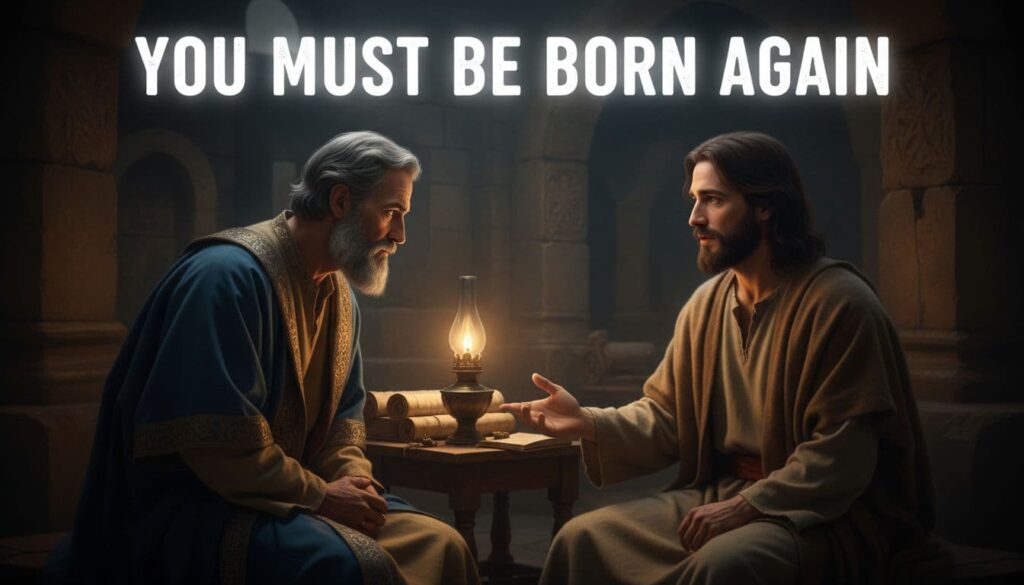
Born Again ChristianWe’re going to walk through the “from above” new birth, the Holy Spirit’s work, Adam’s first calling and choice, what sin really is (in plain Bible terms), why spiritual truth stays hidden to the natural mind, and how salvation (new birth) relates to Holy Spirit baptismRead more...
Why Was Jesus Baptized? We Explain His Anointing – Matthew 3:15
BaptismIf Jesus had no sin, why was Jesus baptized at all? That question isn’t just a kid’s Sunday school question. It’s a doorway into how Israel thought about kings, priests, prophets, and the moment God publicly “marked” someone for aRead more...
Popular
Seven Spirits of God Explained: Trinity Insights for Your Faith Journey – Isaiah 11:2
The Seven Spirits of God stand as one of the most profound and often misunderstood truths in Christian theology. Rooted deeply in Scripture, they aren’t seven separate entities but rather seven attributes of the one Holy Spirit—God revealing Himself in fullness. Isaiah 11:2 describes these [...]Read more...
The 9 Gifts of the Holy Spirit: Biblical Truths, Historical Evidence, and Today
The gifts of the Holy Spirit reveal the active power of God working in the lives of His people. They aren’t just distant historical records or fading Biblical accounts; they’re living because the Holy Spirit, He is living and He is God, and His transformative gifts are reaching people [...]Read more...
Tongues of Fire in Acts 2:3: Meaning, Biblical Significance and Holy Spirit Power
The phrase “tongues of fire” in Acts 2:3 sparks worldwide curiosity and spiritual wonder. It appears in Scripture to describe the Holy Spirit’s descent during Pentecost, when visible flames rested on the apostles, marking the time when God’s Spirit descended on earth, [...]Read more...
The Antichrist
The Apostate Church
The Rapture
Angels
Book of Daniel
Giants
Judgment
Prophecy
The Apostles
Bible Prophecy
Beware of Deception
Sin
Antichrists
Demon Possession
Healing
Millennial Reign
Redemption
The Gospels
The Holy Spirit
American Prophecy
Israel
Armageddon
Forgiveness
Intercession
Prayer
Revival
The Old Testament
The Tribulation
Faith
Kingdom Of God
Bible Interpretation
Free Will
Book Of Jude
Pride
The Afterlife
The Red Dragon
We use cookies so you can have a great experience on our website. View more
Cookies settings
Accept
Decline
Privacy & Cookie policy
Privacy & Cookies policy
Cookies list
Cookie name
Active
Who we are
Our website address is: https://theholyspirit.us.
Comments
When visitors leave comments on the site we collect the data shown in the comments form, and also the visitor’s IP address and browser user agent string to help spam detection.
An anonymized string created from your email address (also called a hash) may be provided to the Gravatar service to see if you are using it. The Gravatar service privacy policy is available here: https://automattic.com/privacy/. After approval of your comment, your profile picture is visible to the public in the context of your comment.
Media
If you upload images to the website, you should avoid uploading images with embedded location data (EXIF GPS) included. Visitors to the website can download and extract any location data from images on the website.
Cookies
If you leave a comment on our site you may opt-in to saving your name, email address and website in cookies. These are for your convenience so that you do not have to fill in your details again when you leave another comment. These cookies will last for one year.
If you visit our login page, we will set a temporary cookie to determine if your browser accepts cookies. This cookie contains no personal data and is discarded when you close your browser.
When you log in, we will also set up several cookies to save your login information and your screen display choices. Login cookies last for two days, and screen options cookies last for a year. If you select "Remember Me", your login will persist for two weeks. If you log out of your account, the login cookies will be removed.
If you edit or publish an article, an additional cookie will be saved in your browser. This cookie includes no personal data and simply indicates the post ID of the article you just edited. It expires after 1 day.
Embedded content from other websites
Articles on this site may include embedded content (e.g. videos, images, articles, etc.). Embedded content from other websites behaves in the exact same way as if the visitor has visited the other website.
These websites may collect data about you, use cookies, embed additional third-party tracking, and monitor your interaction with that embedded content, including tracking your interaction with the embedded content if you have an account and are logged in to that website.
Who we share your data with
If you request a password reset, your IP address will be included in the reset email.
How long we retain your data
If you leave a comment, the comment and its metadata are retained indefinitely. This is so we can recognize and approve any follow-up comments automatically instead of holding them in a moderation queue.
For users that register on our website (if any), we also store the personal information they provide in their user profile. All users can see, edit, or delete their personal information at any time (except they cannot change their username). Website administrators can also see and edit that information.
What rights you have over your data
If you have an account on this site, or have left comments, you can request to receive an exported file of the personal data we hold about you, including any data you have provided to us. You can also request that we erase any personal data we hold about you. This does not include any data we are obliged to keep for administrative, legal, or security purposes.
Where your data is sent
Visitor comments may be checked through an automated spam detection service.