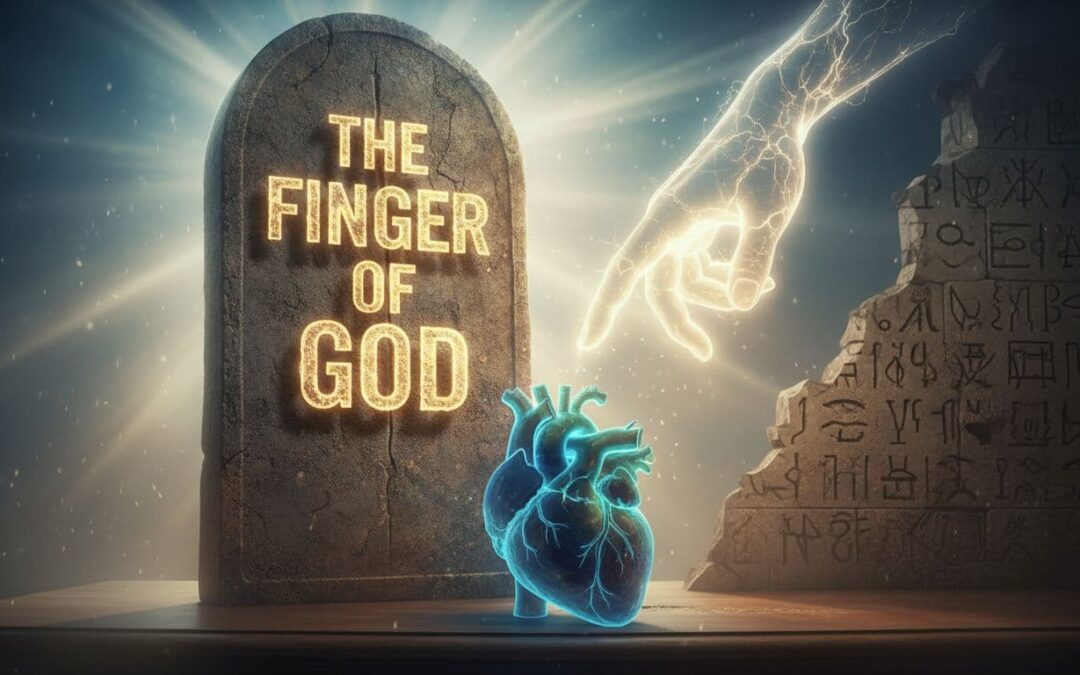
From Stone to Flesh: How God Turns Cold Religion Into Living Relationship
What if the real problem is not that God’s commands are too hard, but that something inside us is too hard?
The Bible talks about a heart of stone and a heart of flesh. It sounds poetic, but it is actually very concrete. It reaches into how you think, what you love, and why you keep doing what you hate.
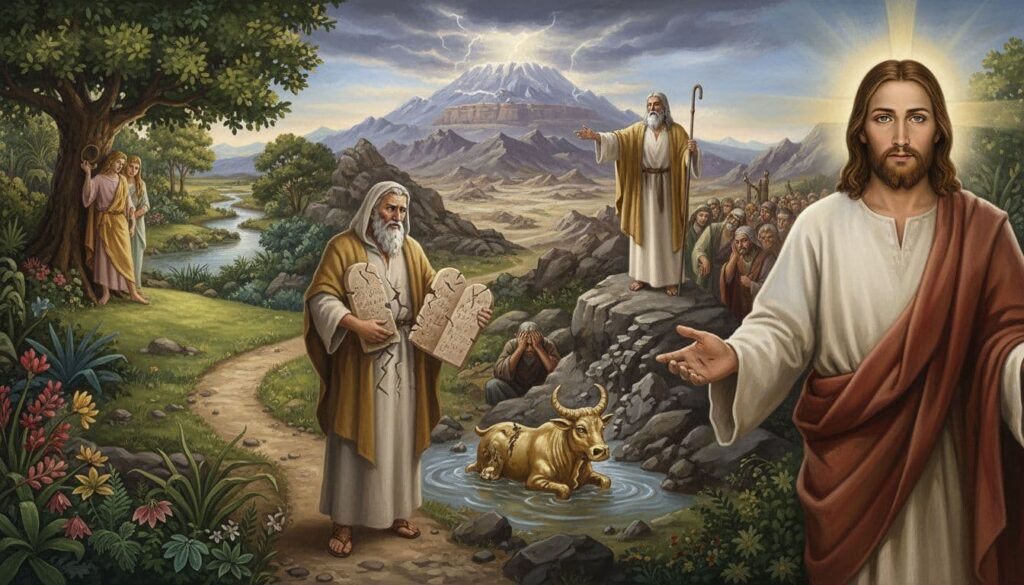
In this article we will walk from the garden of Eden to Mount Sinai, stand beside Moses with the broken tablets, watch the golden calf crumble into water, listen to the promise of a prophet like Moses, and then look straight at Jesus. The goal is simple: to see how God takes a heart of stone and gives a heart of flesh, not just as a doctrine, but as a living reality.
In the Original Language: What Is a Heart of Stone and a Heart of Flesh?
In Hebrew, the word for heart is lev. The phrase heart of stone is lev even. The phrase heart of flesh is lev basar.
These are not fancy religious words. They are simple and earthy.
In Ezekiel 11:19 and 36:26, God says He will remove the lev even and give a lev basar. That is, He will take away a hard, frozen, stubborn inside and give a soft, living, responsive inside.
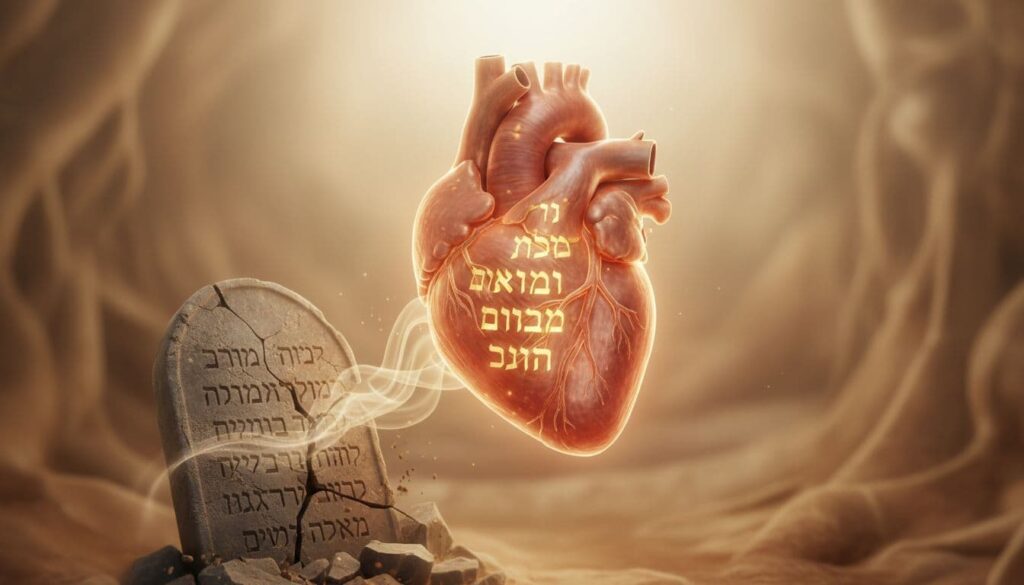
This picture stretches across the whole Bible. The law on stone tablets meets a people with a heart of stone. The result is friction, shame, and distance. Then God promises a new work where the same holy will of God is written on a heart of flesh, where obedience becomes desire, not just pressure.
If you have ever felt trapped in cold religion, this is your story.
The Hebrew Idea of the Heart: More Than Just Feelings
When we say “heart” in English, we often mean feelings. “I feel it in my heart.” In Hebrew, lev is more like the control center.
Your lev is:
Your thoughts
Your choices
Your emotions
Your plans and motives
So when Scripture talks about a heart of stone, it is not just saying, “You feel cold.” It is saying, “Your whole inner life is locked up.” When it talks about a heart of flesh, it is not only, “You feel warm,” but, “Your thinking, your wanting, your deciding now bend toward God.”
That means God is not only after your tears. He is after your mind, your habits, your secret desires, your plans for tomorrow.
Heart of Stone: What Spiritual Hardness Looks Like
So what exactly is a heart of stone?
In simple terms, it is a heart that:
Refuses to listen to God
Resists correction
Loves sin and clings to it
Treats God’s commands as heavy and unfair
Ezekiel 36:26 puts it this way, in plain language: God will take away the heart of stone from our flesh. Picture a rock in someone’s chest where a beating heart should be. You can talk to a rock all day. It does not answer. It does not care. It does not change.
The key thing is this: the problem is not God’s law. The problem is the heart of stone that hears that law and says, “No.” Even when the mind agrees that the law is good, the inner person shrugs, delays, or rebels.
If you have ever read a command of Jesus and thought, “That is right,” then walked away unchanged, you have seen the heart of stone at work.
Heart of Flesh: How God Gives a Soft and Teachable Heart
A heart of flesh, a lev basar, is the opposite. It is tender, alive, and responsive.
A heart of flesh:
Feels conviction when it sins
Can repent instead of making excuses
Actually wants to obey, even when it struggles
Learns to trust that God’s commands are good
In Ezekiel 36:26–27, God not only promises a heart of flesh. He also says, “I will put My Spirit within you and cause you to walk in My statutes.” The change is not just from rock to meat. It is from cold independence to Spirit-filled dependence.
So a true heart of flesh is a Spirit-shaped heart. The same law that once felt like a hammer on stone now becomes the natural desire of that new heart.
From Adam to Sinai: Why God Waited to Write the Law on Stone
There is a long stretch between Adam in Eden and Moses on Mount Sinai. In that time, God speaks, humans sin, and the story keeps breaking.
This gap is not an accident. It tells us something about the heart of stone and about the Ten Commandments written on stone tablets.
God could have given the Ten Commandments to Adam on day one, but He did not. Instead, He started with one simple command, then waited centuries before writing His law on stone. During that time, the human heart of stone kept showing up, again and again.
One Command to Adam: The First Test of the Human Heart
In Genesis 2:16–17, God gives Adam one clear command: eat from every tree except one. That is it. Not ten commands. One.
That command was not about magic fruit. It was about trust. Would Adam trust God’s wisdom over his own? Would his lev say, “Father knows best,” or “I decide what is good”?
When Adam and Eve eat, they are not just breaking a rule. Their inner heart steps out from under God. The heart of stone appears here in seed form. The human will turns inward. That choice sets the pattern for every human after them.
From that point on, people need clearer words, stronger warnings, and deeper rescue.
Why God Waited Centuries Before Giving the Ten Commandments
So why wait so long to give the law on stone?
God lets sin grow in history so that we can see how serious it is. Before there is a written law, there is violence, idolatry, pride, and deep corruption. By the time God calls Abraham, then forms Israel, the disease of the heart of stone is clear.
The apostle Paul explains that the law was later “added because of transgressions” (see Galatians 3). In Romans he says that the law makes sin known and even stirs it up inside us. The law shines a bright light on the heart of stone, but it does not cure it.
So God waits until there is a whole nation, rescued from Egypt, standing at Sinai. Then He gives the Ten Commandments, not to fix them from the inside, but to:
Expose how deep the heart of stone goes
Set Israel apart as His covenant people
Prepare the world for a Savior who can change the heart itself
The Ten Commandments as Law on Stone and the Picture of a Stone Heart
When God writes the Ten Commandments on stone tablets in Exodus 20 and 31, it is a powerful picture.
The law is:
Holy
Just
Good
But it stands outside the people, carved into rock. The people still carry a heart of stone inside. So we end up with stone outside, stone inside, and breaking in between.
In that sense, you can say the heart of stone shows itself in the way Israel relates to the Ten Commandments. The law on stone is perfect, but the people are not. The stone tablets become a mirror that reveals what the heart of stone really is: a stubborn refusal to love God and neighbor from the inside out.
Over time, this sets the stage for a greater promise, where God will not just give stone tablets again, but write His law into a heart of flesh.
For a rich look at how the Ten Commandments connect to Pentecost and the giving of the Spirit, you might enjoy this article on Pentecost and the Ten Commandments origin.
Moses, the Golden Calf, and Broken Tablets: How God Deals With a Heart of Stone
The history of the golden calf in Exodus 32 is one of the clearest pictures of the heart of stone in the entire Old Testament.
God is speaking with Moses on the mountain. The people below grow impatient. They ask Aaron for a god they can see. He gathers their gold, shapes a calf, and they bow down to it.
Right as God gives the law on stone, the heart of stone is dancing around an idol.
Why Moses Broke the Stone Tablets and Why His Anger Was Righteous
When Moses comes down and sees the calf and the wild worship, he burns with anger. He throws the tablets and breaks them at the foot of the mountain.
This is not a temper tantrum. It is righteous anger. The people have broken the covenant almost as soon as it began. The breaking of the tablets shows, in physical form, what their heart of stone has already done spiritually. They have shattered the agreement.
Selfish anger is about your pride being hurt. Righteous anger is about God’s honor and the good of others. Moses is jealous for God’s glory and for Israel’s future. His anger is sharing God’s own grief over a people with a heart of stone.
God Gives the Commandments Again: A Picture of Mercy and a Second Chance
The story could have ended right there. God could have wiped them out. Instead, in Exodus 34, He calls Moses back up the mountain and writes the commandments again.
This is stunning mercy.
God reveals His name as “merciful and gracious, slow to anger, abounding in steadfast love.” He gives the law on stone again to a people with a heart of stone, but He does it while proclaiming His compassion.
The second set of tablets hints at something deeper. If God is willing to renew a broken covenant, maybe He is also willing to one day fix the kind of heart that keeps breaking it.
The repetition of the stone law points forward to the day when God will move from cold stone to warm flesh. You can see that link when you read about Moses’ 40‑day fast and the Ten Commandments along with Jesus’ own ministry in the Spirit.
The Golden Calf in the Water: How Sin Is Exposed and Judgment Falls
Moses does something strange with the golden calf. He burns it, grinds it to powder, scatters it on the water, and makes the people drink it.
Why?
This act forces the idol into their own bodies. The hidden sin becomes personal and inescapable. You cannot pretend the calf is “just a symbol” when you are swallowing the bitter dust of your own god.
In some ways this is like a trial by ordeal. It is also a picture of how God brings sin into the light. The heart of stone loves to stay hidden. God loves to expose what is false so He can heal what is broken.
At the same time, this points toward Christ. We drink the consequences of our idols. Jesus drinks the cup of judgment for us. Where Israel drank the dust of their false god, Jesus later drinks the full cup of our guilt so that we can receive a heart of flesh instead of a heart of stone.
Likewise He also took the cup after supper, saying, “This cup is the new covenant in My blood, which is shed for you. Luke 22:20
The Prophet Like Moses: How Jesus Fulfills the Heart of Stone Prophecy
God did not only promise new hearts in Ezekiel and Jeremiah. Long before, in the days of Moses, He promised a Prophet who would be like Moses, but greater, and that Prophet is Jesus.
That promise and the heart of stone promise belong together. Moses brings the law on stone. The coming Prophet will bring a Word that will reach the heart and He will write the law on our hearts instead of on stone.
Deuteronomy 18: A Prophet Like Moses Who Speaks God’s Very Words
In Deuteronomy 18:15–18, God tells Israel, “I will raise up for them a prophet like you from among their brothers. I will put My words in his mouth.”
This prophet will:
Come from Israel
Speak God’s very words
Demand that people listen
Moses is a mediator, a lawgiver, a miracle worker, and a covenant leader. The coming Prophet will stand in that same line, but with a fuller authority.
In Acts 3 and 7, the apostles clearly identify this Prophet as Jesus. They say that God has raised up the Promised One and that refusing Him is more serious than refusing Moses.
If the people ignored Moses and kept their heart of stone, how much worse to ignore the One who can actually give them a heart of flesh, aka a born again spirit?
When Scripture talks about God giving a heart of flesh, it is talking about a born again spirit, not a better personality or a softer mood. In Ezekiel 36:26, God says He will remove the heart of stone and give a heart of flesh, and that picture is about moving a person from spiritual death to spiritual life.
A heart of stone is cold, unresponsive, and stubborn toward God, like a person who can hear the Bible all day and still feel nothing inside. A heart of flesh, in contrast, is living, tender, and responsive, so it can actually feel conviction, love, and joy in God, which is exactly what happens when the Holy Spirit makes someone new on the inside. Jesus called this new inner life being “born again” in John 3, and He tied it to the work of the Holy Spirit, not to human effort, tradition, or good behavior.
The “flesh” in “heart of flesh” is not sinful flesh, it is living substance, a real, soft, God-sensitive core, the kind of inner life that wants to repent, wants to trust, and wants to obey from the heart. That is why Paul can say in 2 Corinthians 5:17 that anyone in Christ is a new creation, because God has not just cleaned up their old heart, He has given them a new spirit that can actually respond to Him.
The born again spirit is that new heart, joined to Christ, that can cry “Abba, Father” and actually mean it, not just repeat church words out of habit. When your spirit is born again, you start to love what God loves and hate what destroys you, even if you still fight old habits in your soul and body, which shows the change runs deeper than willpower. So when you read “heart of flesh,” you can think, “This is God’s promise to take my dead, locked-up inner life and replace it with a living, responsive spirit that belongs to Him.”
From Stone Tablets to Hearts Written by the Spirit
The prophets pick up this hope. In Jeremiah 31, God promises a new covenant. There, He says He will write His law on the hearts of His people, not on stone alone.
Ezekiel 36 ties this to the removal of the heart of stone and the giving of the Holy Spirit. The New Testament connects these promises straight to Jesus.
Hebrews 8 says that Jesus is the mediator of this better covenant. 2 Corinthians 3 contrasts the old ministry of letters engraved on stone, which brings condemnation, with the ministry of the Spirit, which gives life. The law on stone exposes the heart of stone. The Holy Spirit writes God’s will on a heart of flesh.
Jesus takes the old story, from Adam to Sinai to the golden calf, and brings it to its true end. He dies for the guilt written by the law, rises to give new life, and pours out the Holy Spirit at Pentecost so the law can be written inside His people.
How Jesus Proves He Fulfilled the Heart of Stone Prophecy
How do we know Jesus really fulfills the heart of stone prophecy?
A few clear signs:
His teaching: Jesus speaks with authority beyond Moses. “You have heard it said… but I say to you.” He does not cancel the law. He goes to the root of it, into the heart.
His forgiveness: Jesus forgives sins directly, something only God can do. That strikes at the shame that keeps the heart of stone locked in place.
His new command: He gives a “new commandment,” to love one another as He has loved us. That is law written in living relationship.
His gift of the Spirit: At Pentecost, He sends the Holy Spirit. People who once had a heart of stone toward Him now preach, repent, and share their lives.
Changed people: Look at Peter, who denied Jesus three times, then stood up in Acts 2 to preach boldly. The same man, but not the same heart.
In story after story, people with a heart of stone meet Jesus and leave with a heart of flesh. Tax collectors leave their greed. Pharisees like Paul end up loving the very church they tried to destroy. The law they once used as a weapon becomes, by the Spirit, a path of love.
You can trace these changes while reading passages like Exodus 34:28 on BibleHub and then seeing how Jesus’ forty days, His cross, and His resurrection echo and surpass Moses.
Jesus does not throw the Ten Commandments away. He fulfills them. Then He writes their truth onto a heart of flesh so that you do not live under stone, you live from the inside out.
Conclusion: Letting God Trade Your Stone for Flesh
We started with a simple contrast: a heart of stone and a heart of flesh. Along the way we watched Adam fail one command, Israel receive ten on stone, Moses break and then receive the tablets again, the golden calf crumble into bitter water, and the promise of a prophet like Moses land in the person of Jesus.
The story is big, but the question is personal. Where do you still feel that heart of stone inside you, that cold resistance to what you know is right?
You can ask God today to search your heart, to forgive your sin through Jesus, and to give you a true heart of flesh by His Spirit. The same God who wrote on stone is ready to write on your heart so He doesn’t have to write on your wall. Let Him turn cold religion into a living, soft, obedient heart, filled with the Holy Spirit and shaped by love.
Related Posts
1 Truth: Blood of Jesus: God's Life in Sinless Flesh What if the very thing running through the veins of Jesus was not just human, but the Blood of Jesus holding the actual life of God Himself, poured out for us? That sounds huge, maybe even hard to take in at first, yet Scripture keeps pulling us back to this one thread: life is in the blood, sin corrupts human…
God Works All Things for Good: The Heart of God in Us Romans 8:28 Romans 8:28 is a deep promise, not a shallow slogan. In the original Greek, in its real context, Paul is talking about the heart of God, the Holy Spirit inside us, and how God is forming us into true sons and daughters who see the world like Jesus. This is where God works all things for good becomes more than…
Reprobate Mind: 5 Warning Signs and Hope for Change The Bible’s take on a reprobate mind isn’t just a warning or a piece of theology. It’s a wake-up call. “Reprobate mind” (from the Greek adokimos, meaning rejected or unapproved) describes what happens when people no longer care about God’s truth—they trade what’s holy for what feels good, grow numb to right and wrong, and God lets go. It’s mentioned…
Bible Prophecy / Bible Study / Devotional / Faith / Heart of Stone / SinPre-Born! gives free ultrasounds to women looking to abort their babies and 86% of those women choose to keep theirRead more...
Who Is the Helper in John 14:16? The Holy Spirit
Bible Study / Holy Spirit Scriptures / Spirit Of Truth / The Upper RoomPre-Born! gives free ultrasounds to women looking to abort their babies and 86% of those women choose to keep theirRead more...
John 14:26 Explained: The Holy Spirit as Teacher
Bible Study / Devotional / Holy Spirit Scriptures / Spirit Of TruthPre-Born! gives free ultrasounds to women looking to abort their babies and 86% of those women choose to keep theirRead more...
Popular
Seven Spirits of God Explained: Trinity Insights for Your Faith Journey – Isaiah 11:2
The Seven Spirits of God stand as one of the most profound and often misunderstood truths in Christian theology. Rooted deeply in Scripture, they aren’t seven separate entities but rather seven attributes of the one Holy Spirit—God revealing Himself in fullness. Isaiah 11:2 describes these [...]Read more...
The 9 Gifts of the Holy Spirit: Biblical Truths, Historical Evidence, and Today
The gifts of the Holy Spirit reveal the active power of God working in the lives of His people. They aren’t just distant historical records or fading Biblical accounts; they’re living because the Holy Spirit, He is living and He is God, and His transformative gifts are reaching people [...]Read more...
Tongues of Fire in Acts 2:3: Meaning, Biblical Significance and Holy Spirit Power
The phrase “tongues of fire” in Acts 2:3 sparks worldwide curiosity and spiritual wonder. It appears in Scripture to describe the Holy Spirit’s descent during Pentecost, when visible flames rested on the apostles, marking the time when God’s Spirit descended on earth, [...]Read more...
The Antichrist
The Apostate Church
The Rapture
Angels
Book of Daniel
Giants
Judgment
Prophecy
The Apostles
Bible Prophecy
Beware of Deception
Sin
Antichrists
Demon Possession
Healing
Millennial Reign
Redemption
The Gospels
The Holy Spirit
American Prophecy
Israel
Armageddon
Forgiveness
Intercession
Prayer
Revival
The Old Testament
The Tribulation
Faith
Kingdom Of God
Bible Interpretation
Free Will
Book Of Jude
Pride
The Afterlife
The Red Dragon
We use cookies so you can have a great experience on our website. View more
Cookies settings
Accept
Decline
Privacy & Cookie policy
Privacy & Cookies policy
Cookies list
Cookie name
Active
Who we are
Our website address is: https://theholyspirit.us.
Comments
When visitors leave comments on the site we collect the data shown in the comments form, and also the visitor’s IP address and browser user agent string to help spam detection.
An anonymized string created from your email address (also called a hash) may be provided to the Gravatar service to see if you are using it. The Gravatar service privacy policy is available here: https://automattic.com/privacy/. After approval of your comment, your profile picture is visible to the public in the context of your comment.
Media
If you upload images to the website, you should avoid uploading images with embedded location data (EXIF GPS) included. Visitors to the website can download and extract any location data from images on the website.
Cookies
If you leave a comment on our site you may opt-in to saving your name, email address and website in cookies. These are for your convenience so that you do not have to fill in your details again when you leave another comment. These cookies will last for one year.
If you visit our login page, we will set a temporary cookie to determine if your browser accepts cookies. This cookie contains no personal data and is discarded when you close your browser.
When you log in, we will also set up several cookies to save your login information and your screen display choices. Login cookies last for two days, and screen options cookies last for a year. If you select "Remember Me", your login will persist for two weeks. If you log out of your account, the login cookies will be removed.
If you edit or publish an article, an additional cookie will be saved in your browser. This cookie includes no personal data and simply indicates the post ID of the article you just edited. It expires after 1 day.
Embedded content from other websites
Articles on this site may include embedded content (e.g. videos, images, articles, etc.). Embedded content from other websites behaves in the exact same way as if the visitor has visited the other website.
These websites may collect data about you, use cookies, embed additional third-party tracking, and monitor your interaction with that embedded content, including tracking your interaction with the embedded content if you have an account and are logged in to that website.
Who we share your data with
If you request a password reset, your IP address will be included in the reset email.
How long we retain your data
If you leave a comment, the comment and its metadata are retained indefinitely. This is so we can recognize and approve any follow-up comments automatically instead of holding them in a moderation queue.
For users that register on our website (if any), we also store the personal information they provide in their user profile. All users can see, edit, or delete their personal information at any time (except they cannot change their username). Website administrators can also see and edit that information.
What rights you have over your data
If you have an account on this site, or have left comments, you can request to receive an exported file of the personal data we hold about you, including any data you have provided to us. You can also request that we erase any personal data we hold about you. This does not include any data we are obliged to keep for administrative, legal, or security purposes.
Where your data is sent
Visitor comments may be checked through an automated spam detection service.