“Now Faith Is the Substance”: Hearing God, Trusting God, Walking With God
We read Hebrews 11:1 all the time, but many of us still wonder what it really means in daily life. What does it mean that faith is “the substance of things hoped for, the evidence of things not seen”? And how is that connected to a real relationship with a real God we cannot see?
In this article we want to slow down, look at the original Greek words, and then follow the history line from Adam and Eve to Abraham. Along the way, we will look at how different Christian traditions treat hearing God’s voice, and why a true relationship with God is more than knowing facts. It is hearing His voice and responding in obedience.
Watch and share our video of this article to help us spread the Word of God. Be kind and subscribe to our YouTube Channel. Thank You!
At the center of all of this is one simple claim: faith begins when God speaks, and it shows itself when we act on what we heard.
Understanding Hebrews 11:1 in the Original Language and Context
What Hebrews 11:1 Actually Says: Word‑by‑Word Breakdown
Pistis (faith). This word means trust, loyalty, confidence in a Person. It is like leaning your full weight on a chair because you know it will hold you. In the Bible, this trust is always toward God, based on what He has said.
Elpizomenon (things hoped for). This is not “I wish this would happen.” It is solid expectation based on God’s promise. Think of a child waiting at the window for a parent they know is coming home.
Hypostasis (substance). This is the hardest word, but also the most beautiful. In ancient Greek law, hypostasis could mean the “title deed” to a property. It was the legal document that proved you owned land you might not be standing on yet. Some scholars walk through this idea in detail in this study on hupostasis as “title deed”.
So we could say: faith is the title deed of what we expect from God.
Pragmaton (things, realities). This points to real things, real situations, not just ideas. The promises of God are about actual realities, even if we cannot see them yet.
Elenchos (evidence, proof). This is a courtroom word. It means proof that convinces, the evidence that shows what is really true. You can see this pattern laid out in the Hebrews 11 Greek interlinear.
Ou blepomenon (things not seen). These are realities that are invisible to our eyes, but not imaginary. They are unseen, not unreal.
Put together, we might say:
Faith is the title deed in our hands to the things God promised, and it is the inner proof of the invisible things He has spoken about.
It is legal, solid, and anchored in God’s Word, not a soft feeling that comes and goes.
First‑Century Jewish‑Christian Context: Why Faith Needed This Definition
The Book of Hebrews was written to Jewish followers of Jesus who were suffering. They were being rejected by family, losing status, even losing property. Some were tempted to slide back into old patterns of religion because that felt safer.
For people like that, “just believe and feel better” was not enough. They needed to know that this faith in Jesus was solid. That it had weight. That it was worth losing everything else for.
Hebrews 10 talks about believers who “joyfully accepted the plundering” of their goods because they knew they had “a better and enduring possession in heaven.” Their visible world was shaking, but the unseen Word of God to them was stronger.
That is why the writer gives such a strong definition in Hebrews 11:1. He wants them to see that when God speaks, His promise becomes more real than whatever the world can take away.
“By faith we understand that the worlds were framed by the Word of God, so that the things which are seen were not made of things which are visible.”
Here we see the pattern: God speaks, and unseen Word brings visible things into being. The invisible is not less real, it is more real. Our faith takes hold of what His voice has already set in motion.
Putting It Simply: Faith as Trust in God’s Voice About Things We Cannot See
If we had to explain Hebrews 11:1 to a teenager, we might say it like this:
Faith is like holding the title deed to a house we have never walked into yet, because God promised it to us.
Faith is trusting the most honest Person in the universe, who has never lied, and treating His Word as more real than what our eyes see.
That means faith is never just us trying to believe hard enough. It is always our response to something God has already spoken.
So if we talk about faith without talking about God’s voice, we are missing the center. Real faith grows out of real relationship with a real Speaker.
If we want to see how that relationship works, we have to talk about hearing and answering.
“My sheep hear My voice, and I know them, and they follow Me.”
He did not say, “My sheep know a lot of facts about Me.” He said they hear Him and follow.
So relationship with God is a two‑way connection:
He speaks.
We listen.
We trust.
We act.
We might experience this in very simple ways:
We feel clearly convicted to stop gossiping, and we choose to repent.
Someone comes to mind strongly, and we sense a gentle push to pray or reach out.
We read a verse, and it feels like it is “for us” that day, pointing to a choice we have to make.
That is conversation. Love, trust, and obedience are all wrapped together.
If we never expect God to speak, we are left with a silent “relationship” where we talk and He never answers. That is not how the Bible describes life with God.
How We Grow a Real Relationship With God Today
So how do we grow this relationship in a healthy way, without chasing voices or getting weird?
A simple path might look like this:
We come to God through Jesus. We admit our sin and trust His death and resurrection, not our goodness.
We listen to Him first through the Bible. Scripture is the steady voice of God. We read, think, and ask Him to highlight what we need.
We talk with Him in honest prayer. We tell Him the truth about our fears, desires, and questions. We ask for help to obey.
We pay attention to the inner leading of the Holy Spirit. As we fill our mind with Scripture, the Holy Spirit uses it to nudge us, warn us, and guide us.
We obey what we hear. Even small steps matter. When He nudges us to forgive, give, confess, or wait, we respond.
If we want help learning to think more clearly so we can hear Him, passages like Ephesians 4 speak directly to that. A great reflection on this is found in the article on How to Hear God Through a Clear Mind.
Abraham, Adam, and Eve: How Hearing God’s Voice Produced Faith in the Bible
Adam and Eve: Hearing God’s Voice in the Garden Before and After the Fall
In Genesis 3 we read that Adam and Eve heard the qol of the Lord God “walking in the garden.” Qol in Hebrew can mean sound or voice. The picture is intimate. God’s presence had a sound they knew, and He spoke with them.
Before they sinned, that sound meant friendship. They trusted His Words about the garden and the one forbidden tree. Their faith was simple: God knows best, and His voice is true.
Then another voice entered our history. The serpent questioned what God had said. Adam and Eve chose to trust that other voice over God’s Voice.
They still heard God after sin, but now they hid. The same sound that once meant safety now sparked fear and shame.
This is our pattern too. Broken faith starts when we treat another voice, even our own desires, as more trustworthy than God.
Between Adam and Abraham: Cain, Noah, and the Few Times God Spoke
The Bible does not record God speaking to every person in the early generations. But we do see some clear moments.
God speaks to Cain in Genesis 4, warning him that sin is crouching at the door and calling him to do what is right.
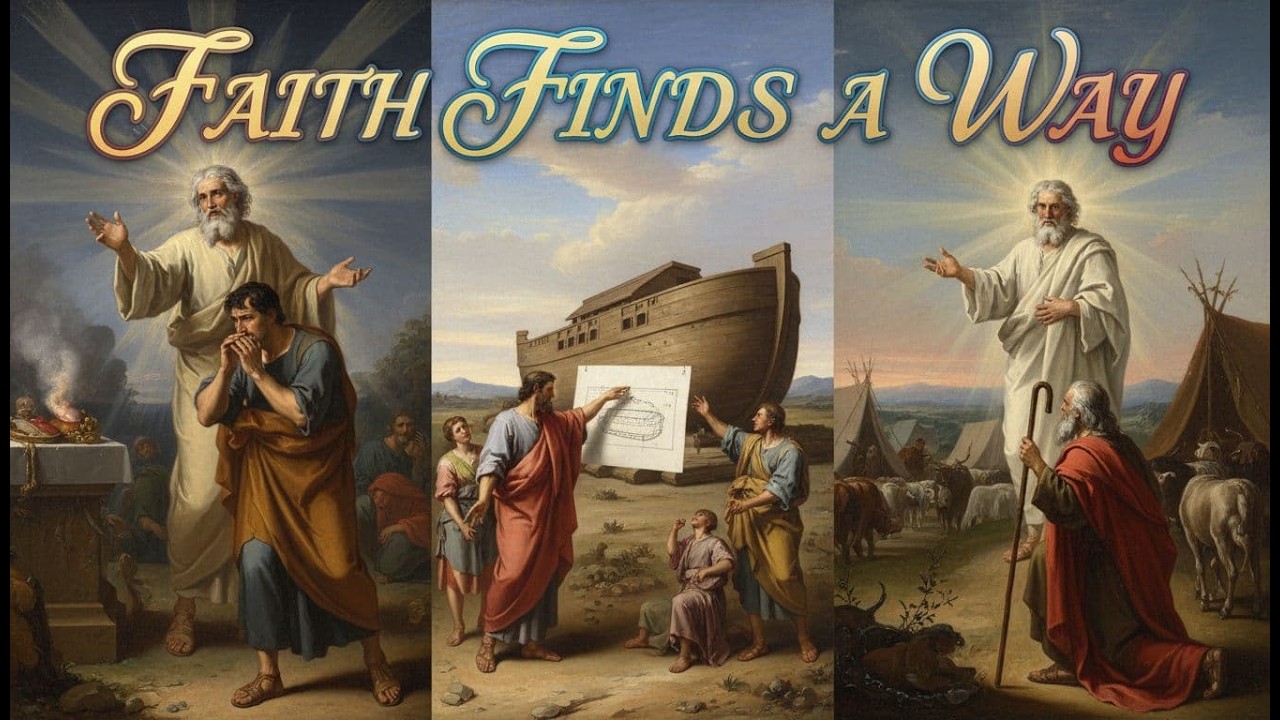
God speaks to Noah in Genesis 6, giving detailed instructions about the ark and making a covenant with him.
Between Noah and Abraham, we mostly get genealogies. The text is quiet about direct speeches. We are not told every reason why God spoke at some moments and not others. What we can see is that He spoke at turning points, when judgment or rescue was coming, and always called for a response.
Every time God’s voice comes, people have a choice: faith that leads to obedience, or unbelief that leads to loss.
Abraham’s Call: What God Said and How Hearing Became Faith
When we reach Genesis 12, everything sharpens. God speaks to Abram:
“Get out of your country, From your family And from your father’s house, To a land that I will show you. I will make you a great nation; I will bless you … and in you all the families of the earth shall be blessed.”
Abram hears about:
Click Our Ad to Support Us!
An unseen land.
An unseen nation coming from an old, childless couple.
An unseen worldwide blessing.
He has no map, no photos, no proof, only God’s voice. Hebrews 11:8 says:
“By faith Abraham obeyed when he was called to go out to the place which he would receive as an inheritance. And he went out, not knowing where he was going.”
His faith did not start with an inner effort. It started when God spoke. The promise itself became like a title deed in his heart. He stepped out, treating that unseen Word as more real than the familiar land under his feet.
Why Abraham’s History Shows What Faith Really Looks Like
Abraham’s life gives us a clear pattern:
God speaks a promise.
We listen.
We trust His unseen Word more than what we see.
We act in obedience, even without all the details.
That is Hebrews 11:1 in motion. The promise becomes substance inside us, and our obedience becomes evidence that we believe.
We still live in that same pattern today. God’s speaking is now centered on Jesus and the New Testament, but the flow has not changed. Promise, trust, obedience. Title deed, inner proof, outward steps.
When we go back to the original Hebrew of Genesis 22:18, we find that God tells Abraham, “in your seed (zeraʿ) all the nations of the earth shall be blessed,” and that word zeraʿ, while it can be collective, is treated in the text as a single, specific offspring who will carry the covenant blessing, which is exactly how Paul reads it in Galatians 3:16, where he says the promise was made to Abraham “and to his seed,” not “seeds,” and then boldly claims “that Seed is Christ.”
In other words, God is not talking about a vague group, or “good people,” or “Abrahamic faiths” in general, but about one coming Messiah whose life would pour blessing on every nation that will receive Him, something we can see unpacked deeply when we connect Abraham’s promise to The New Covenant and the Blessing of All Nations.
When God speaks again in Deuteronomy 18:18 and promises to raise up “a Prophet like you from among their brothers” and put His own words in that Prophet’s mouth, He is not starting a new idea, He is continuing the same seed promise from Abraham, now described as a Moses-like mediator who will speak God’s final, binding Word. In the New Testament, Jesus claims that role without flinching, saying He only speaks what the Father gives Him, that Moses wrote about Him, and that the Scriptures all point to Him, which makes sense only if He is the promised Seed and the promised Prophet wrapped into one person.
If we take Genesis 22:18, Deuteronomy 18:18, and Galatians 3 together, we do not get room for a “generic Jesus,” we get a very precise Jesus: eternal Son, true man, crucified, risen, and enthroned as the unique channel of blessing to the nations, something even careful academic work, like C. John Collins’ study of the singular seed in Galatians 3:16, has argued in detail (PDF here). Once that clicks, the popular re-definitions of Jesus start to fall apart; the Qur’anic Isa of Islam, who is only a created prophet, not the Son, not crucified, and not the covenant-fulfilling Seed, simply does not match the original promise that all nations are blessed “in” Him through His death and resurrection.
The Mormon Jesus, taught as one god among many, a spirit-brother of Lucifer and a literal offspring of heavenly parents inside an eternally existing universe of countless gods, cannot be the same Seed God Himself swears by in Genesis 22, because that Seed is tied to the one true Creator, not to a family line of deities.
The Jesus of Jehovah’s Witnesses, who is really Michael the archangel, the first created being, also fails the test, because the Abrahamic Seed is the One through whom God Himself justifies the nations, receives worship, and brings an unending covenant, something no created angel could ever carry.
Once we let the Hebrew zeraʿ, the flow of the Old Testament, and the apostolic explanation guide us, we see there is only one Biblically faithful definition of Jesus, and any system that denies He is God, His unique Sonship, or His cross and resurrection as the source of blessing to “all nations” is not just a different flavor of the same faith, it is a different gospel, a different Jesus, and a break from the very promise God spoke to Abraham “because you have obeyed My voice.”
If we want to see how the true Abrahamic pattern runs through the people of God across history, it is helpful to look at the origins and history of the Christian Church, from Jewish roots to today.
Christian Denominations and Hearing God’s Voice: Where Relationship Often Falls Short
We want to be careful and kind here. In every stream of Christianity there are people who walk closely with God and people who do not. We are not judging souls. We are looking at patterns that can either help or block a living relationship where we hear and respond to God.
Catholic and Orthodox Views: Hearing God Mostly Through Church and Tradition
In Roman Catholic and Eastern Orthodox churches, believers are taught to meet God mainly through:
Scripture
Church teaching and councils
Sacraments and liturgy
Inner peace in prayer
Lives of the saints
There is much good here. These traditions honor history, guard against obvious error, and keep people rooted in the history of the church.
But in practice, many ordinary believers begin to feel that only priests, bishops, or monks really “hear” God. Personal conversation with God in daily life can feel out of reach. God’s voice is expected mostly in official spaces, not in the kitchen or at work.
That can slowly empty faith of its relational flavor. We may trust doctrines, but not expect a living Person to speak into Tuesday afternoon.
Protestant Traditions: Strong on Bible Faith, Weak on Expecting God’s Living Voice
Many Baptists, Lutherans, Methodists, Presbyterians, and Anglicans lift up the Bible as the main way, sometimes the only way, that God speaks. This brings huge benefits:
Clear teaching
Strong focus on truth
Protection from strange prophecies
The danger is that some begin to act as if God stopped speaking in any personal way after the first century. This view is often called cessationism, the belief that gifts like prophecy have ceased.
When that view hardens, faith can shrink into agreeing with doctrines only. Cessationists believe about God, but stop expecting God to guide them in specific ways today. Cessationists still pray for wisdom, but they no longer expect to recognize His voice when it comes.
Pentecostal and Charismatic Churches: Hungry for God’s Voice
Pentecostal and Charismatic believers, on the other hand, we strongly expect God to speak now. We look for:
Inner promptings
Prophetic words
Tongues with interpretation
Dreams and visions
But mostly we have a real relationship with God where we talk back and forth. Just the other morning I was ready to leave for work and I could not find my car keys. I asked, “Lord, where are they?” And God replied, “laundry basket, pants pocket,” then I immediately remembered they were there.
We can tell the difference between our thoughts and God’s voice. On the other hand, people who don’t understand hear demonic voices all the time and believe those voices are their own thoughts. Demons are deceptive like that.
How did God reply to me? That was Jesus talking to me through the power of the Holy Spirit, just like He promised would happen. Cessationists believe that stopped with the apostles, but if they believe that then they should also believe every other promise to us was also only to the apostles.
When we walk through the promises Jesus made to His apostles, we quickly see that Cessationism only works if we slice those promises away from the rest of the New Testament and from the ongoing life of the church.
Jesus told the apostles, “Whoever believes in Me will also do the works that I do, and greater works than these” (John 14:12), and that promise is tied, not to a job title, but to “whoever believes,” the same wide-open language Paul uses when he describes the list of spiritual gifts in 1 Corinthians 12.
When Jesus said, “I am with you always, to the end of the age” in Matthew 28, He attached His presence to the Great Commission, and if that promise only applied to the original apostles, then the Great Commission itself would have expired with them, which none of us believes.
In John 14 to 16, He promised the Helper, the Holy Spirit, who would abide with them forever, teach, remind, and empower, and the book of Acts shows that this power was quickly shared with believers beyond the Twelve, which lines up with Paul’s teaching that the Spirit “apportions to each one individually as He wills.”
When we read Acts 1:8, “You will receive power when the Holy Spirit has come upon you, and you will be My witnesses,” the text connects power with witness, not with a closed, one-time apostolic club, and church history plus modern testimony, like the many accounts gathered in Healing, Deliverance, Gifts, and Miracles are for Today: The Problems with Cessationism, keep pressing that point.
If Cessationists are right, then promises such as “these signs will accompany those who believe” in Mark 16 would describe a tiny, unrepeatable window, and the rich teaching on gifts in 1 Corinthians 12 to 14 would be little more than a museum tour; yet the Holy Spirit continues to distribute gifts for the common good, which we can see both Biblically and in modern accounts of the nine Biblical gifts of the Holy Spirit.
We also have to notice that Jesus did not just give power, He gave a pattern, since He ministered as a Spirit-anointed man, then said, in effect, “Follow Me in this,” which is why we still see miracles and charismatic gifts in modern Christianity wherever believers take His words at face value.
To say “those promises were only for the apostles” is to say the church no longer needs what Jesus thought His body would need until the end of the age, which quietly suggests that our time is safer, cleaner, or more manageable than the world of the first century. When we are honest, we know our neighborhoods are full of the same sickness, bondage, fear, and deception that Jesus faced, so it makes no sense to claim He has withdrawn the very tools He gave to confront those things in His name.
So we stand in that tension with humility, but also with confidence, taking Jesus at His Word that His presence, His Spirit, and His gifts still belong to “whoever believes,” and we refuse to shrink His promises down to match our disappointments or our traditions.
There is something beautiful in our relationship with God. We truly have a relationship with the Holy Spirit and we are willing to take risks, to pray, to step out when we sense God speaking.
True faith never contradicts Scripture and never produces pride, confusion, or manipulation. Hearing God requires testing, humility, and accountability.
Living Out Hebrews 11:1 Today: Hearing God, Trusting Him, and Walking by Faith
How We Learn to Recognize God’s Voice in a Noisy World
Our world is loud. Our own thoughts are loud. How do we tell which voice is God’s?
Some simple tests help:
It matches Scripture and never twists it.
It lines up with the character of Jesus, full of truth and grace.
It produces peace and holiness, not panic, shame, or sin.
It stands firm over time and is confirmed by wise, mature believers.
We grow in this by steady Bible reading, quiet prayer, and a soft heart that is willing to obey when God highlights something, even if it is small.
The first time God talked to me that I remember was 1997 shortly after I became born again. I was not expecting it and He initiated the conversation. I grew up Catholic and I really had no clue how to pray. Prayer was a very difficult aspect of Christianity for me to get into because I always prayed to a far away God, and that is the problem.
Catholicism taught me to go to a priest for confession, to confess my sins to another human being who would tell me to recite some Our Fathers (the Lord’s Prayer) and say the rosary a few times. I never understood what that did for sin and I never believed that was the way, so I walked around with the cumulative weight of all my entire life’s sin on my shoulders.
One day, in March 1997 at the age of 20, I walked into a Full Gospel Church of God and I heard for the 1st time in my life that when Jesus hung on that cross, He looked into the future and He saw me, He specifically saw me! No one ever paid much attention to me, and Jesus, the God of the universe, sacrificed Himself on a cross specifically for me!
At that moment there was only Jesus and I in the entire universe. Also in that moment I realized I could go directly to God and He could forgive my sins personally, right then and there! Talk about a Revelation! All my entire life’s sin came crashing off me and fell into hell where it belonged, never to be remembered by God again.
I was completely amazed, astonished, forgiven! In that moment Jesus became my personal Savior, my personal Friend, my personal God. No longer was Jesus a far away figure in the sky I prayed to without an answer. In that moment Jesus came to live inside my heart, which is another word for spirit. In that moment I became born again and the Holy Spirit, aka the Spirit of God, aka the Spirit of Jesus, aka the Holy Ghost became one with my spirit.
Practical Ways to Walk by Faith as the Substance and Evidence of the Unseen
Here are a few simple ways we can practice Hebrews 11:1 in daily life:
Hold a specific promise as your “title deed.” Take a verse, such as “I will never leave you nor forsake you,” write it down, and talk with God about it each day as something already signed in your name.
Ask God clear questions and wait with an open Bible. Bring choices to Him, then sit quietly and read. Pay attention to verses or inner nudges that line up with Scripture.
Take small steps of obedience even when you do not see the outcome. Give when He nudges you to give. Forgive when He brings a name to mind. Make the phone call He lays on your heart.
Share stories of unseen trust with other believers. When God confirms His Word after you stepped out, tell someone. These stories strengthen our faith as real evidence that God still speaks.
Every time we act on His Word, our obedience becomes visible evidence of an invisible God at work in our lives.
Conclusion: From Hearing to Walking
We have walked from the Greek words of Hebrews 11:1, through the garden with Adam and Eve, out into the unknown with Abraham, and into the divided church of today. In every scene the pattern is the same: God speaks, and faith is our answer.
Some traditions guard truth, some chase experience, some lean into ritual. All of us are invited into something deeper and simpler. A living relationship with the Father through Jesus, by the Spirit, where we hear, trust, and obey.
If we want that, we can start right now:
“Lord Jesus, I want real faith. I want to know Your voice in Scripture and by Your Spirit. Teach me to trust what You say more than what I see, and help me walk in simple obedience every day. Amen.”
He is not far away. He is already speaking. Our part is to listen, believe, and walk.
Related Posts
1 Truth: Blood of Jesus: God's Life in Sinless Flesh What if the very thing running through the veins of Jesus was not just human, but the Blood of Jesus holding the actual life of God Himself, poured out for us? That sounds huge, maybe even hard to take in at first, yet Scripture keeps pulling us back to this one thread: life is in the blood, sin corrupts human…
Reprobate Mind: 5 Warning Signs and Hope for Change The Bible’s take on a reprobate mind isn’t just a warning or a piece of theology. It’s a wake-up call. “Reprobate mind” (from the Greek adokimos, meaning rejected or unapproved) describes what happens when people no longer care about God’s truth—they trade what’s holy for what feels good, grow numb to right and wrong, and God lets go. It’s mentioned…
21 Century Spirituality According to God: What the Bible Says vs. World Beliefs and New Age What does it really mean to be spiritual? The word gets thrown around everywhere, but rarely with the kind of clarity or honesty God gives us in the Bible. Spirituality is not just a feeling or an idea—it has roots, a shape, actual words that God used in ancient times to tell us exactly what matters to Him. Through the…
Quench Not the Spirit: Understanding 1 Thessalonians 5:19
Bible Study / Devotional / Discernment / Holy Spirit Scriptures / Humility / Pentecost / ProphecyPre-Born! gives free ultrasounds to women looking to abort their babies and 86% of those women choose to keep their babies! A fire can fade in two ways, by attack or by neglect. Paul’s warning in 1 Thessalonians 5:19 speaks to that simple image with sharp force: “Quench not the [...]Read more...
Holy Spirit and Fire in Matthew 3:11 Explained
Baptism / Baptized in the Holy Spirit / Bible Study / Holy Spirit Scriptures / Pentecost / Repentance / WrathPre-Born! gives free ultrasounds to women looking to abort their babies and 86% of those women choose to keep their babies! When we hear Holy Spirit and fire in Matthew 3:11, we may picture Pentecost, power, or deep renewal. Yet John the Baptist was not speaking into a calm room. He was standing in [...]Read more...
Anointing Oil in the Bible: What James 5:14 Means
Anointing / Bible Study / Faith / Forgiveness / Miracles / The ChurchPre-Born! gives free ultrasounds to women looking to abort their babies and 86% of those women choose to keep their babies! When sickness hits, we often want something we can hold. A bottle of oil can feel concrete, while prayer can feel hidden. Yet James 5:14 pulls us back to what matters [...]Read more...
Popular
Seven Spirits of God Explained: Trinity Insights for Your Faith Journey – Isaiah 11:2
The Seven Spirits of God stand as one of the most profound and often misunderstood truths in Christian theology. Rooted deeply in Scripture, they aren’t seven separate entities but rather seven attributes of the one Holy Spirit—God revealing Himself in fullness. Isaiah 11:2 describes these [...]Read more...
The 9 Gifts of the Holy Spirit: Biblical Truths, Historical Evidence, and Today
The gifts of the Holy Spirit reveal the active power of God working in the lives of His people. They aren’t just distant historical records or fading Biblical accounts; they’re living because the Holy Spirit, He is living and He is God, and His transformative gifts are reaching people [...]Read more...
Tongues of Fire in Acts 2:3: Meaning, Biblical Significance and Holy Spirit Power
The phrase “tongues of fire” in Acts 2:3 sparks worldwide curiosity and spiritual wonder. It appears in Scripture to describe the Holy Spirit’s descent during Pentecost, when visible flames rested on the apostles, marking the time when God’s Spirit descended on earth, [...]Read more...
The Antichrist
The Apostate Church
The Rapture
Angels
Book of Daniel
Giants
Judgment
Prophecy
The Apostles
Bible Prophecy
Beware of Deception
Sin
Antichrists
Demon Possession
Healing
Millennial Reign
Redemption
The Gospels
The Holy Spirit
American Prophecy
Israel
Armageddon
Forgiveness
Intercession
Prayer
Revival
The Old Testament
The Tribulation
Faith
Kingdom Of God
Bible Interpretation
Free Will
Book Of Jude
Pride
The Afterlife
The Red Dragon
We use cookies so you can have a great experience on our website. View more
Cookies settings
Accept
Decline
Privacy & Cookie policy
Privacy & Cookies policy
Cookies list
Cookie name
Active
Who we are
Our website address is: https://theholyspirit.us.
Comments
When visitors leave comments on the site we collect the data shown in the comments form, and also the visitor’s IP address and browser user agent string to help spam detection.
An anonymized string created from your email address (also called a hash) may be provided to the Gravatar service to see if you are using it. The Gravatar service privacy policy is available here: https://automattic.com/privacy/. After approval of your comment, your profile picture is visible to the public in the context of your comment.
Media
If you upload images to the website, you should avoid uploading images with embedded location data (EXIF GPS) included. Visitors to the website can download and extract any location data from images on the website.
Cookies
If you leave a comment on our site you may opt-in to saving your name, email address and website in cookies. These are for your convenience so that you do not have to fill in your details again when you leave another comment. These cookies will last for one year.
If you visit our login page, we will set a temporary cookie to determine if your browser accepts cookies. This cookie contains no personal data and is discarded when you close your browser.
When you log in, we will also set up several cookies to save your login information and your screen display choices. Login cookies last for two days, and screen options cookies last for a year. If you select "Remember Me", your login will persist for two weeks. If you log out of your account, the login cookies will be removed.
If you edit or publish an article, an additional cookie will be saved in your browser. This cookie includes no personal data and simply indicates the post ID of the article you just edited. It expires after 1 day.
Embedded content from other websites
Articles on this site may include embedded content (e.g. videos, images, articles, etc.). Embedded content from other websites behaves in the exact same way as if the visitor has visited the other website.
These websites may collect data about you, use cookies, embed additional third-party tracking, and monitor your interaction with that embedded content, including tracking your interaction with the embedded content if you have an account and are logged in to that website.
Who we share your data with
If you request a password reset, your IP address will be included in the reset email.
How long we retain your data
If you leave a comment, the comment and its metadata are retained indefinitely. This is so we can recognize and approve any follow-up comments automatically instead of holding them in a moderation queue.
For users that register on our website (if any), we also store the personal information they provide in their user profile. All users can see, edit, or delete their personal information at any time (except they cannot change their username). Website administrators can also see and edit that information.
What rights you have over your data
If you have an account on this site, or have left comments, you can request to receive an exported file of the personal data we hold about you, including any data you have provided to us. You can also request that we erase any personal data we hold about you. This does not include any data we are obliged to keep for administrative, legal, or security purposes.
Where your data is sent
Visitor comments may be checked through an automated spam detection service.