Judge Not or Judge Rightly? What Jesus, Gossip, And God’s “Hate” Really Mean
Most of us feel the same tension. We don’t want to be seen as judgmental, but we also don’t want to pretend that sin is no big deal. We feel that pull in friendships, in our churches, even online.
Are we supposed to judge other people at all? Or does “judge not” mean we should stay silent no matter what happens?
Watch and share our video of this article to help us spread the Word of God. Be kind and subscribe to our YouTube Channel. Thank You!
In this article we walk through what Jesus actually said in the original languages, how God speaks about gossip and lying, what Scripture means when it says God “hates,” and why calling out sin is not the same as hateful, judgmental religion.
We will keep it simple, but we will not water it down.
What Did Jesus Really Mean By “Judge Not” In The Original Language?
Jesus teaching on right and wrong judgment.
The Greek Word “Krinō”: What “Judge” Actually Means
In Matthew 7:1, Jesus says, “Do not judge, or you too will be judged.” The Greek word for “judge” there is krinō. It simply means to decide, to evaluate, to give a verdict.
Krinō can describe a fair judge who follows God’s standard, or a harsh critic who crushes people. The word itself is neutral. The problem is a sinful, judgmental heart that uses krinō to tear people down. You can see the grammar and usage in tools like the Greek text of Matthew 7:1.
Matthew 7:1-5: Jesus Condemns Hypocritical Judgment, Not All Judgment
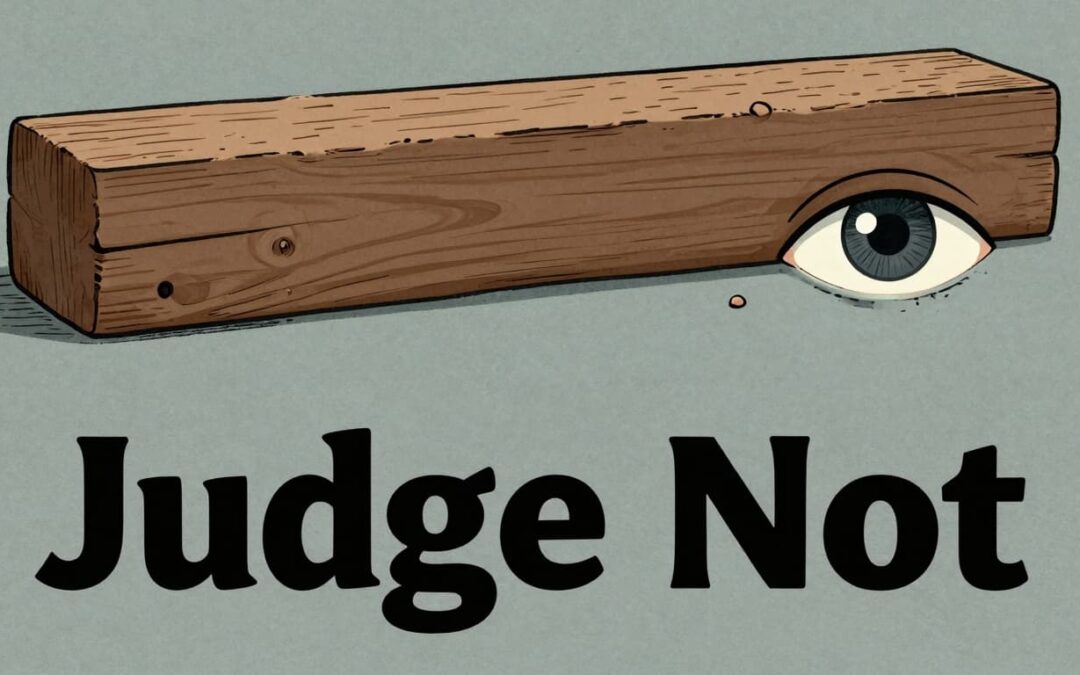
Jesus follows “judge not” with a funny, sharp picture. We have a log in our own eye, but we point at a speck in our brother’s. That is a judgmental spirit: blind to our own sin, sharp toward everyone else.
The beam and speck picture exposing hypocritical judgment.
Jesus does not say, “Never help your brother with his speck.” He says, “First take the log out of your own eye, and then you will see clearly to take the speck out.” That is humble, honest correction, not cold, judgmental policing.
John 7:24: “Judge With Right Judgment,” Not By Appearances
Later, in John 7:24, Jesus says the opposite-sounding thing: “Do not judge by appearances, but judge with right judgment.” He expects us to use krinō, but in a righteous way.
Here He warns against snap judgments based on looks, bias, or rumors. He calls us to weigh things by God’s Word, not by feelings or group pressure. You can see how different translations bring this out in John 7:24 in context.
Paul And The Early Church: When Judgment Is Required
Paul also talks about judging. In 1 Corinthians 5 he tells the church to judge serious, unrepentant sin inside the church and to remove it for the good of the body. He is not asking them to be harsh and judgmental. He is asking them to protect people from sin that spreads like mold.
This matches Leviticus 19:15, which calls Israel to judge fairly, without favoritism. Honest judgment is part of love. It guards the weak and honors God.
Are We Supposed To Judge People Or Only Their Sin?
The big heart question is this: what, exactly, can we judge?
Scripture makes a clear line. We may judge actions by God’s Word. We must not pretend we can fully read motives, because only God sees the heart.
For example, when we look at patterns of hard, ongoing sin and rejection of truth, the Bible warns that a person can drift into what it calls a reprobate mind and God’s judgment. That is serious. But even there, we describe what God has said about actions and outcomes, not claim we know every hidden motive.
Judging Actions: Calling Sin What God Calls Sin
We are not more loving than God. When He calls something sin, we do not help anyone by calling it “a struggle” and leaving it there.
Passages like Galatians 6:1 and 2 Timothy 4:2 call us to correct and rebuke, but gently and patiently. When we speak about clear actions that Scripture names as sin, in a humble tone, we are not being judgmental. We are simply agreeing with God.
When we look at Romans 1:26‑27 in the NLT, especially with the original Greek and the flow of Paul’s thought in mind, we see that he’s describing what happens when people trade the worship of the true God for idols, so in context the same‑sex acts he names are not random, they grow out of a bigger exchange of God’s truth for a lie, which he already laid out in Romans 1:18‑25 and we can see clearly in the NLT text itself here: Romans 1 NLT on Bible Gateway.
In the Greek, Paul says God “gave them over” (parédōken) to “dishonorable passions,” and then he spells out examples, women “exchanged” (another form of that same word from earlier) natural sexual relations for those “against nature” (paraphusin), and men “abandoned” (aphentes) natural relations with women and were “inflamed” with desire for each other, so in the NLT wording the thing that’s labeled as “sin” is not just a vague feeling, it is the chosen behavior of “sex with each other,” “shameful things with other men,” that flows from a prior refusal to honor God.
Paul does not single out a modern category like “orientation,” he speaks about actions and desires that reject God’s created pattern, so the sin in this passage is the active exchange of God-given sexual order for something else, tied to idol worship, self-rule, and a heart that says “we know better than our Creator.”
When the NLT says, “as a result of this sin, they suffered within themselves the penalty they deserved,” it is reflecting the Greek phrase “receiving in themselves the due penalty of their error,” which most scholars see as a present, built‑in consequence, not only a later judgment, something that starts working inside the person and the community here and now; if we want a deeper technical walk‑through of that phrase, we can see how one careful study unpacks it in plain language here: What exactly does “receiving in themselves the due penalty for their error” mean?.
In other words, what did they “suffer within themselves”? At the most basic level, Paul is saying that the sin carries its own fallout, so we are watching God judge by handing people over to what they insist on, and that hand‑over works like spiritual gravity inside them.
Many readers rush to list diseases or social shame, but in the flow of Romans 1 the deeper penalty sits at the level of the person’s inner life, their thinking, their desires, and their sense of self, so the mind gets darkened, the conscience gets dull, the body gets used in ways that don’t match its purpose, and the person becomes both less free and less able to see that they are not free at all.
That is a hard truth, and if we are honest, it keeps us from being judgmental, because Paul will soon say in Romans 2 that we all stand under sin, just in different shapes and stories, so we read these verses not as if “they” are the bad ones and “we” are fine, but as a mirror of what sin does whenever we trade God for anything else.
The “penalty they deserved” is not God losing his temper and lashing out; it is God, with grief, allowing the internal breakdown that comes when we use His gifts, including our bodies, against the design that reflects His character and love.
In simple terms, the suffering “within themselves” shows up as inner confusion, restless craving that never really satisfies, broken relationships, shame that we try to cover with more sin, and a kind of inward slavery that looks like freedom on the surface, yet eats away at joy and peace.
When we sit with that, we start to see that Romans 1:26‑27 is not written so we can point fingers at one group, it is written so we can feel the weight of what happens whenever any of us, in any area of life, says “my way, not yours” to God, then lets that choice sink into our bodies, our desires, and our souls until the penalty is not only outside us, it lives inside us.
We Are All Natural Born Sinners
We start with the hard truth that Scripture gives us, that every one of us is born a sinner, bent away from God, already under judgment, with no neutral ground where we can stand and say we are fine on our own, because Romans 3:23 says that “all have sinned and fall short of the glory of God,” and we can see the depth of that claim in resources like this study of Romans 3:23.
In our natural state we are not slowly drifting toward hell, we are already condemned, which Jesus explains in John 3 when He says that the one who does not believe “stands condemned already,” and that is why we must be born again, not just slightly improved, a truth many unpack when they explain what it means to be a born again Christian. New birth and real repentance are two sides of the same miracle, God opening our eyes to see our sin, turning us from trusting ourselves to trusting Christ, and teaching us to agree with Him about what is holy and what is not.
When we talk about same-sex relationships, we cannot be honest with the Bible if we pretend God is silent, because Leviticus 18:22 calls a man lying with a man “an abomination,” and in the New Testament, Romans 1:26-27, 1 Corinthians 6:9-10, and 1 Timothy 1:8-10 all speak of same-sex acts as sin, which we can read together in context at this combined passage.
Paul does not carve out a special category of “worse people” there, he lists same-sex behavior right beside greed, adultery, theft, drunkenness, and slander, and then says that “those who practice such things will not inherit the kingdom of God.” That line pulls us all into the light, because our anger, our lies, our porn use, our gossip, our pride, and our self-righteousness all sit in the same courtroom before the same Judge, and any one of them, held onto without repentance, is enough to keep us outside His Kingdom forever.
Different sins have different ripple effects in this life, but when it comes to our standing before a holy God, every sin exposes the same rebellion, which is why many teachers say that at the level of guilt, all sin separates us from God.
The cross does not split us into “respectable sinners” and “terrible sinners,” it levels us, since Christ carried the judgment for every kind of sin, including sexual sin of every kind, so the same blood that cleanses the self-righteous church kid is the blood that can cleanse the man or woman who has lived years in a same-sex relationship. This is why we cannot single out same-sex sin as if it is the only road to hell, yet we also cannot soften it and call it holy, because love tells the truth and then points to the same open door of repentance and new birth that every one of us needs.
When we finally stop arguing with God about which sins are acceptable and fall at the feet of Jesus, trusting Him and turning from whatever He calls sin, we find that the path away from hell and into life is the same for all of us, no matter what our past has held.
Why Judging Motives Crosses A Line Only God Can See
Motives live deep in the heart. Paul says in 1 Corinthians 4:5 that the Lord will “bring to light what is hidden in darkness and will disclose the purposes of the heart.”
Click Our Ad to Support Us!
When we say, “She only did that to get attention,” or “He is just power hungry,” and we do not really know, we are acting as if we are God. That is more than judgmental. It is false. It destroys trust and relationships.
When Jesus says in John 3:17 that He didn’t come to judge the world but to save it, many of us grab that line and use it like a shield against anything that feels even slightly judgmental, but if we read the whole flow of the passage, we see that salvation and judgment are sitting right next to each other, because the same Light that saves is the Light that exposes what we love in the dark (John 3:17–19).
In that sense, when we say “Jesus isn’t judgmental,” we can accidentally mean “Jesus doesn’t confront sin,” and that is not what He claimed at all, because later He tells us very plainly that the person who rejects Him already has a judge, and that the words He has spoken will judge that person on the last day (John 12:48).
That sounds harsh to a judgmental heart, but if we slow down, we see that His words are not random rules; they are the Father’s own words, given for our good, meant to bring us to repentance, which in simple terms is a deep change of mind about God, about our sin, and about who gets to be Lord.
Jesus even explains that He has not spoken “from Himself” but that the Father commanded Him what to say and what to speak, and that this command is eternal life, so the very message that feels judgmental to our pride is actually the doorway to life if we bow to it (John 12:48–50). When we look at this through the promise in Deuteronomy 18, it starts to make even more sense, because Yahweh had already said He would raise up a Prophet like Moses and put His own words in that Prophet’s mouth, and that whoever would not listen to those words, God Himself would require it of him (Deuteronomy 18:15–19).
Many Jewish and Christian readers have seen that “Prophet like Moses” as pointing to the Messiah, and we see how naturally Jesus steps into that role when crowds recognize Him as the Prophet and when the apostles later apply that text to Him as the One who speaks with final, covenant-level authority about our lives and our hearts (The Messiah Would Be a Prophet Like Moses).
Since Jesus is that Prophet, then His words are not casual advice that we can treat with a judgmental shrug; they are the very standard by which our lives will be weighed, and repentance is what happens when we stop arguing, stop being judgmental toward God, and admit that His verdict about our sin is right.
In that light, “I did not come to judge the world” is not a soft excuse to stay as we are; it is a rescue mission where the Judge steps into our story first as Savior, holding out time and space for repentance before the final court date, which is why those who refuse Him stand “judged already” by their own unbelief.
When people accuse Christians of being judgmental for repeating Jesus’ warnings, we can check our own hearts, because we never want a cold, self-righteous, judgmental tone, yet at the same time we remember that sharing His words is an act of mercy, not cruelty, since those same words will one day be the standard everyone faces.
It helps us to remember that even our conversations about what sounds judgmental need to be shaped by Scripture, not by culture, and resources that unpack how Jesus’ “do not judge” teaching fits with real discernment can steady us so we are not proudly judgmental, but also not silent when truth is at stake (Bible explanation of “Do not judge”; Why are Christians often called judgmental?).
In the end, we find ourselves standing before a Savior who is not petty or unfairly judgmental, but perfectly holy and perfectly loving, and His call to repent and trust Him is not the voice of a harsh critic, it is the voice of the promised Prophet, the Messiah, whose words will judge us because they were first spoken to save us.
How Guessing Motives Becomes Gossip And Lying In God’s Eyes
Once we start guessing about motives, it is very easy to start talking about those guesses with others. That is where gossip and lying come in, even if we think we are on the person’s side.
Whispers and rumors that damage a neighbor.
What The Bible Calls Gossip And Why It Is So Destructive
Gossip is when we share someone’s faults or private matters behind their back, in a way that harms them. Proverbs 11:13 says a gossip betrays a confidence. Proverbs 20:19 warns us not to hang around those who talk too freely.
We have all seen how “sharing a concern” can shift into a juicy, judgmental story that makes us feel important while someone else’s name slowly burns.
When Our “Best Guess” About Motives Turns Into A Lie
Here is how it works. First we guess: “I think she did that because she hates her husband.” Then we repeat it as if it were fact. At that moment, we are lying.
Proverbs 6:16-19 lists things the Lord hates, like haughty eyes, a lying tongue, and sowing discord. You can read the list in Proverbs 6:16-19 in context. When we pass on motive-guesses that divide people, we are walking into all three at once.
God cares about truth. A “white lie” about someone’s motives is still a lie.
Does God Hate Gossip And Lies? What Scripture Actually Says
Yes, God hates gossip and lies. Not in a wild, cruel way, but with holy, steady opposition. Gossip and lies tear apart families, churches, and friendships that He loves.
Proverbs 6 says God hates “a lying tongue” and “a false witness who pours out lies” and “a person who stirs up conflict.” That covers both bold lies and soft, judgmental whispers. Resources that gather verses on lying, like what the Bible says about a lying tongue, show how often God warns us here.
What Does It Mean When God “Hates” Something In The Bible?
The Hebrew word often translated “hate” is sane. In many passages it means to reject, to stand strongly against, to turn away from.
God’s “hate” is not like a bitter, human outburst. It is His holy refusal to ever call evil good.
Biblical “Hate” In Hebrew: Firm Rejection, Not Wild Rage
If we look at a lexicon entry for sane, such as Strong’s Hebrew 8130, we see ideas like “to hate, be hostile to.” In context, when God says He hates a lying tongue or unjust worship, He is saying, “I will not accept this. I oppose it.”
In Amos 5:21 God says He hates fake worship while people trample the poor. That is not a temper fit. It is moral clarity. His hate for sin flows from deep love for the people that sin hurts.
How God’s Hate For Sin Differs From Human Hate
Human hate is usually selfish. We hate people for hurting our pride or blocking our plans. God’s holy hate is the opposite. He opposes what destroys love, justice, and truth.
So when Scripture says God hates certain sins, it does not make Him judgmental in the ugly, human way. It shows that His love is not soft on the things that ruin us.
Is Pointing Out Sin Hate Or Love? Why Many Get This Wrong
Balancing mercy and truth in our judgments.
Today many people say that any clear moral stance is hateful and judgmental. But if that is true, even Jesus would be guilty, because He named sin and called people to repent.
Scripture paints a different picture. Honest, gentle correction is a form of mercy.
Why Many People Feel Corrected And Instantly Say “You Are Being Judgmental”
Some of us carry heavy church wounds. Others have only known loud, shaming religion. When we hear any “No,” old pain gets pushed, and it feels like the same thing all over again.
Our culture also teaches that real love always affirms and never disagrees. With that lens, any call to repent sounds judgmental, even when it is spoken with tears and patience.
Biblical Loving Correction: Gentle, Honest, And For Restoration
Galatians 6:1 tells spiritual people to restore a sinner gently, while watching their own hearts. Matthew 18:15-17 lays out a path that starts with private, quiet correction, not public blasting.
This kind of correction is the opposite of a harsh, judgmental style. It risks awkward talks and possible pushback for the sake of another person’s good.
Hating Sin While Loving People: What That Actually Looks Like
The phrase “hate the sin, love the sinner” can be overused, but the idea has a Biblical core. We are called to say a clear “no” to what God calls sin, while saying a clear “yes” to the person’s worth.
That means we pray, we listen, we examine our own hearts first, then we speak truth with kindness. Sometimes we speak with tears. Sometimes we walk with someone for years. That is not soft, judgmental hate. That is costly love.
Conclusion
When we listen closely to Scripture, a clear picture appears. Jesus forbids harsh, hypocritical, judgmental attitudes, but He also commands right judgment. We are called to judge actions by God’s Word, not to pretend we can see every motive of the heart.
Guessing motives and spreading those guesses is gossip and lying, and God truly hates those things because they damage people He loves. His hate is holy opposition to evil, not wild rage.
So we ask the Spirit to teach us a new way: humble discernment. We examine our own hearts first, speak carefully, refuse gossip, and correct gently for the sake of restoration. Imagine a church family like that, where truth and love walk side by side, and where no one is crushed by judgmental pride, yet no one is left alone in their sin.
Related Posts
5 Religions Humility: Biblical Warning On False Humility Most people agree that humility is good. Few agree on what it actually is. Some think humility means hating yourself. Others think it is being quiet, passive, or “nice.” Many people, even in churches, live in something that looks like humility but is actually spiritual poison. The Bible calls that false humility.
Reprobate Mind: 5 Warning Signs and Hope for Change The Bible’s take on a reprobate mind isn’t just a warning or a piece of theology. It’s a wake-up call. “Reprobate mind” (from the Greek adokimos, meaning rejected or unapproved) describes what happens when people no longer care about God’s truth—they trade what’s holy for what feels good, grow numb to right and wrong, and God lets go. It’s mentioned…
Wrath in the Bible: Hebrew, Greek, the Cross, and John 14 What does God say about wrath? In Scripture, God’s wrath is holy, measured, and aimed at evil, not a flare-up like ours. We’ll trace the Hebrew terms khemah and qetseph, the Greek orge and thumos, and watch the story of the Bible show how God judges sin while making a way for sinners to live.
The Seven Spirits of God stand as one of the most profound and often misunderstood truths in Christian theology. Rooted deeply in Scripture, they aren’t seven separate entities but rather seven attributes of the one Holy Spirit—God revealing Himself in fullness. Isaiah 11:2 describes these [...]
The gifts of the Holy Spirit reveal the active power of God working in the lives of His people. They aren’t just distant historical records or fading Biblical accounts; they’re living because the Holy Spirit, He is living and He is God, and His transformative gifts are reaching people [...]
The phrase “tongues of fire” in Acts 2:3 sparks worldwide curiosity and spiritual wonder. It appears in Scripture to describe the Holy Spirit’s descent during Pentecost, when visible flames rested on the apostles, marking the time when God’s Spirit descended on earth, [...]
The Bible’s take on a reprobate mind isn’t just a warning or a piece of theology. It’s a wake-up call. “Reprobate mind” (from the Greek adokimos, meaning rejected or unapproved) describes what happens when people no longer care about God’s truth—they trade what’s holy for what feels good, grow numb [...]
The upper room, a sacred space in Jerusalem, holds profound significance in Christian history. Acts 2 tells us it is the gathering place for Jesus’ disciples when the Holy Spirit descended upon them during Pentecost. This transformative moment not only empowered those present but also sparked [...]
Pentecost isn’t just a Christian event; its roots stem from the Jewish celebration of Shavuot, the day Moses received the Ten Commandments from God. For Christians, Pentecost marks the moment when God poured out His Spirit and Jesus’ worldwide church empowered by the Holy Spirit and His gifts [...]
Charismatic gifts, often referred to as manifestation gifts, showcase the miraculous power of the Holy Spirit. From healing and miracles to prophecy and discernment, they serve as tangible evidence of God’s presence and transformative work. These gifts, seen throughout Biblical history, have [...]
Revelation 3:7-8 offers a powerful message to the church in Philadelphia, a message that remains relevant today. It speaks of a divine “open door” that no man can shut, given by the one who holds the Key of David. This imagery represents not only an opportunity but also God’s sovereign [...]
Have you ever wondered why the word “anointing” carries so much depth in Scripture? The idea of anointing—of sacred oil poured out on kings, priests, and prophets—echoes through the Old Testament as a symbol of God choosing, empowering, and setting apart. God didn’t leave the details of [...]
The Bible boldly declares the truth that Jesus is both fully God and fully man—a mystery that anchors the Christian faith. But what does it mean, practically, for us as believers? Jesus didn’t perform miracles or operate in the gifts of the Holy Spirit simply as God; He demonstrated how a [...]
The Antichrist
The Apostate Church
The Rapture
Angels
Book of Daniel
Giants
Judgment
Prophecy
The Apostles
Bible Prophecy
Beware of Deception
Sin
Antichrists
Demon Possession
Healing
Millennial Reign
Redemption
The Gospels
The Holy Spirit
American Prophecy
Israel
Armageddon
Forgiveness
Intercession
Prayer
Revival
The Old Testament
The Tribulation
Faith
Kingdom Of God
Bible Interpretation
Free Will
Book Of Jude
Pride
The Afterlife
The Red Dragon
We use cookies so you can have a great experience on our website. View more
Cookies settings
Accept
Decline
Privacy & Cookie policy
Privacy & Cookies policy
Cookies list
Cookie name
Active
Who we are
Our website address is: https://theholyspirit.us.
Comments
When visitors leave comments on the site we collect the data shown in the comments form, and also the visitor’s IP address and browser user agent string to help spam detection.
An anonymized string created from your email address (also called a hash) may be provided to the Gravatar service to see if you are using it. The Gravatar service privacy policy is available here: https://automattic.com/privacy/. After approval of your comment, your profile picture is visible to the public in the context of your comment.
Media
If you upload images to the website, you should avoid uploading images with embedded location data (EXIF GPS) included. Visitors to the website can download and extract any location data from images on the website.
Cookies
If you leave a comment on our site you may opt-in to saving your name, email address and website in cookies. These are for your convenience so that you do not have to fill in your details again when you leave another comment. These cookies will last for one year.
If you visit our login page, we will set a temporary cookie to determine if your browser accepts cookies. This cookie contains no personal data and is discarded when you close your browser.
When you log in, we will also set up several cookies to save your login information and your screen display choices. Login cookies last for two days, and screen options cookies last for a year. If you select "Remember Me", your login will persist for two weeks. If you log out of your account, the login cookies will be removed.
If you edit or publish an article, an additional cookie will be saved in your browser. This cookie includes no personal data and simply indicates the post ID of the article you just edited. It expires after 1 day.
Embedded content from other websites
Articles on this site may include embedded content (e.g. videos, images, articles, etc.). Embedded content from other websites behaves in the exact same way as if the visitor has visited the other website.
These websites may collect data about you, use cookies, embed additional third-party tracking, and monitor your interaction with that embedded content, including tracking your interaction with the embedded content if you have an account and are logged in to that website.
Who we share your data with
If you request a password reset, your IP address will be included in the reset email.
How long we retain your data
If you leave a comment, the comment and its metadata are retained indefinitely. This is so we can recognize and approve any follow-up comments automatically instead of holding them in a moderation queue.
For users that register on our website (if any), we also store the personal information they provide in their user profile. All users can see, edit, or delete their personal information at any time (except they cannot change their username). Website administrators can also see and edit that information.
What rights you have over your data
If you have an account on this site, or have left comments, you can request to receive an exported file of the personal data we hold about you, including any data you have provided to us. You can also request that we erase any personal data we hold about you. This does not include any data we are obliged to keep for administrative, legal, or security purposes.
Where your data is sent
Visitor comments may be checked through an automated spam detection service.