Why Philosophers Feel Empty And What It Really Means To Know God
We are drowning in data and opinions, yet starving for certainty. Podcasts, books, YouTube channels, and university classrooms are full of ideas. So why do so many people still feel lost and unsure what is actually true?
Behind that question sits a deeper one: what does it really mean to know God, not just talk about Him? And why have so many brilliant philosophers, with all their insight and study, still ended up miserable, restless, or empty?
This walk is simple on the surface, but it presses on heavy things. We will look at what the Bible means by “know” in the original languages, how famous philosophers searched for meaning, how Scripture challenges human wisdom, and then ask a hard question: how many people today really know what they’re saying, and how many are just copying what they’ve heard?
And at the center of it all is Jesus, who says that eternal life is to know Him, and that only those He knows will enter Heaven.
What It Really Means To Know God In The Bible (Not Just Know About Him)
To the Bible writers, “knowing” God was never just having correct facts in your head. It was a deep, lived relationship with the living Lord.
In Hebrew, the key word is yada. In Greek, the key word is ginosko.
Both words carry the idea of personal contact, trust, and shared life. Think about the difference between knowing a celebrity from the internet and knowing your closest friend. One is distant information. The other is real, tested relationship.
Biblically, many religious people “know about” God. Only some actually know Him.
The Hebrew Word “Yada”: Knowing God As Deep Relationship
In the Old Testament, yada shows up everywhere. It can mean:
To know by seeing
To know by experience
To know someone in covenant love
Genesis 4:1 says, “Adam knew (yada) Eve his wife, and she conceived.” That is not about casual knowledge. It is close, personal, committed love. The same word is used when God calls His people to know Him instead of idols.
Verses like Jeremiah 9:23-24 show God’s heart: He does not brag about power or riches the way humans do. He invites people to understand and know Him. To yada God is to live inside a covenant, like a faithful marriage where love, trust, and loyalty grow over time.
Many philosophers chase “truth” as an idea. Scripture presents truth as a Person to be known. God is not just a theory; He is the One who says, “I will be your God, and you will be My people.”
The Greek Word “Ginosko”: Jesus On Being Known By Him
When we move to the New Testament, ginosko carries the same heartbeat. It is not cold theory. It is knowledge that comes from encounter and surrender.
Look at these key passages:
John 17:3: “Now this is eternal life, that they may know (ginosko) You, the only true God, and Jesus Christ whom You have sent.” Eternal life is not just “going to Heaven.” Eternal life starts now as a relationship of knowing the Father and the Son.
John 10:14: Jesus says, “I am the good shepherd; I know My own and My own know Me.” His sheep do not only know His title. They know His voice.
Matthew 7:21-23: Many people will say, “Lord, Lord,” and point to miracles and ministry, but Jesus will answer, “I never knew (ginosko) you.” That is chilling. Their problem was not lack of religious activity. It was lack of relationship.
Head Knowledge Vs Heart Knowledge: Why The Difference Matters
Think about fire. You can read ten books about it, memorize the chemical formula, and know the temperatures involved. That is head knowledge.
Then there is sitting by a fire on a cold night, feeling the heat on your face. That is different. You are not just thinking about it. You are inside the experience.
It is the same with marriage. You can study statistics on marriage and quote experts. That does not make you a faithful spouse. Real love is lived, not only analyzed.
Many philosophers have had deep head knowledge. They studied logic, ethics, and metaphysics. But many still wrote about loneliness, confusion, and despair, because information cannot heal a broken heart or forgive sin. Only knowing God in the yada and ginosko sense can do that.
What Famous Philosophers Were Missing (And Why Their Knowledge Did Not Satisfy)
Philosophers have done real good work. They ask hard questions about truth, beauty, meaning, and justice. Christians can even learn from them.
But human thinking alone cannot give what only God can give. When we look at the lives and writings of well-known philosophers, we start to see a pattern: brilliant minds, honest questions, and yet a deep ache that their systems could not cure.
Ancient Philosophers: Socrates, Plato, And Aristotle Searching For The Good
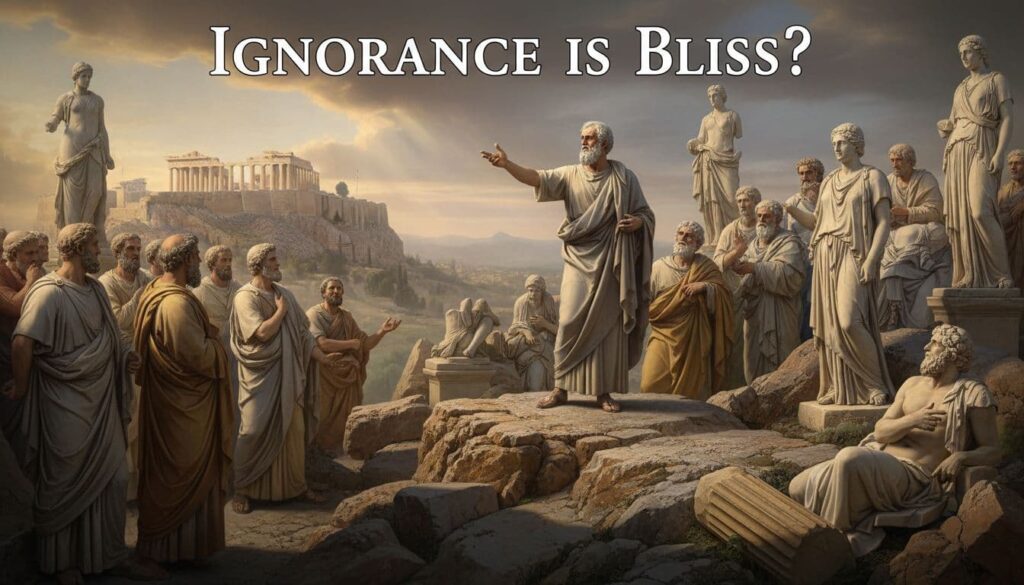
Socrates walked through Athens asking questions about virtue. He believed a good life meant knowing what is right and living by it. Plato talked about eternal “Forms,” with the Form of the Good as the highest reality. Aristotle studied nature and purpose and spoke about a “Prime Mover,” some kind of ultimate cause.
These philosophers saw hints of order, morality, and a higher good. Their minds were reaching toward something beyond this world. But they did not know the Biblical God as Father, Son, and Spirit. They had glimpses of a Mind behind the universe, but not the Gospel of Jesus who dies for sinners and rises in history.
They had ideas about “the good life.” They did not have a Savior who says, “Come to Me, all who are weary, and I will give you rest.”
Skeptical Philosophers: Descartes, Hume, And Kant Questioning What We Can Know
Later, other philosophers started to doubt everything.
Descartes began by doubting all his beliefs until he reached, “I think, therefore I am.” His project was to build certain knowledge from the ground up.
Hume questioned cause and effect, miracles, and even the idea of a solid self. His radical doubt about knowledge made it hard to trust anything beyond what we feel.
Kant said that our minds shape what we experience, so we can never know “the thing in itself,” including God as He truly is. God, in his view, can be believed in as a moral postulate, but not really known in a direct way.
These philosophers put human reason at the center. God became, at best, a distant idea that reason could maybe point to. Scripture says the opposite: real reason works best when it sits under God, not above Him. The cross looks foolish to proud minds, yet it is the very wisdom of God.
Existential Philosophers: Nietzsche, Sartre, And Camus Wrestling With Meaning
When belief in God fades in a culture, meaning itself starts to shake. Some philosophers felt that earthquake in their souls.
Nietzsche spoke of the “death of God,” not as a literal event, but as a cultural loss of belief. Without God, he tried to rebuild values through human will and power. You can see a helpful summary of this in a short piece on Nietzsche and the “death of God” idea.
Sartre said existence comes before essence. We are thrown into the world with no fixed nature, then we must create our own meaning through radical freedom.
Camus described life as “absurd,” like pushing a rock up a hill that always rolls back down.
These philosophers were honest about the emptiness of a world without God. Their writing is full of weight, tension, and often quiet despair. Their courage to look at the darkness is real, but they still miss the light that comes from knowing the living Christ.
Who Actually Found Truth? Philosophers Who Got Closer But Still Needed Christ
Some philosophers moved closer to Biblical truth.
Augustine started as a young man chasing pleasure and ideas. He read Plato. He admired clever arguments. Yet his heart stayed restless until he met Jesus. His famous line says it well: “You have made us for Yourself, O Lord, and our hearts are restless until they rest in You.” He still didn’t get it completely right. He practiced Replacement Theology, something God frowns upon.
Blaise Pascal saw the limits of cold rationalism. In his Pensées, he wrote about “the misery of man without God,” arguing that humans are great and wretched at the same time. You can see some of his reflections in this study on the misery of man without God.
Both thinkers were philosophers, but they were not saved by philosophy. They found peace only when they bowed before Christ. Christian philosophers today still say the same: reason is a gift that should serve revelation, not replace it.
When Philosophers Met The Bible: How Human Wisdom Was Challenged And Corrected
Scripture speaks straight to the pride of human wisdom. It is not anti-thinking. It is against thinking that tries to kick God off the throne.
Old Testament Examples: God Exposes The Limits Of Human Wisdom
In Job 38-42, God answers Job’s pain with questions. “Where were you when I laid the earth’s foundation?” God does not crush Job, but He shows how tiny human understanding is next to His.
Click Our Ad to Support Us!
In Ecclesiastes, the writer tests life “under the sun.” Work, pleasure, wealth, and even human wisdom feel empty when God is pushed to the side. The closing words land here: “Fear God and keep His commandments.”
In Isaiah, God mocks idols and human pride. He laughs at people who carve a statue, bow to it, then cook dinner with the leftover wood. Clever thinking without fear of the Lord always drifts into confusion.
Jesus And The Thinkers Of His Day: Religious And Political Philosophies Challenged
Jesus did not mostly argue with Greek philosophers. He confronted religious and political thinkers.
The Pharisees built a system of strict rules. They loved debates, honor, and control. Jesus told them they honored God with lips while their hearts were far from Him.
The Sadducees were like religious rationalists. They denied the resurrection and limited what they accepted from Scripture. Jesus exposed their shallow reading and said they did not know the Scriptures or the power of God.
Various political groups wanted power and safety. Jesus spoke of a Kingdom not of this world.
He showed all of them that knowing God is not about winning arguments. It is about mercy, faith, and relationship with Him.
Paul In Athens: When Greek Philosophers Heard The Gospel
Acts 17 gives us an amazing picture. Paul walks into Athens, a city full of idols, and begins to speak. Some Epicurean and Stoic philosophers invite him to share more.
He starts with what they know: an altar “To the unknown god.” Then he says, “What you worship as unknown, this I proclaim to you.” He corrects both pleasure-focused and fate-focused systems. God is not far away. He made the world, rules history, and calls all people to repent because He has raised Jesus from the dead.
Some laugh. Some stall. Some believe. Human wisdom meets the risen Christ, and everyone has to respond.
How Often Philosophers’ Thinking Fails In Light Of Scripture
Paul later writes in 1 Corinthians 1:18-25 that God makes the “wisdom of the world” look foolish through the cross. Jews want signs. Greeks want wisdom. God gives them a crucified Messiah, which looks like weakness and nonsense, yet is the power and wisdom of God.
He also warns in Colossians 2:8: “See to it that no one takes you captive through hollow and deceptive philosophy, which depends on human tradition…and not on Christ.”
The Bible is not against philosophers as people. It is against any system, religious or secular, that treats God as an idea instead of Lord.
How Many People Today Really Know What They Are Talking About?
Now we move from famous philosophers to everyday life.
Look around. People speak with strong confidence online and in person. Yet much of what we repeat is secondhand. News headlines, short clips, a quote from a podcast. We “know” because someone we like said it.
Why Most People Only Think They Know: Secondhand Opinions And Shallow Learning
Think about school. How many times did you “know” the chapter for a test, then forget it a week later? The information never sank deep. It never connected to your life.
Grown-ups do the same thing with news, science, and theology. We skim. We scroll. We pick up phrases. We repeat them with bold faces and shaky roots.
Real knowledge takes time, humility, and testing. Spiritually, it means holding ideas up to Scripture, to the Holy Spirit, and to real obedience. Without that, we are just echoing voices, not speaking truth.
A Careful Estimate: How Many Actually Understand What They Claim?
This is not a lab study. It is an honest guess shaped by what the Bible says about people.
Jesus spoke of a narrow gate that few find and a broad road many travel. Paul warned about people who are “always learning but never able to come to a knowledge of the truth” (2 Timothy 3:7). Scripture often shows crowds being deceived while a smaller group walks in truth.
If you put that into rough numbers, maybe:
In general topics, perhaps 10-20 percent of people really understand what they speak about at a deep level, if even that high. The rest mostly pass along what they heard, not knowing for sure if it is the truth or not.
In spiritual matters, the number is likely lower. Maybe 5-10 percent truly “know what they are talking about” because real knowing here means knowing God in Christ, not just knowing doctrines or knowing what people you trust have taught you.
Again, this is not a scientific poll. It is a sober guess that lines up with Biblical patterns. The main point is not the exact percentage. The point is this: we should be slow to trust our own opinions as well as those of others and quick to cling to God’s Word.
Only Those Who Know Jesus Enter Heaven: The Ultimate Difference Between Knowledge And Salvation
At the end of the day, the line that matters is not between smart and simple. It is between those who only know about Jesus and those who actually know Him.
You can be a brilliant philosopher or a humble farmer. You can be a theology professor or a brand-new believer. The question is the same: does Jesus know you?
What Jesus Said About Knowing Him And Eternal Life
We already saw John 17:3. Eternal life is to know the Father and the Son.
In John 10:14, Jesus calls Himself the good Shepherd who knows His sheep and is known by them. This is mutual, living relationship.
In Matthew 7:21-23, He warns that many will do miracles, preach, and prophesy in His name, yet hear the words, “I never knew you.” That is terrifying to our religious pride. You can be active in ministry and still unknown to Jesus.
To know Jesus is to trust Him, to turn from sin, to follow Him as Lord, and to receive His Spirit. It is not just agreeing with statements. It is letting Him remake your life from the inside.
If you want to see how Jesus knows hearts in a supernatural way, look at examples of the Word of Knowledge in His ministry. He is still that personal and that present.
Why Brilliant Philosophers And Everyday People Alike Need The Same Savior
The cross is a great leveler. It humbles every proud mind.
Philosophers are not saved by their IQ.
Preachers are not saved by their sermons.
Ordinary people are not saved by being “nice.”
All are saved the same way: by grace through faith in Christ, or not at all.
The good news is that Jesus gladly reveals Himself to children, the poor in spirit, and anyone who comes honestly. He is not impressed by degrees. He is moved by humble trust.
Conclusion: Stop Borrowing Opinions, Start Knowing God
We walked a long road: from Hebrew yada and Greek ginosko, through the lives of famous philosophers, into the Bible’s challenge to human wisdom, and finally into our own noisy age of opinions.
The pattern is clear. Human thinking, even at its best, cannot fill the ache that only knowing God in Christ can fill. Philosophers show us how far the mind can go and where it runs out of road. Scripture shows that real wisdom starts when we bow before the crucified and risen Jesus.
So do not settle for secondhand ideas about God. Do not content yourself with repeating what others say. Open the Bible. Talk to the Lord. Test what you hear. Ask Him to move you from cold knowledge into living relationship.
He is not hiding. He wants to be known. And those who truly know Jesus, He will never say to them, “I never knew you.”
Related Posts
1 Truth: Blood of Jesus: God's Life in Sinless Flesh What if the very thing running through the veins of Jesus was not just human, but the Blood of Jesus holding the actual life of God Himself, poured out for us? That sounds huge, maybe even hard to take in at first, yet Scripture keeps pulling us back to this one thread: life is in the blood, sin corrupts human…
21 Century Spirituality According to God: What the Bible Says vs. World Beliefs and New Age What does it really mean to be spiritual? The word gets thrown around everywhere, but rarely with the kind of clarity or honesty God gives us in the Bible. Spirituality is not just a feeling or an idea—it has roots, a shape, actual words that God used in ancient times to tell us exactly what matters to Him. Through the…
What Changes in Us to Become a Born Again Christian - John 3:3 We’re going to walk through the “from above” new birth, the Holy Spirit’s work, Adam’s first calling and choice, what sin really is (in plain Bible terms), why spiritual truth stays hidden to the natural mind, and how salvation (new birth) relates to Holy Spirit baptism (empowerment).
The Seven Spirits of God stand as one of the most profound and often misunderstood truths in Christian theology. Rooted deeply in Scripture, they aren’t seven separate entities but rather seven attributes of the one Holy Spirit—God revealing Himself in fullness. Isaiah 11:2 describes these [...]
The gifts of the Holy Spirit reveal the active power of God working in the lives of His people. They aren’t just distant historical records or fading Biblical accounts; they’re living because the Holy Spirit, He is living and He is God, and His transformative gifts are reaching people [...]
The phrase “tongues of fire” in Acts 2:3 sparks worldwide curiosity and spiritual wonder. It appears in Scripture to describe the Holy Spirit’s descent during Pentecost, when visible flames rested on the apostles, marking the time when God’s Spirit descended on earth, [...]
The Bible’s take on a reprobate mind isn’t just a warning or a piece of theology. It’s a wake-up call. “Reprobate mind” (from the Greek adokimos, meaning rejected or unapproved) describes what happens when people no longer care about God’s truth—they trade what’s holy for what feels good, grow numb [...]
The upper room, a sacred space in Jerusalem, holds profound significance in Christian history. Acts 2 tells us it is the gathering place for Jesus’ disciples when the Holy Spirit descended upon them during Pentecost. This transformative moment not only empowered those present but also sparked [...]
Pentecost isn’t just a Christian event; its roots stem from the Jewish celebration of Shavuot, the day Moses received the Ten Commandments from God. For Christians, Pentecost marks the moment when God poured out His Spirit and Jesus’ worldwide church empowered by the Holy Spirit and His gifts [...]
Charismatic gifts, often referred to as manifestation gifts, showcase the miraculous power of the Holy Spirit. From healing and miracles to prophecy and discernment, they serve as tangible evidence of God’s presence and transformative work. These gifts, seen throughout Biblical history, have [...]
Revelation 3:7-8 offers a powerful message to the church in Philadelphia, a message that remains relevant today. It speaks of a divine “open door” that no man can shut, given by the one who holds the Key of David. This imagery represents not only an opportunity but also God’s sovereign [...]
Have you ever wondered why the word “anointing” carries so much depth in Scripture? The idea of anointing—of sacred oil poured out on kings, priests, and prophets—echoes through the Old Testament as a symbol of God choosing, empowering, and setting apart. God didn’t leave the details of [...]
The Bible boldly declares the truth that Jesus is both fully God and fully man—a mystery that anchors the Christian faith. But what does it mean, practically, for us as believers? Jesus didn’t perform miracles or operate in the gifts of the Holy Spirit simply as God; He demonstrated how a [...]
The Antichrist
The Apostate Church
The Rapture
Angels
Book of Daniel
Giants
Judgment
Prophecy
The Apostles
Bible Prophecy
Beware of Deception
Sin
Antichrists
Demon Possession
Healing
Millennial Reign
Redemption
The Gospels
The Holy Spirit
American Prophecy
Israel
Armageddon
Forgiveness
Intercession
Prayer
Revival
The Old Testament
The Tribulation
Faith
Kingdom Of God
Bible Interpretation
Free Will
Book Of Jude
Pride
The Afterlife
The Red Dragon
We use cookies so you can have a great experience on our website. View more
Cookies settings
Accept
Decline
Privacy & Cookie policy
Privacy & Cookies policy
Cookies list
Cookie name
Active
Who we are
Our website address is: https://theholyspirit.us.
Comments
When visitors leave comments on the site we collect the data shown in the comments form, and also the visitor’s IP address and browser user agent string to help spam detection.
An anonymized string created from your email address (also called a hash) may be provided to the Gravatar service to see if you are using it. The Gravatar service privacy policy is available here: https://automattic.com/privacy/. After approval of your comment, your profile picture is visible to the public in the context of your comment.
Media
If you upload images to the website, you should avoid uploading images with embedded location data (EXIF GPS) included. Visitors to the website can download and extract any location data from images on the website.
Cookies
If you leave a comment on our site you may opt-in to saving your name, email address and website in cookies. These are for your convenience so that you do not have to fill in your details again when you leave another comment. These cookies will last for one year.
If you visit our login page, we will set a temporary cookie to determine if your browser accepts cookies. This cookie contains no personal data and is discarded when you close your browser.
When you log in, we will also set up several cookies to save your login information and your screen display choices. Login cookies last for two days, and screen options cookies last for a year. If you select "Remember Me", your login will persist for two weeks. If you log out of your account, the login cookies will be removed.
If you edit or publish an article, an additional cookie will be saved in your browser. This cookie includes no personal data and simply indicates the post ID of the article you just edited. It expires after 1 day.
Embedded content from other websites
Articles on this site may include embedded content (e.g. videos, images, articles, etc.). Embedded content from other websites behaves in the exact same way as if the visitor has visited the other website.
These websites may collect data about you, use cookies, embed additional third-party tracking, and monitor your interaction with that embedded content, including tracking your interaction with the embedded content if you have an account and are logged in to that website.
Who we share your data with
If you request a password reset, your IP address will be included in the reset email.
How long we retain your data
If you leave a comment, the comment and its metadata are retained indefinitely. This is so we can recognize and approve any follow-up comments automatically instead of holding them in a moderation queue.
For users that register on our website (if any), we also store the personal information they provide in their user profile. All users can see, edit, or delete their personal information at any time (except they cannot change their username). Website administrators can also see and edit that information.
What rights you have over your data
If you have an account on this site, or have left comments, you can request to receive an exported file of the personal data we hold about you, including any data you have provided to us. You can also request that we erase any personal data we hold about you. This does not include any data we are obliged to keep for administrative, legal, or security purposes.
Where your data is sent
Visitor comments may be checked through an automated spam detection service.