Seeing, Entering, and Inheriting the Kingdom of God (What Jesus Really Meant)
James loved Jesus.
He had prayed the sinner’s prayer, he believed Jesus died for his sins, and he tried to read his Bible. But every time he ran into phrases like “see the Kingdom of God,” “enter the Kingdom of God,” “inherit the Kingdom of God,” or “receive the Kingdom”, he felt lost.
Was the Kingdom of God the same as Heaven? If he was “saved,” did that mean he had already entered the Kingdom? And what about Jesus promising rewards according to our works? How did that fit with grace?
If you’ve ever felt that same tension, you are not alone. This is where a lot of sincere believers quietly struggle. In this article we will walk through what these verbs mean in their original Bible context, how they fit together, and how they help us see the difference between the Kingdom of God, Heaven, being born again, and being saved.
Under all of it stands one simple truth: the King Himself, Jesus, is inviting you into far more than “not going to hell.” He is inviting you into His Kingdom life, starting now.
What Is the Kingdom of God According to the Bible?
The simplest way to say it is this: the Kingdom of God is God’s rule and reign, through Jesus the King, in the hearts, lives, and future of His people.
In Greek, the word for kingdom is basileia. It points first to rule or reign, then to the realm where that rule is active. You can see this in word studies like this basic overview of basileia, which shows how Scripture uses it for both a present, spiritual reality and a future, completed rule.
So the Kingdom of God is:
Present: Jesus rules now in and through His people.
Future: Jesus will return and fully establish His visible rule.
Jesus preached this from the very start.
“Repent, for the Kingdom of Heaven is at hand” (Matthew 4:17). “The time is fulfilled, and the Kingdom of God is at hand; repent and believe in the Gospel” (Mark 1:15).
The Kingdom of God is about:
A King (Jesus),
A people (those who belong to Him),
A way of life (His righteousness, peace, and joy).
It is bigger than “where you go when you die.” It is God’s reign breaking into every part of life, right now and forever.
Why Jesus Talked So Much About the Kingdom of God
Jesus did not walk around offering people a tiny ticket that said “Avoid Hell.”
He proclaimed the Kingdom of God. He called people into a new rule, a new authority, a new center of gravity for their whole existence.
His first public message was clear: repent and believe because the Kingdom of God is near. Repent means “change your mind and turn.” Believe means “trust and cling.” He was not just saying, “Be safe from fire,” but, “Come into My Father’s rule, under My lordship, in My Spirit’s power.”
When we grasp this, salvation stops feeling like a small escape plan and starts looking like the doorway into a whole new world.
The King, the People, and the Way of the Kingdom
Three pieces help us picture it.
The King Jesus is not only Savior, He is Lord. He has all authority in Heaven and on earth. The Kingdom of God always centers on His rule, not ours.
The people Those who repent, believe, are born again, and follow Him are His people. They are citizens of the Kingdom, even while they still live on this earth.
The way of life Paul describes the Kingdom of God as “righteousness and peace and joy in the Holy Spirit” (Romans 14:17). Life under the Kingdom is different from life under sin and self. It means forgiveness, yes, but also a new pattern of obedience, love, and power. This includes spiritual conflict, which is why learning how to stand firm in faith amid spiritual conflict matters for Kingdom people.
With that in mind, the verbs you see connected to the Kingdom start to make sense.
Seeing, Entering, Inheriting, and Receiving the Kingdom of God
The New Testament uses several key verbs with the Kingdom of God. Each one pictures a stage or angle of our journey with Jesus.
A simple order looks like this:
See
Enter
Receive
Seek
Inherit
Possess (or hold, live in)
Let’s walk through them in light of Scripture and their original meaning.
Seeing the Kingdom of God: Spiritual Sight and Understanding
Jesus told Nicodemus, a respected religious leader:
“Unless one is born again he cannot see the Kingdom of God” (John 3:3).
The Greek verb here is from horaō, often used for more than eyesight. It can mean to perceive, to grasp, to recognize.
Nicodemus knew the Scriptures, but Jesus said he still could not “see” the Kingdom of God. Why? Because his inner eyes were not yet opened by the Holy Spirit.
To be “born again” (or “born from above”) is to receive new life from the Holy Spirit. That new life gives you spiritual sight. Suddenly you see Jesus not only as a teacher, but as King. You see sin not just as bad behavior, but as rebellion against a rightful Lord. You see the Kingdom of God as real, present, and precious.
Without this new birth, the Kingdom stays blurry and far away, like a city you can barely see through fog.
Entering the Kingdom of God: Becoming Part of God’s Reign
Jesus goes further:
“Unless one is born of water and the Spirit, he cannot enter the Kingdom of God” (John 3:5).
The verb for “enter” is eiserchomai, to go into, to move inside. Think of entering a house. First you see the doorway, then you step through.
Being “born of water and the Spirit” points to a real inner change: cleansing, new heart, new Spirit. It is not just a ritual. It shifts you from outside to inside.
To enter the Kingdom of God means:
You come under Jesus’ lordship.
You accept His rule over your choices and future.
You become a citizen, not a visitor.
Some Bible teachers like to contrast “entering” and “inheriting.” You can see that kind of discussion in studies like this article on entering the Kingdom or this look at enter vs inherit. The basic picture is simple though. Entering is the first step into the Kingdom life. Inheriting is about your full share later.
Inheriting the Kingdom of God: The Eternal Reward of God’s Children
Paul writes:
“Do you not know that the unrighteous will not inherit the Kingdom of God?” (1 Corinthians 6:9). “Flesh and blood cannot inherit the Kingdom of God” (1 Corinthians 15:50).
The Greek verb is klēronomeō, to receive a share as an heir, to come into what is promised to the children. It is the language of family and future.
“Inheriting the Kingdom of God” points to the final, full share in God’s Kingdom when Jesus returns. It is connected to:
Being a true child of God.
Living in repentance and obedience.
Growing in holiness by the Spirit.
This is why Paul lists lifestyles that “will not inherit the Kingdom of God.” He is not talking about one-time stumbles, but settled patterns that show a heart refusing the King’s rule. Persistent, unrepentant sin is out of line with an heir’s life.
Some Greek discussions unpack how klēronomeō relates to believers receiving their promised share. The heart of it is simple: inheritance is about what belongs to the Father’s children in the age to come.
Receiving and Seeking the Kingdom of God: Our Daily Response
Jesus said:
“Whoever does not receive the Kingdom of God like a child shall not enter it” (Mark 10:15).
The verb here is dechomai, to welcome, to accept with open arms. A child does not earn the Kingdom. A child simply trusts and receives.
Receiving the Kingdom of God means:
Humble trust in the King.
Open hands instead of proud demands.
Letting the rule of God come into every area of life.
Jesus also said:
“Seek first the Kingdom of God and His righteousness, and all these things will be added to you” (Matthew 6:33).
To “seek” is zēteō, to look for, to desire, to aim at. Seeking the Kingdom is not a one-time event. It is a daily priority, a top pursuit.
Most people do not know what Daily Bread means. It is one word and this was the only time this word was used in the Bible and researchers had no reference to translate the word. Recently, during excavations in Israel, archeologists found ancient shopping lists. On these shopping lists was the word Daily Bread.
This was bread with ingredients that would rot by the end of the day, just like Manna. It was known as Poor Man’s Bread. So, Jesus was saying we need to get fed fresh from God every day or our spiritual man will begin to decay. -from Ministry Jesus
Every day, we can ask:
What does the Kingdom of God look like in this choice?
How can I honor the King in this relationship?
Where is His righteousness, peace, and joy calling me to respond?
Receiving is the posture of the heart. Seeking is the direction of the life.
Possessing the Kingdom of God: Living in What God Has Given
The Bible sometimes speaks of God’s people receiving or taking the Kingdom, as in Daniel 7:18 where the saints “shall receive the Kingdom and possess the Kingdom forever.” The New Testament leans more on “inherit” and “receive,” but the idea of possessing fits how we walk out what God already gave.
Click Our Ad to Support Us!
To possess the Kingdom of God means:
You live as if the Kingdom is real now.
You hold fast to Jesus’ words and ways.
You persevere when it is hard, knowing your full inheritance is coming.
You are not only waiting for the Kingdom of God. You are tasting it, expressing it, and carrying it wherever the King sends you.
What Jesus Compared the Kingdom of God To and Why It Matters
Jesus knew we needed pictures, not just definitions. So He gave parables that let us “feel” the Kingdom of God.
Small Beginnings, Great Growth: The Mustard Seed and the Leaven
A mustard seed, the smallest seed in the garden, that grows into a large tree.
Leaven, a tiny bit of yeast, that spreads through the whole lump of dough.
At first the Kingdom of God looks small, weak, easy to ignore. A poor teacher on a cross. A quiet prayer. A small church. A hidden act of mercy.
Over time, if the seed is real, it grows. If the leaven is real, it spreads. The Gospel has moved from eleven disciples to every continent. The Holy Spirit takes one small “yes” in your heart and keeps working it through your habits, words, and desires.
What looks tiny today may be part of a vast work of God tomorrow.
Worth More Than Everything Else: Hidden Treasure and the Pearl
In both stories, someone finds something so valuable that they gladly sell everything to gain it. The point is not that we “buy” the Kingdom of God with our money. The point is value.
The Kingdom of God is worth more than:
Reputation,
Comfort,
Career,
Even earthly security.
When we see the Kingdom as treasure, our choices change. We start asking, “What keeps me from obeying the King?” instead of “What can I get away with and still be saved?”
Final Sorting and Judgment: The Net and the End of the Age
Finally, Jesus said the Kingdom is like a net thrown into the sea that gathers fish of every kind. At the end, the good are kept and the bad are thrown away (Matthew 13:47–50).
This points to final judgment. The Kingdom of God gathers many people now, some true, some false. At the end of the age, the Judge will sort. Those who truly belong to Him will shine. Those who rejected His rule will face separation and hell.
The tone is sober but not hopeless. The same King who will judge is the Savior who now offers mercy.
Kingdom of God vs. Heaven, Born Again vs. Saved: Clearing Up Confusion
Let’s clear up two big questions that often blur together in people’s minds.
Is the Kingdom of God the Same as Heaven?
In the Gospels, “Kingdom of God” and “Kingdom of heaven” are parallel phrases. In Matthew 19:23–24, Jesus uses both side by side. Many scholars point out that “Kingdom of heaven” reflects a Jewish way of avoiding saying God’s name directly. So most of the time they refer to the same basic idea: God’s rule.
But “heaven” in the Bible can mean:
The place of God’s presence, His dwelling.
The future home of believers and the new creation.
The Kingdom of God is God’s rule that starts now and is fully seen in that future reality. You could say:
Heaven is where the Kingdom is perfectly expressed.
The Kingdom of God is breaking in on earth, preparing us for that day.
If we think the Kingdom of God is only a far-away place after death, we miss the call to live under God’s rule today.
Born Again and Saved: Two Views of the Same New Life
“Born again” comes from John 3. It pictures what God does inside you by the Holy Spirit. New birth, new heart, new life.
“Saved” is the Bible’s word for being rescued, delivered.
“Believe in the Lord Jesus, and you will be saved” (Acts 16:31). This includes rescue from:
Sin’s guilt,
Death,
Hell and God’s wrath.
You could say:
Born again describes how God changes you.
Saved describes what He rescues you from and brings you into.
They belong together. When you truly trust Christ, the Holy Spirit makes you alive (born again) and God counts you righteous and safe from judgment (saved).
From the Doorway to a New Life: Salvation, Hell, and Rewards in the Kingdom of God
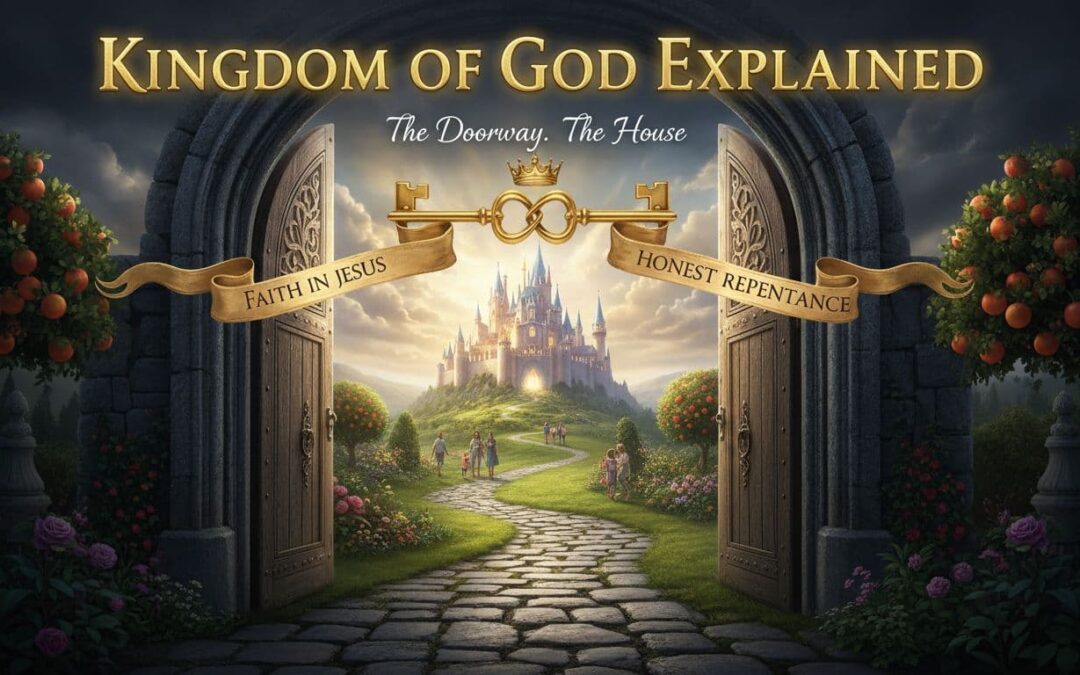
Now we come back to that “doorway” picture.
Belief and Repentance: Stepping Through the Door of the Kingdom of God
To believe in Jesus as your personal Savior means you trust His death and resurrection for you. You stop resting in your goodness and lean on His finished work.
To repent as a sinner means you agree with God about your sin and you turn from it toward Him. It is not perfect performance. It is a real turn of heart and mind.
When you believe and repent, you are saved. You have stepped through the doorway into the Kingdom of God. You are not outside anymore.
But the doorway is not the whole house.
From that point on:
You grow as a disciple.
You learn to obey the King.
You seek, receive, and live out the Kingdom in daily life.
John 3:16 and Romans 10:9 are real promises. Whoever believes has eternal life and will not perish in hell. That is where salvation starts.
Saved From Hell, Saved For a Kingdom Purpose
Biblically, to be saved means you are not going to hell. Jesus saves us from God’s wrath, from judgment, from eternal separation. That is not a small thing. That is massive mercy.
But He also saves you for something.
You are saved:
To belong to the King.
To bear fruit that lasts.
To serve others in love.
To shine as a witness in a dark world.
Your daily job, your relationships, your private battles, all sit inside the story of the Kingdom of God. You are not just killing time until Heaven. You are learning to live as a citizen of the Kingdom right now.
Jesus Will Reward His People According to Their Works
Here is where many hearts get nervous.
The Bible is clear: salvation is by grace through faith, not by works. But the Bible is also clear: rewards are according to works.
Paul writes in 1 Corinthians 3:12–15 that each believer’s work will be tested by fire. Some works last, like gold and silver. Some burn away, like wood and straw. The one who built with straw “will suffer loss, though he himself will be saved, but only as through fire.”
Jesus said, “The Son of Man is going to come with His angels in the glory of His Father, and then He will repay each person according to what he has done” (Matthew 16:27). In Revelation 22:12, He says, “I am coming soon, bringing My recompense with Me, to repay each one for what he has done.”
This is not about earning salvation. It is about:
Rewards in the Kingdom of God,
Responsibilities in the age to come,
Joy that matches faithfulness.
What kind of works matter?
Acts of love when no one sees.
Faithfulness in hidden obedience.
Generosity toward the poor and the Gospel.
Perseverance under pressure.
Speaking truth with grace.
Jesus is coming back. He will bring His reward. Your salvation means you will not face hell. Your works, done in faith, will follow you into the Kingdom and be honored by the King.
Living Today as Citizens of the Kingdom of God
We covered a lot. But it all fits together around one center: Jesus the King.
To see the Kingdom of God is to have your eyes opened by the Holy Spirit. To enter is to move from outside to inside, under His rule. To receive and seek is to live every day with open hands and a Kingdom-first heart. To inherit and possess is to look ahead to your full share in the age to come, while walking in Kingdom life now.
The Kingdom of God is not just another word for Heaven. It is God’s rule, starting now and completed in the new creation. Being born again describes the inner miracle that makes you alive to that Kingdom. Being saved describes your rescue from hell and your welcome into God’s family.
Faith in Jesus and honest repentance are the doorway. Life with the King is the house.
So here is the quiet question: are you just standing in the doorway, grateful not to be outside, or are you walking into the rooms, learning the ways of the Kingdom of God, and living as an active citizen until Jesus returns with His reward?
The King is willing. The Kingdom is open. Step in, and keep walking.
1 Truth: Blood of Jesus: God's Life in Sinless Flesh What if the very thing running through the veins of Jesus was not just human, but the Blood of Jesus holding the actual life of God Himself, poured out for us? That sounds huge, maybe even hard to take in at first, yet Scripture keeps pulling us back to this one thread: life is in the blood, sin corrupts human…
Difference Between Catholic and Christian: 5 Truths on Faith and Real Unity There’s a lot of confusion around the difference between Catholic and Christian—sometimes it feels like everyone has an opinion, but not everyone has the facts straight. At the core, every true Christian faith centers on this one unshakable truth: Jesus isn’t just a teacher or prophet—Jesus is God. This makes all the difference. Beliefs that deny the full divinity of…
Reprobate Mind: 5 Warning Signs and Hope for Change The Bible’s take on a reprobate mind isn’t just a warning or a piece of theology. It’s a wake-up call. “Reprobate mind” (from the Greek adokimos, meaning rejected or unapproved) describes what happens when people no longer care about God’s truth—they trade what’s holy for what feels good, grow numb to right and wrong, and God lets go. It’s mentioned…
The Seven Spirits of God stand as one of the most profound and often misunderstood truths in Christian theology. Rooted deeply in Scripture, they aren’t seven separate entities but rather seven attributes of the one Holy Spirit—God revealing Himself in fullness. Isaiah 11:2 describes these [...]
The gifts of the Holy Spirit reveal the active power of God working in the lives of His people. They aren’t just distant historical records or fading Biblical accounts; they’re living because the Holy Spirit, He is living and He is God, and His transformative gifts are reaching people [...]
The phrase “tongues of fire” in Acts 2:3 sparks worldwide curiosity and spiritual wonder. It appears in Scripture to describe the Holy Spirit’s descent during Pentecost, when visible flames rested on the apostles, marking the time when God’s Spirit descended on earth, [...]
The Bible’s take on a reprobate mind isn’t just a warning or a piece of theology. It’s a wake-up call. “Reprobate mind” (from the Greek adokimos, meaning rejected or unapproved) describes what happens when people no longer care about God’s truth—they trade what’s holy for what feels good, grow numb [...]
The upper room, a sacred space in Jerusalem, holds profound significance in Christian history. Acts 2 tells us it is the gathering place for Jesus’ disciples when the Holy Spirit descended upon them during Pentecost. This transformative moment not only empowered those present but also sparked [...]
Pentecost isn’t just a Christian event; its roots stem from the Jewish celebration of Shavuot, the day Moses received the Ten Commandments from God. For Christians, Pentecost marks the moment when God poured out His Spirit and Jesus’ worldwide church empowered by the Holy Spirit and His gifts [...]
Charismatic gifts, often referred to as manifestation gifts, showcase the miraculous power of the Holy Spirit. From healing and miracles to prophecy and discernment, they serve as tangible evidence of God’s presence and transformative work. These gifts, seen throughout Biblical history, have [...]
Revelation 3:7-8 offers a powerful message to the church in Philadelphia, a message that remains relevant today. It speaks of a divine “open door” that no man can shut, given by the one who holds the Key of David. This imagery represents not only an opportunity but also God’s sovereign [...]
Have you ever wondered why the word “anointing” carries so much depth in Scripture? The idea of anointing—of sacred oil poured out on kings, priests, and prophets—echoes through the Old Testament as a symbol of God choosing, empowering, and setting apart. God didn’t leave the details of [...]
The Bible boldly declares the truth that Jesus is both fully God and fully man—a mystery that anchors the Christian faith. But what does it mean, practically, for us as believers? Jesus didn’t perform miracles or operate in the gifts of the Holy Spirit simply as God; He demonstrated how a [...]
The Antichrist
The Apostate Church
The Rapture
Angels
Book of Daniel
Giants
Judgment
Prophecy
The Apostles
Bible Prophecy
Beware of Deception
Sin
Antichrists
Demon Possession
Healing
Millennial Reign
Redemption
The Gospels
The Holy Spirit
American Prophecy
Israel
Armageddon
Forgiveness
Intercession
Prayer
Revival
The Old Testament
The Tribulation
Faith
Kingdom Of God
Bible Interpretation
Free Will
Book Of Jude
Pride
The Afterlife
The Red Dragon
We use cookies so you can have a great experience on our website. View more
Cookies settings
Accept
Decline
Privacy & Cookie policy
Privacy & Cookies policy
Cookies list
Cookie name
Active
Who we are
Our website address is: https://theholyspirit.us.
Comments
When visitors leave comments on the site we collect the data shown in the comments form, and also the visitor’s IP address and browser user agent string to help spam detection.
An anonymized string created from your email address (also called a hash) may be provided to the Gravatar service to see if you are using it. The Gravatar service privacy policy is available here: https://automattic.com/privacy/. After approval of your comment, your profile picture is visible to the public in the context of your comment.
Media
If you upload images to the website, you should avoid uploading images with embedded location data (EXIF GPS) included. Visitors to the website can download and extract any location data from images on the website.
Cookies
If you leave a comment on our site you may opt-in to saving your name, email address and website in cookies. These are for your convenience so that you do not have to fill in your details again when you leave another comment. These cookies will last for one year.
If you visit our login page, we will set a temporary cookie to determine if your browser accepts cookies. This cookie contains no personal data and is discarded when you close your browser.
When you log in, we will also set up several cookies to save your login information and your screen display choices. Login cookies last for two days, and screen options cookies last for a year. If you select "Remember Me", your login will persist for two weeks. If you log out of your account, the login cookies will be removed.
If you edit or publish an article, an additional cookie will be saved in your browser. This cookie includes no personal data and simply indicates the post ID of the article you just edited. It expires after 1 day.
Embedded content from other websites
Articles on this site may include embedded content (e.g. videos, images, articles, etc.). Embedded content from other websites behaves in the exact same way as if the visitor has visited the other website.
These websites may collect data about you, use cookies, embed additional third-party tracking, and monitor your interaction with that embedded content, including tracking your interaction with the embedded content if you have an account and are logged in to that website.
Who we share your data with
If you request a password reset, your IP address will be included in the reset email.
How long we retain your data
If you leave a comment, the comment and its metadata are retained indefinitely. This is so we can recognize and approve any follow-up comments automatically instead of holding them in a moderation queue.
For users that register on our website (if any), we also store the personal information they provide in their user profile. All users can see, edit, or delete their personal information at any time (except they cannot change their username). Website administrators can also see and edit that information.
What rights you have over your data
If you have an account on this site, or have left comments, you can request to receive an exported file of the personal data we hold about you, including any data you have provided to us. You can also request that we erase any personal data we hold about you. This does not include any data we are obliged to keep for administrative, legal, or security purposes.
Where your data is sent
Visitor comments may be checked through an automated spam detection service.